## Un atelier devenu empire
Un atelier devenu empire
Reggio di Calabria, early 1970s. Gianni Versace is bent over a cutting table in his mother's dressmaking shop, tracing a pattern into silk. The fabric is for a local client, the fee modest. He is twenty-four, already restless. His older brother Santo keeps the books. His younger sister Donatella, still a teenager, watches from the doorway and offers opinions no one has asked for. This is the beginning, though none of them know it yet.
By 1978, Gianni has moved north to Milan and staged his first women's collection under his own name. The clothes are unambiguous: saturated colour, chain-mail mesh, leather worked until it moves like jersey. The Italian press takes note. What distinguishes the work is not novelty — others have done louche, others have done maximalism — but a kind of unrepentant intensity. Versace does not apologise for wanting to be seen.
Formation and early vocabulary
Gianni's training was not formal in the academic sense. He learned draping and construction in his mother Francesca's atelier, where the work was bespoke and the clients were local. This grounding in made-to-measure craft would inform his later approach to ready-to-wear: even at scale, Versace garments were engineered to flatter a body in motion. He studied architecture briefly at university, then abandoned it. The spatial thinking remained.
His early years as a freelance designer in Milan — working for Genny, Complice, Callaghan — taught him speed and commercial pragmatism. He learned to design for production, to anticipate what a buyer would order six months out. By the time he launched his own label, he understood both the atelier and the factory. That duality became the house signature: couture techniques applied to clothes meant for nightclubs, not salons.
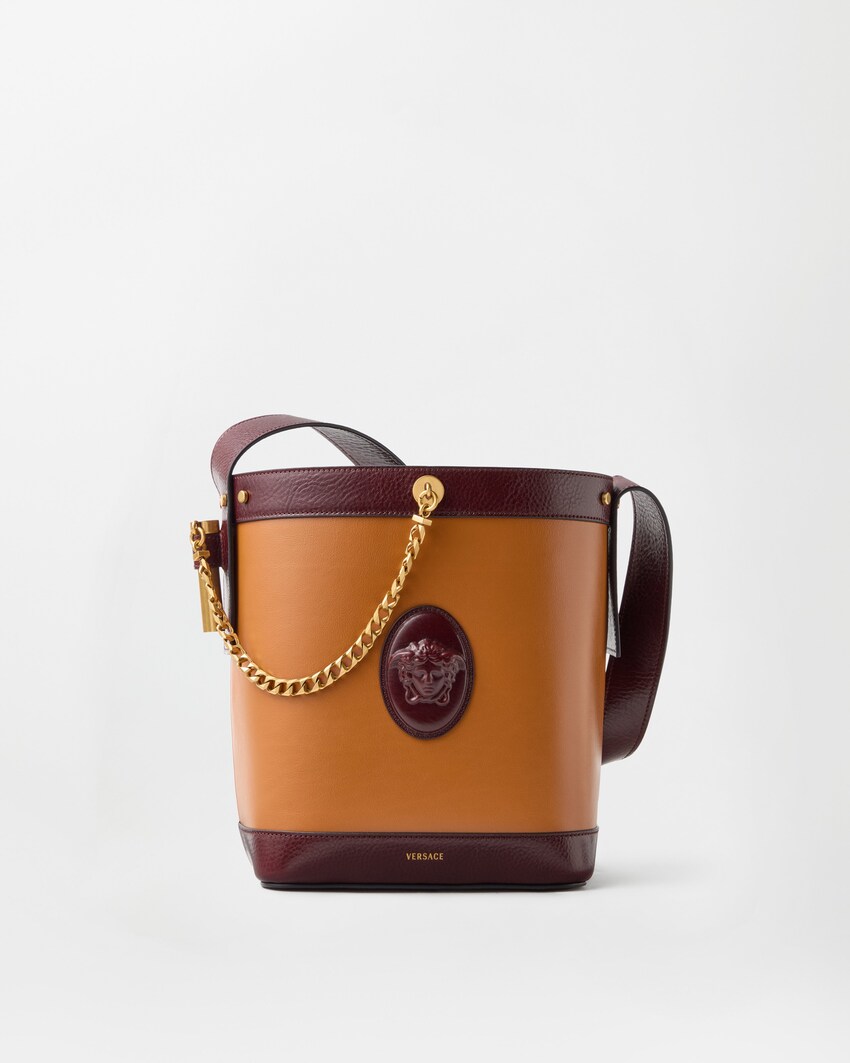
The Versace aesthetic cohered quickly. Greco-Roman motifs, Medusa heads, baroque ornamentation, and a particular shade of saturated gold that read as neither tasteful nor kitsch but something else entirely. The silhouette was unapologetic: high-cut legs, plunging necklines, body-consciousness as a form of power rather than submission. Critics called it vulgar. Clients called it liberating. Both were correct.
The machinery of spectacle
Santo Versace, the eldest sibling, built the business architecture. He negotiated licensing deals, managed cash flow, expanded into accessories and fragrance. By the mid-1980s, Versace was not merely a fashion house but a diversified luxury brand with global distribution. This was unusual for an Italian independent at the time — most houses of comparable scale were either French or backed by conglomerates. Santo's financial acumen kept the company private and profitable.
Donatella's role evolved more slowly. Initially a muse and sounding board, she began to shape the house's communication and casting. She understood, perhaps before Gianni did, that Versace's real product was not clothing but a certain vision of glamour: unsubtle, heterosexual, sun-drenched, and profoundly un-Parisian. The supermodels of the early 1990s — Naomi, Linda, Christy, Cindy — became synonymous with the brand. They walked the runway arm-in-arm to George Michael's "Freedom! '90" in 1991, a moment of pure spectacle that had little to do with the clothes and everything to do with image management. Donatella orchestrated it.
The house's commercial peak coincided with a broader cultural shift. In the 1990s, fashion moved from the salon to the street, from editorial to entertainment. Versace was early to this realisation. The brand dressed rock stars, athletes, actors — people who were famous for reasons other than wearing clothes well. The safety-pin dress Elizabeth Hurley wore to a film premiere in 1994 was not a couture commission but a loaned ready-to-wear piece. It generated more press than the film itself. This was the Versace model: fashion as event, garment as headline.
Rupture
On 15 July 1997, Gianni Versace was shot outside his Miami Beach mansion. He was fifty. The murder was random in the sense that it was not motivated by business or personal vendetta — the killer, Andrew Cunanan, was a spree murderer with no apparent connection to the designer. But the randomness did not make it less catastrophic for the house.
Donatella, then forty-two, became creative director. She had worked closely with her brother but had never led a collection alone. The first few seasons were uncertain. Some pieces felt like direct copies of Gianni's work; others veered toward a softer, more commercial register that pleased no one. The house's identity, so clear under Gianni, became muddled.
What saved Versace in the early 2000s was not creative reinvention but brand discipline. Donatella leaned into the house codes — Medusa, baroque prints, gold hardware — and applied them with increasing confidence. She also understood that Versace's audience had shifted. The 1990s supers had aged out of the fantasy. A new generation of celebrities — pop stars, reality television personalities, influencers — wanted the same unambiguous glamour but required different delivery mechanisms. Versace adapted. The clothes became more logo-forward, more legible in photographs, more suited to red carpets than runways.
What remains
In 2018, the Versace family sold the house to Capri Holdings (formerly Michael Kors Holdings) for approximately two billion dollars. Donatella stayed on as creative director. Santo stepped back from day-to-day operations. The sale marked the end of Versace as a family-controlled entity, though the family remains its most visible symbol.
One can argue that the house today is less a design studio than a licensing apparatus. Versace-branded products span eyewear, fragrances, home goods, hotels. The runway collections, while still produced twice a year, function primarily as marketing collateral for the broader brand ecosystem. This is not unique to Versace — most heritage houses operate similarly — but it does represent a shift from the founder's original vision, which was garment-centric and, in its way, uncompromising.
The question of what survives a founder is never straightforward. In Versace's case, the surface vocabulary remains intact: the Medusa, the Greek key, the saturated palette, the body-conscious cut. What has largely disappeared is the specific cultural moment that made those elements feel urgent rather than nostalgic. Gianni's Versace was a product of post-war Italian prosperity, Miami Vice aesthetics, the supermodel economy, and a particular strain of 1980s excess that has since been ironised out of existence.
Donatella's Versace, by contrast, is a heritage brand in the contemporary sense: self-referential, aware of its own iconography, designed to be consumed as much through images as through physical garments. Whether this constitutes continuation or dilution depends on what one values. The craft is still present — the atelier in Milan still produces couture, the leather goods are still constructed with care — but the context has shifted. A Versace dress today signifies differently than it did in 1995, and differently still than it did in 1982.
The house endures because it understood early that fashion is as much about distribution and image as it is about design. The Versace family built a machine that could survive its own founder, and that machine continues to operate. Whether it produces anything genuinely new, or merely iterates on an established formula, is a question the market has already answered. The brand is worth two billion dollars. The clothes, one suspects, are secondary.