Acne Studios aujourd'hui : où en est la maison
The navy blazer on the rack in Acne Studios' Rue Saint-Honoré boutique carries a sleeve lining in the house's signature dusty pink — a flash of colour visible only when the garment moves. It's a small gesture, one that has persisted through three creative directors and fifteen years of expansion. Whether it still signifies what it once did is the question hanging over the Swedish house as it enters its third decade.
Acne Studios began in 1996 as Acne Jeans, a collective project among four friends in Stockholm. Jonny Johansson, the group's creative lead, produced a hundred pairs of raw denim with red stitching and gave them away. The jeans found their way onto certain backs — stylists, photographers, the early adopters of a particular Nordic aesthetic — and the requests began. By the early 2000s, the house had moved beyond denim into ready-to-wear, carving out a position that felt distinct: not quite minimalist, not quite avant-garde, but something cooler and more wearable than either extreme.
The defining era arrived in the late 2000s and early 2010s. Johansson's collections during this period — oversized tailoring in muted tones, shearling-lined biker jackets, those pink-lined blazers — captured a moment when Scandinavian design meant something specific in fashion. Clean lines, yes, but also a certain emotional reserve, an intelligence that didn't announce itself. The house opened stores in Paris, New York, Tokyo. The Pistol boot, a blunt-toed Chelsea with an exaggerated shaft, became a signature. So did the Canada scarf, a wool style in tonal stripes that one still sees on certain streets in winter. Acne Studios occupied a space between Céline's rigour and A.P.C.'s ease, and for a time that space felt like the centre of a conversation.
The Shift
In 2017, Johansson stepped back from day-to-day design. The house brought in outside directors — first Fabien Baron as image consultant, then a rotating cast of collaborators. The collections continued, but something had loosened. The tailoring grew softer, the colour palette brighter. Prints appeared where once there had been texture. Some of this felt like natural evolution; some of it read as a search for the next thing.
By 2019, the house had been majority-owned by IDG Capital Partners, a Chinese private equity firm, since 2015. The investment brought resources — more stores, expanded categories, a push into Asia — but also expectations. Revenue growth became a public matter. The house reported annual sales north of 300 million euros by 2020, a figure that positioned it firmly in the contemporary luxury tier but still well below the scale of LVMH or Kering holdings. Johansson returned to the creative director role in 2020, a move the house framed as a homecoming but which also suggested that the experiment with external direction had not produced the desired momentum.
The Collections Now
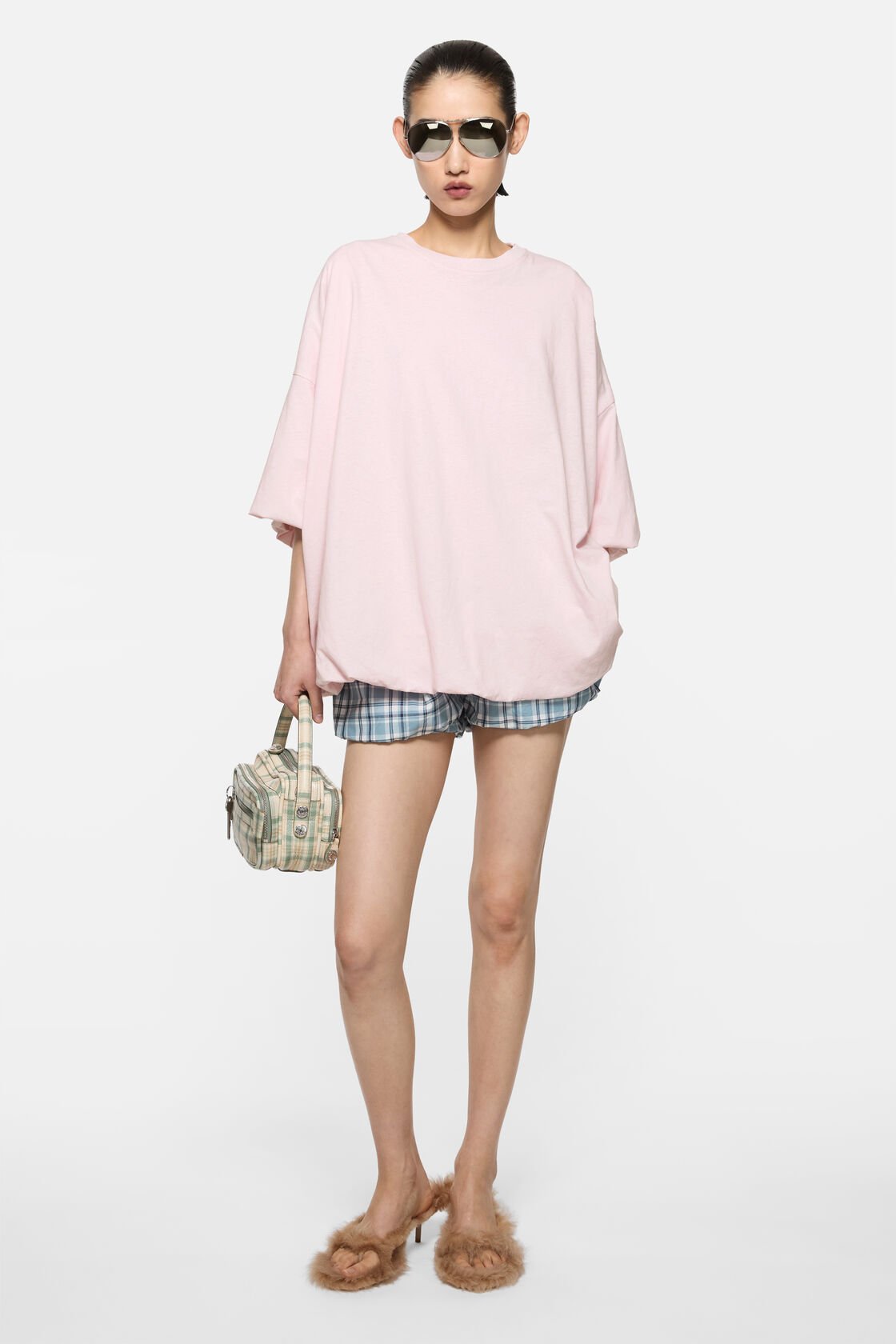
Walk through the autumn-winter 2024 collection and you see a house in negotiation with itself. The tailoring remains — wide-shouldered blazers, trousers with a considered break — but it shares space with puffer coats in electric blue, knit dresses with cutouts, logo-heavy accessories. The pink lining is still there, but so is a new monogram, introduced in 2022, that appears on bags, sneakers, even knitwear. It's a legible move, one that aligns with broader industry trends toward logo visibility and brand codes, but it sits oddly against the house's history of understatement.
The runway shows, held in Paris rather than Stockholm since 2018, have grown more theatrical. Last season's presentation featured a mirrored set and a soundtrack of distorted synth pop. The clothes themselves — a mix of sharp suiting, oversized knitwear, and statement outerwear — felt competent but not urgent. One notes the craftsmanship, the quality of the wool flannel and the hand of the leather, but the emotional pull that characterised the early work has become harder to locate.
The accessories category has expanded significantly. The Musubi bag, introduced in 2018 with its knotted silhouette, has become a commercial anchor. The house now produces multiple sizes and colourways each season, along with a growing range of small leather goods. The strategy is sound — accessories drive margin and brand visibility — but it also signals a shift in how the house sees itself. Where once Acne Studios felt like a designer's project that happened to sell well, it now reads more clearly as a business that employs a designer.
The Market Position
Acne Studios occupies an uneasy middle ground in the current landscape. It is too expensive and too design-forward to compete with the accessible contemporary brands — COS, & Other Stories — that have absorbed some of its aesthetic. It is not quite prestigious or exclusive enough to sit comfortably alongside the established luxury houses. The customer base, once concentrated among a specific cohort of creatives and early adopters, has broadened but also diffused. One sees the Musubi bag on the street, but it doesn't carry the same charge as it might have a decade ago when an Acne piece functioned as a kind of signal.
The house's retail expansion has been aggressive. Roughly 60 stores worldwide now, with a significant concentration in Asia. The e-commerce platform has been overhauled multiple times. Collaborations have multiplied — with Mulberry, with Fjällräven, with a rotating cast of artists and photographers. Each partnership generates press and product, but the cumulative effect is a brand identity that feels less defined rather than more so. When everything is a collaboration, what remains of the house itself?
What Persists
That said, certain things endure. The quality of the knits — dense, weighty, with a hand that improves over seasons. The cut of the outerwear, which still manages to be both generous and precise. The colour sense, even when it veers into brighter territory, retains a certain muted intelligence. A friend who works in buying describes Acne Studios as "reliable but not exciting," which feels both fair and slightly unfair. Reliability in fashion is not nothing, particularly in an era when so many brands lurch from one creative direction to another in search of viral moments.
Johansson himself remains a compelling figure, though he gives fewer interviews than he once did. In a rare conversation published last year in System, he spoke about the challenge of maintaining a point of view while meeting commercial expectations. "You can't make the same thing forever," he said, "but you also can't abandon what made people care in the first place." It's a tension that runs through the current collections, visible in the coexistence of the pink lining and the new monogram, the tailored blazer and the logo hoodie.
The question, then, is not whether Acne Studios is a relevant house — it clearly is, by most commercial and critical measures — but whether it still occupies a distinct position. In the late 2000s, one could describe the Acne aesthetic in a sentence or two and be understood. Now the description requires qualifications, exceptions, multiple reference points. Perhaps that's maturity. Or perhaps it's dilution. The difference is not always clear from the inside.
At the Rue Saint-Honoré boutique, a customer tries on that navy blazer, checks the fit in the mirror, runs a hand down the sleeve. The pink lining flashes once, then disappears back into the folds of the fabric. She buys it. Whether she knows the history of that detail, whether it matters to her that it connects to a specific moment in the house's evolution, is impossible to say. The blazer will be worn, or it won't. The detail will be noticed, or it will remain a small gesture, visible only in motion, signifying less than it once did but persisting nonetheless.