Jacquemus aujourd'hui : où en est la maison
The pleated raffia tote from Le Chiquito Soleil sat in the window at Bon Marché last June, priced at €590, beside a stack of woven espadrilles and a display card reading L'été selon Simon. It sold out in four days. Two weeks later, it reappeared on Vinted for €780. That cycle—drop, queue, resale markup—has become Jacquemus's operating rhythm, and it's worked with a consistency that makes most heritage houses look like they're moving through honey.
Simon Porte Jacquemus founded the label in 2009, aged nineteen, after his mother died and he left design school. The early collections were shown in his apartment, later in a Chinese restaurant on rue du Faubourg Saint-Denis. By 2013, he had backing from the Chambre Syndicale and a slot at Paris Fashion Week. The clothes were referential in a way that read as earnest rather than derivative—Provence by way of Alaïa's tailoring, straw hats sized like cartwheels, linen shirting cut to skim the body and then stop. The silhouette was specific enough that you could spot it across the Marais.
What changed wasn't the vocabulary. Jacquemus still works the same handful of ideas: exaggerated scale, exposed skin, primary colour, a kind of staged naïveté that knows exactly what it's doing. What changed was the infrastructure underneath. In 2013, the house generated around €500,000 in revenue. By 2022, that figure had crossed €200 million. The Le Chiquito bag—a micro handbag so small it barely holds a lipstick—launched in 2017 and became the kind of object that moves faster than editorial can keep up with. It wasn't designed to be practical. It was designed to be photographed, and it was, tens of thousands of times, which turned out to be the same thing as being practical.
The Bastien Daguzan era and what it built
Jacquemus hired Bastien Daguzan as CEO in 2017, the same year Le Chiquito launched. Daguzan had come from Céline under Phoebe Philo, where he'd been managing director, and he brought the operational rigour that allows a designer-founder to keep designing while someone else builds the backend. Under Daguzan, Jacquemus opened its first standalone boutique, restructured production to meet demand without flooding the market, and began licensing selectively—eyewear with Thélios, beauty with Puig. The house stayed independent, which in 2023 means it stayed without LVMH or Kering capital, but it built the kind of distribution model that looks like it has that capital anyway.
The shows became events engineered for virality before that term sounded cynical. Spring 2020 was staged in a lavender field in Valensole, models walking a narrow pink runway through purple rows under flat Provençal light. The images moved through Instagram, then TikTok, then back to editorial as though the whole thing had been organic. It wasn't organic. It was planned with the precision of a Vuitton runway, but it looked like a founder with a vision and a field, which is a different kind of currency.
Daguzan left in 2020. The house announced his departure in a two-line statement and didn't name a replacement. Since then, Jacquemus has operated without a titled CEO, with Porte Jacquemus taking a more visible role in business decisions alongside his creative direction. The structure is leaner now, which either means more agile or more centralised depending on where you're standing.
Where the line is now
The Spring 2025 collection, shown in October, opened with white shirting over low-waisted denim, followed by a series of draped jersey dresses in shades that read as sun-faded even under controlled lighting—pale coral, washed mint, a blue so soft it almost disappeared. The accessories were oversized again: tote bags wide enough to double as weekend luggage, raffia hats with brims that cast a shadow across the shoulders. The collection moved through its references without stopping to explain them, which is Jacquemus's version of restraint.
What's harder to read is whether the work is developing or iterating. The silhouettes have refined—the cut is cleaner now, the tailoring more controlled—but the gesture is familiar. You could place an image from Spring 2025 beside one from Spring 2018 and the line would be clear. That consistency is either the point or the problem, depending on whether you think a house needs to move or just needs to stay legible.
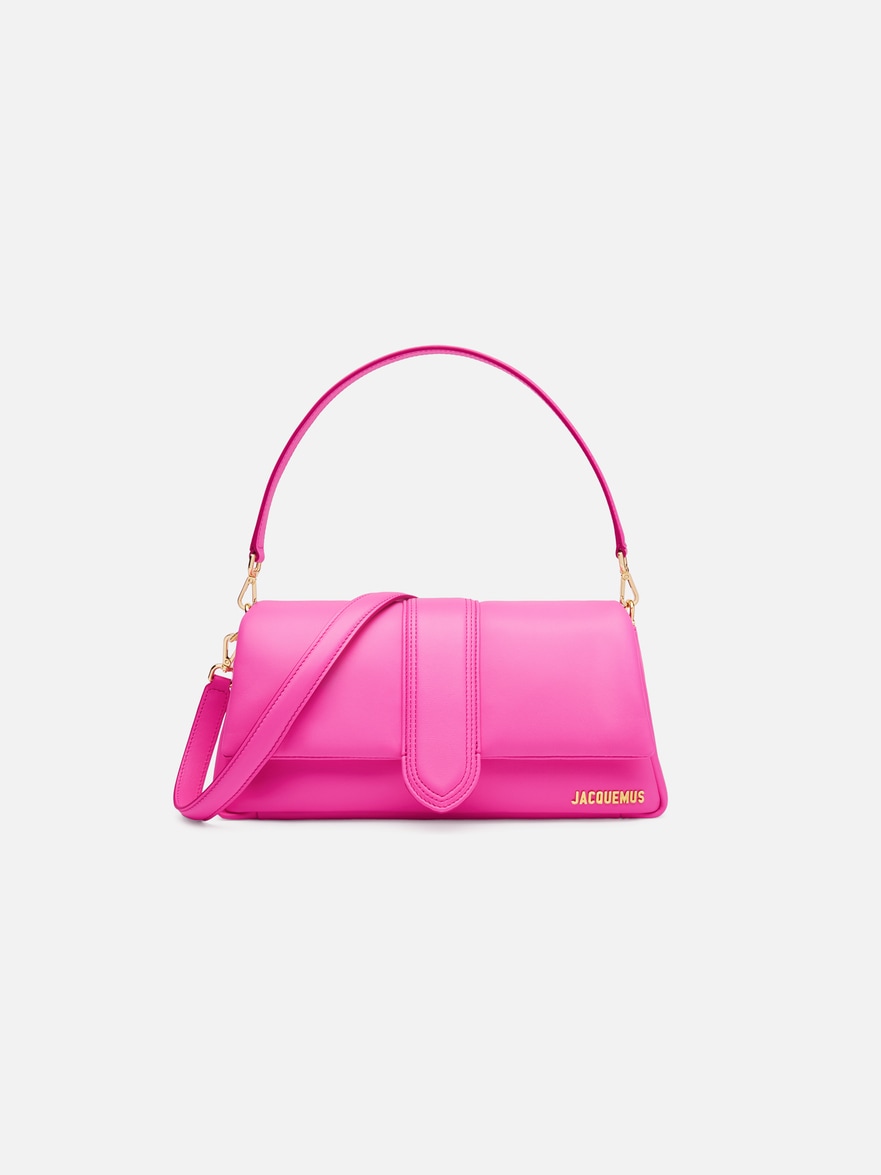
The handbag line has expanded past Le Chiquito into a full range: Le Grand Bambino, Le Petit Bambino, the Rond Carré, the Bello. The names are French-inflected but not actually French, which mirrors the way the brand positions itself—Provençal in aesthetic, global in distribution, specific enough to feel like a point of view but broad enough to work in Seoul, Miami, Paris. The bags range from €350 for a small woven style to €1,200 for structured leather, which puts them below Loewe and above Strathberry, a bracket that has proven durable.
The brand opened a Saint-Tropez boutique in 2022, a Venice Beach pop-up in 2023, and a permanent Paris flagship on rue de Turenne in 2024. The retail strategy leans into resort towns and neighbourhoods that read as aspirational but accessible—not Place Vendôme, not Bond Street, but close enough to signal arrival. The interiors are minimal in a way that photographs well: travertine, linen curtains, one or two pieces of statement furniture that look like they were borrowed from a private home. It's the same logic as the runway shows—build something that looks intimate, then scale it.
The question of what comes next
Jacquemus has done what few independent houses manage: it has built a business that operates at near-luxury scale without losing the founder's handwriting. The question now is whether that handwriting can carry another decade, or whether the house needs to find a second act.
There are signs of expansion that suggest the latter. The beauty line, launched in 2023 with Puig, includes lip oils, skin tints, and a body mist that sold through its first production run in six weeks. The eyewear collaboration with Thélios has moved past sunglasses into opticals, which is a quieter signal—less about image, more about daily use. These are the moves of a house building for retention, not just for the next drop.
But the creative direction hasn't shifted to match. The Spring 2025 collection felt like a refinement of an established language, not a new chapter. That's not necessarily a failure—Alaïa worked the same silhouette for twenty years, Lemaire has been circling the same ideas since his Hermès tenure—but it does mean the house is betting that the language itself is strong enough to hold.
The risk is that the market moves and the language doesn't. Jacquemus built its momentum on a specific kind of optimism—bright, legible, sun-soaked—that worked in the 2010s when Instagram was aspirational and escapism felt generative. In 2025, that optimism reads differently. Not false, but perhaps less urgent. The question isn't whether Jacquemus can keep making what it makes. It's whether what it makes will still feel necessary.
The last look from Spring 2025 was a white linen dress, ankle-length, with a single asymmetric strap and a skirt that moved like water. It was shown at dusk, the model walking slowly, the fabric catching the last of the light. It was beautiful in the way Jacquemus has always been beautiful—specific, studied, and just staged enough that you couldn't tell where the intention stopped. Whether that's enough depends on what you think fashion is supposed to do. For now, it's still working.