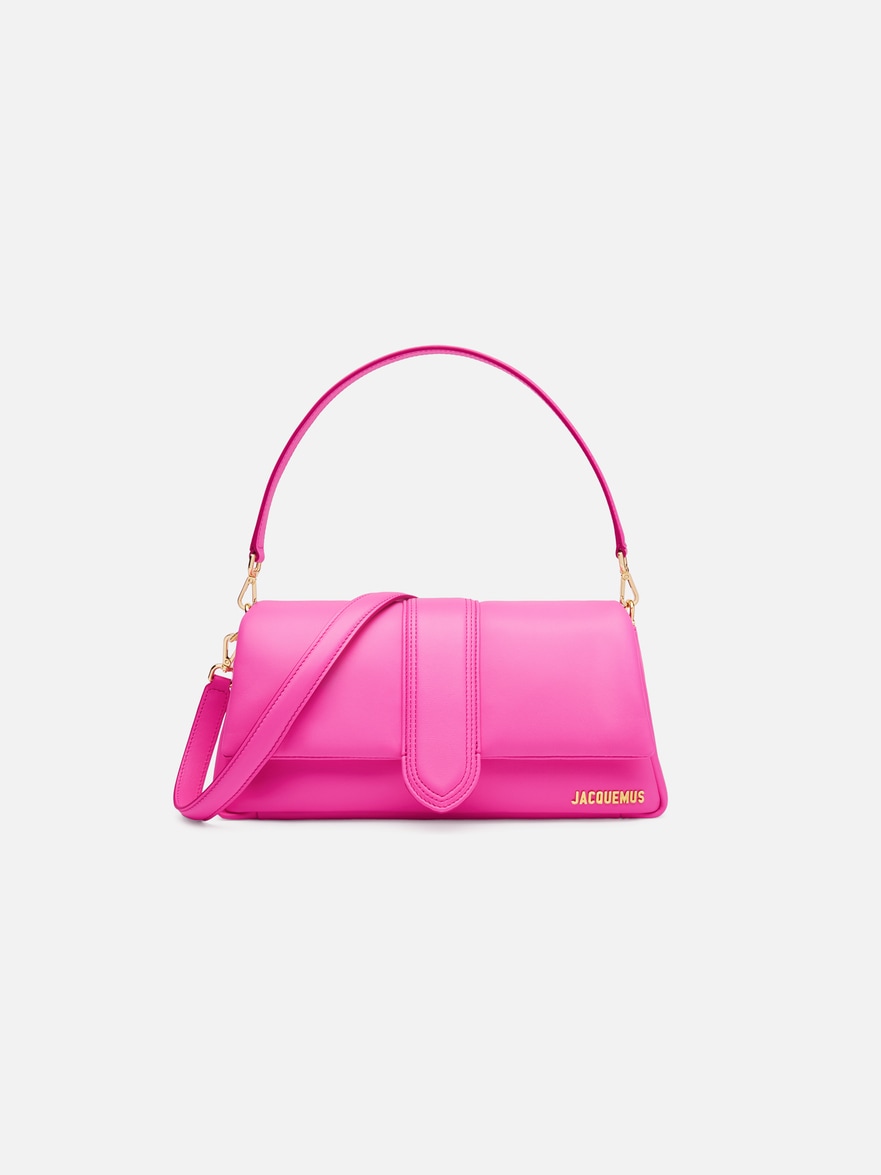
Jacquemus pour celles qui débutent
The Le Chiquito arrived in my hands two seasons late, borrowed from a colleague who had bought it in Nice and promptly regretted the purchase. It measured eleven centimetres across. One could fit a lipstick, a folded fifty-euro note, perhaps a single key if the fob wasn't oversized. She called it "a joke I paid three hundred euros for." I called it the most efficient distillation of what Simon Porte Jacquemus has been doing since 2009: making you smile, then making you want it anyway.
For those approaching Jacquemus without the benefit of a decade spent watching him work, the question is not whether the house makes covetable things—it does, demonstrably—but which of those things will serve you past the first flush of acquisition. The line between charming and disposable runs finer here than at most houses operating at this price point.
Ce qu'il faut savoir d'abord
Jacquemus is not a heritage maison. Simon Porte Jacquemus founded the house at nineteen, showed his first collection in 2009 with a budget that wouldn't cover the flowers at a Dior presentation, and named the enterprise after his mother's maiden name. She had died the year prior. The work has always carried that mix of memorial and levity—serious about craft, unserious about convention.
The house sits in a peculiar position within the French system. It shows in Paris but draws heavily from Provençal light, colour, and a certain unforced sensuality that reads as southern rather than metropolitan. Jacquemus makes clothes for women who eat lunch outdoors, who don't consider a handbag an heirloom proposition, who might pair a structured blazer with nothing underneath and think nothing of it. The silhouette tends toward the body—cropped, open-backed, asymmetric—but not in the manner of a house that wants you to look worked-over. Effortless is the wrong word, overused and imprecise. Better to say: considered, but not laboured.
The palette leans into wheat, terracotta, sky blue, cream. When Jacquemus uses black, it feels like a concession. The fabrics are good—linen that wrinkles well, cotton poplin with some weight to it, wool suiting that doesn't collapse—but you are not paying for hand-finished seams or atelier hours. You are paying for the cut, the colour, and the fact that the piece will photograph winningly on a whitewashed wall.
Les sacs — où l'on commence, souvent
Most people meet Jacquemus through the bags, which is both efficient and slightly misleading. The Le Chiquito became a phenomenon not because it was practical—it wasn't—but because it was witty and looked extraordinary in street-style shots. Jacquemus followed it with the Bambino, the Grand Bambino, the Piccolo, each a variation on the same taut, geometric form. These are not subtle bags. They announce themselves.
Prices begin around €290 for the smallest iterations and climb to €650 for larger, more functional styles in leather. The Le Grand Bambino, at roughly 25 centimetres, will actually hold a phone, a cardholder, keys, and sunglasses—the minimum loadout for a day that doesn't require a laptop. The leather is smooth, occasionally grained, and develops a patina if you let it. Hardware is minimal, usually a single turn-lock or magnetic closure. The straps are thin, sometimes detachable, often just long enough to sling crossbody if you don't mind the bag sitting high on your ribs.
If you want a Jacquemus bag that will serve past its first season, avoid the micro novelties and look instead at the Bambino in a mid-size, or the Le Porte Azur tote, which debuted as a beach bag and has since proven itself capable of carrying more than a towel and a paperback. The totes run €450 to €590, depending on finish. They won't develop the same storied relationship with you that a Goyard or a Longchamp might—Jacquemus isn't built for that kind of longevity—but they will last three or four years of regular use if you don't treat them carelessly.
Les vêtements — la proposition réelle
The bags draw attention, but the clothing is where Jacquemus makes his actual case. The house produces ready-to-wear that understands proportion in a way that reads as almost architectural: a blazer cropped to hit just below the bust, worn open over high-waisted trousers; a shirt with one sleeve extended and the other cut short; a dress with a single strap that somehow stays put without looking precarious.
This is not clothing for women who dress conservatively, but neither is it for women who want to be noticed in the manner of, say, a Mugler devotee. Jacquemus pieces tend to work best when worn as the only statement in an outfit. Pair the asymmetric top with denim and flat sandals. Wear the sculptural skirt with a plain white tee. The house does not reward styling excess.
Prices for ready-to-wear begin around €195 for a cotton poplin shirt and move up to €890 for tailored outerwear. Knits run €250 to €450. Dresses land between €350 and €695, depending on fabric and construction. You are not getting couture finishing, but you are getting a cut that has been thought through with care. Seams sit where they should. Hems fall cleanly. The clothes photograph well because they are designed with an understanding of how fabric moves and where shadows land.
The house's linen shirting, in particular, deserves mention. It wrinkles exactly as linen should—not sloppily, but in a way that suggests you have been somewhere warm and did not worry about it. The same applies to the cotton poplin pieces, which hold their shape through a day of wear and then relax into something softer by evening. Jacquemus does not make precious clothes. He makes clothes that improve with a little wear.
Ce qui ne marchera pas pour tout le monde
Jacquemus is not for everyone, and the house does not pretend otherwise. If you require full coverage, structured support, or garments that will carry you through a decade, look elsewhere. The cuts skew young not in age but in attitude—they assume a certain comfort with the body, a willingness to show a shoulder or a midriff or a length of leg without making it a production.
The sizing runs European standard, which is to say it does not accommodate a wide range of bodies. A 40 is a 40, and the house does not offer extended sizing in any meaningful way. This is a limitation, not a feature, and one that Jacquemus has been slow to address.
The quality is good but not exceptional. A Jacquemus blazer will last you several seasons if you treat it well, but it will not become an heirloom. The stitching is clean, the linings adequate, the finishes competent. You are paying for design, not for the kind of handwork that justifies a four-figure price at other houses. If that exchange feels equitable to you—style over longevity, moment over permanence—then the house will serve you well.
Où acheter, et quand
Jacquemus sells through its own e-commerce platform, through multi-brand retailers like Net-a-Porter and Matches, and in a handful of standalone boutiques. The house runs two main collections per year, with occasional capsules that drop without much advance notice. Sales happen, though not with the regularity or depth of discounting you might find at larger houses. Expect 30 to 40 percent off during end-of-season markdowns, usually in January and July.
The secondary market for Jacquemus is thin. Pieces do appear on Vestiaire and The RealReal, but they do not hold value the way a Hermès or a Chanel bag might. If you buy Jacquemus, buy it to wear it, not to archive it.
Une dernière chose
I returned the borrowed Chiquito after three days. It had charmed me, briefly, in the way a well-executed joke does. But I kept thinking about a linen shirt I had seen in the same collection—a pale yellow, one sleeve rolled and stitched permanently in place, the other left long. It cost €295. I bought it six months later, on sale, and have worn it at least two dozen times since. It wrinkles beautifully. It works over denim, over a slip skirt, under a blazer if I leave it unbuttoned. That, more than the tiny bag, is the Jacquemus I would recommend: the piece that makes you smile when you put it on, and then gets out of the way.