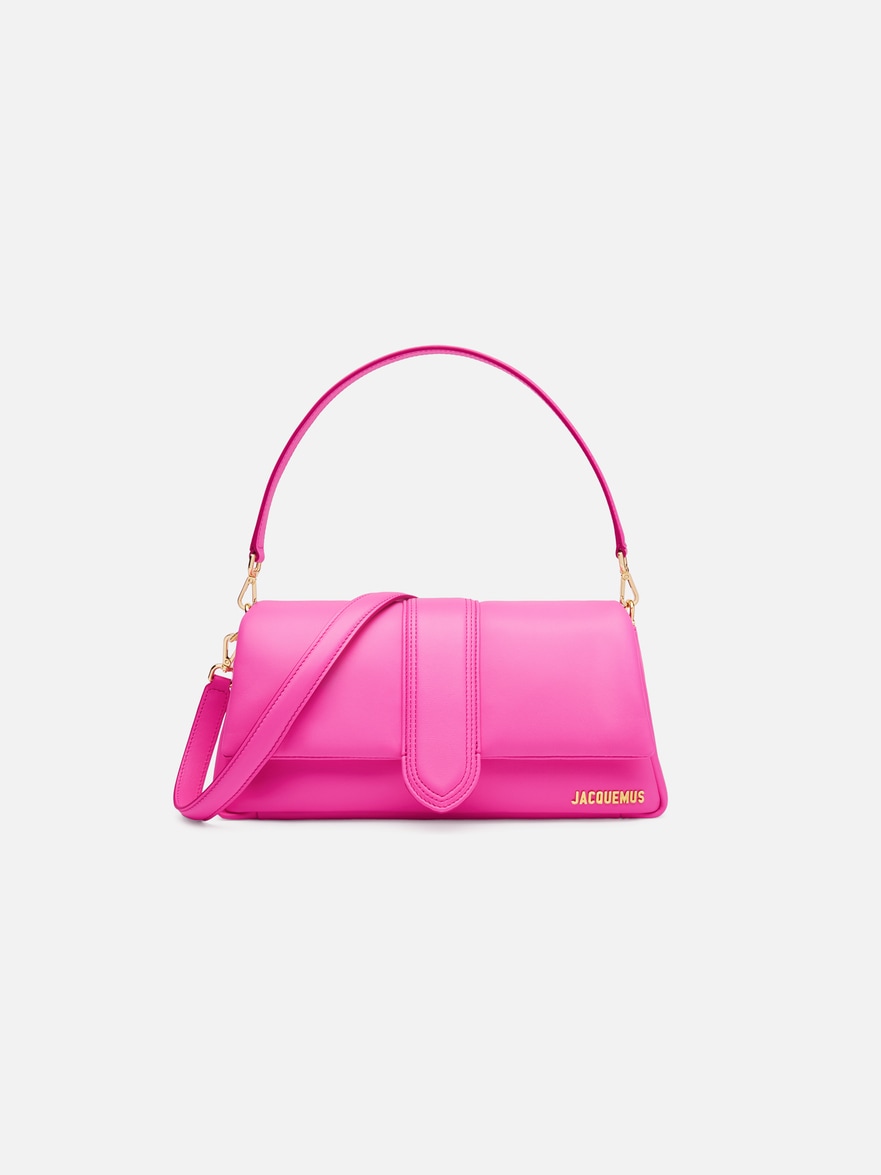
Les codes de Jacquemus qu'on a oubliés
The buttonhole on a Jacquemus shirt from 2015 — not the oversized linen ones that ended up on every influencer grid, but the tailored cotton poplin from Le Souk — is bound with a single strand of grosgrain, hand-stitched at the collar and cuffs. The detail appears nowhere in the press notes. It survives in perhaps two hundred pieces, most of them long since donated or discarded. Simon Porte Jacquemus was twenty-six when he specified that finish, and the atelier in the 10th arrondissement that executed it has since closed. One suspects he no longer remembers requesting it.
Which is to say: before Jacquemus became a handbag phenomenon, before the Chiquito became visual shorthand for a certain strain of French-girl aspiration, the house spent a decade building a vocabulary that had little to do with accessories and even less to do with logos. That vocabulary — call it a syntax of silhouette, proportion, and a very particular strain of Provençal pragmatism — has largely been eclipsed by the success it enabled. This is not a lament. It is an accounting.
Arles, fil conducteur
Simon Porte Jacquemus founded his house in 2009, aged nineteen, with no formal training and no financial backing beyond what he could borrow. The origin story is well-worn by now: his mother's death, the move to Paris, the decision to use her first name as his label's surname. What tends to get compressed in the retelling is the aesthetic programme he arrived with, which was neither naive nor unformed.
The early collections — Les Garcons, La Riviera, L'Été — drew on a specific rural iconography that had little currency in Paris fashion at the time. Straw hats with brims wide enough to cast real shade. Espadrilles with jute soles thick as your thumb. Shirts cut like the ones men wore to pétanque in Arles on a Sunday, which is to say: boxy through the body, short in the sleeve, with a collar that sat flat and open. He showed these pieces on girls, and the effect was not whimsy. It was dislocation — the city watching the country, the country refusing to perform.
The palette in those years rarely strayed from white, ecru, navy, and a particular shade of sun-faded black that reads almost charcoal. When colour appeared, it arrived as a single block: a tangerine linen dress in SS13, a cobalt poplin shirtdress in SS14. The fabrics were cheap — cotton, linen, broderie anglaise — but the cutting was already confident. He understood ease, which is a harder trick than it looks. A sleeve set low in the armscye, a waistband that sat two centimetres below the natural waist, a hemline that ended mid-shin rather than at the ankle. These are not details that photograph well, but they are the ones that make a garment wearable past a single season.
The asymmetry years
By 2016, Jacquemus had developed what the trade refers to as a signature, though the term flattens what was actually happening. The asymmetrical neckline — one shoulder bare, the other covered — became his most visible motif, and it appeared in enough permutations that it stopped feeling like a gimmick. A knit dress with the left shoulder exposed. A poplin shirt with the right side unbuttoned to the waist. A linen blazer with one lapel and one raw edge.
The gesture had precedent, of course. Rei Kawakubo had excavated asymmetry in the early eighties; Margiela had used it to expose construction. Jacquemus deployed it differently. His asymmetry was not conceptual. It was social. The girl wearing his clothes was not making a statement about deconstruction or the male gaze. She was getting dressed in a hurry, or she had pulled her shirt half off in the heat, or she had decided that one sleeve was enough. The effect was studied informality, which is a French tradition older than ready-to-wear.
What made it cohere was proportion. Jacquemus has always worked with extreme ratios — tiny bag against oversized blazer, cropped knit against wide-leg trouser, micro-mini against thigh-high boot — but he calibrates them with enough precision that the result reads as intentional rather than chaotic. A 2017 runway look paired a bra-sized bandeau top with trousers so voluminous they required a drawstring waist. On paper, it should have collapsed. On the body, it held because the trouser sat exactly at the hip, and the bandeau ended exactly at the base of the ribcage, and the interval between them was exactly wide enough to register as deliberate.
This is craft, not instinct. The atelier samples each piece in muslin, adjusts the fit on a model, samples again. The process is invisible in the final garment, which is the point.
Le Chiquito, et après
The Chiquito launched in 2018, and within eighteen months it had rewritten the house's business model. A bag the size of a deck of cards, rendered in grained leather with a top handle and a logo plate, priced at €390. It was absurd. It was also irresistible, in the way that a very good joke is irresistible — you see the punchline coming, and it still lands.
What the Chiquito did, beyond generating revenue, was shift the terms of engagement. Jacquemus had spent a decade building a reputation as a ready-to-wear house with a point of view. The bag turned him into an accessories brand with a clothing line. This is not a moral judgement. It is a structural observation. The handbag business operates on different logic than the clothing business. Margins are higher, sell-through is faster, brand recognition is more direct. A customer who would never spend €800 on a Jacquemus dress will spend €600 on a Jacquemus bag, and she will carry it in a way that makes the logo visible.
The house leaned in. Le Grand Bambino, Le Petit Bambino, Le Vanity, Le Sac Rond, Le Porte-Clés — the naming convention itself became part of the brand language, a kind of self-aware Frenchness that played well on Instagram and even better in duty-free. The ready-to-wear continued, and some of it was very good (the SS21 collection, shown in a lavender field outside Valensole, contained some of the most considered tailoring the house has produced), but the centre of gravity had moved.
What remains
There are codes that survive, though you have to look for them now. The atelier still cuts shirts with a boxy body and a short sleeve. The linen dresses still end mid-shin, and the hemline is still left raw. The colour palette, when it is not responding to a seasonal theme (the pink period, the green period, the brown period), still defaults to white, navy, and that sun-faded black.
And there are details that persist in the making, even when they don't register in the marketing. The grosgrain-bound buttonhole has long since disappeared, but the house still specifies a particular weight of cotton poplin — 120 grams per square metre, woven in Italy — that takes a crease well and holds its shape through a full day. The espadrilles, now produced at scale, still use a jute sole rather than a synthetic substitute, which makes them less durable but more honest. The straw hats, when they appear, still have brims wide enough to cast real shade.
One can argue that these are minor points, and that the broader shift — from a niche ready-to-wear house to a globally recognised accessories brand — represents a kind of success that makes the early codes irrelevant. That argument has merit. But there is another reading, which is that the codes were never about scarcity or purity. They were about a way of seeing, and a way of cutting, that originated in a specific place and a specific set of material constraints. Those constraints no longer apply. The house now operates at a scale that requires industrial production, global distribution, and a marketing apparatus sophisticated enough to move product in thirty-two countries.
What Jacquemus has managed, against considerable odds, is to keep some part of that original vision legible even as the business has transformed around it. The asymmetrical neckline still appears, though now it shares the runway with logo-print bikinis and neon-soled sneakers. The linen shirting still gets made, though it represents a smaller percentage of the offering each season. The atelier still exists, though it now reports to a structure that includes licensing deals and pop-up retail and collaborations with sportswear giants.
The question is not whether the house has changed. The question is whether the change has been managed with enough care that the original syntax remains intact, available to anyone willing to look past the handbag and the logo and the influencer grid. On balance, one suspects it has. But the margin is narrower than it was five years ago, and it narrows further each season.
There is a photograph from the SS12 lookbook — not a runway image, but a campaign shot — that shows a model in a white linen dress, standing in a field outside Arles. The dress is sleeveless, with a square neckline and a hem that ends just below the knee. No logo, no asymmetry, no visible detail that would mark it as Jacquemus rather than something pulled from a grandmother's wardrobe. But the proportions are perfect: the neckline exactly wide enough, the armscye exactly low enough, the hem exactly long enough. She is holding a straw hat in one hand, and the light is the hard, white light of Provence in July. The image contains everything the house was, and very little of what it has become. Whether that represents a loss or simply an evolution depends, in the end, on what you value more: the purity of the original idea, or the reach of its most successful expression.