Les codes de Versace qu'on a oubliés
The first thing you notice in the Versace archive — before the safety pins, before the metal mesh, before even the Medusa — is the weight of the silk. It's printed, yes, but it's also engineered. Double-ply in places. Reinforced at stress points you wouldn't think to reinforce. Gianni Versace didn't just print on fabric. He built structure into it, then treated the structure like a second skin.
That approach has become easy to forget. Versace today reads as logo, as baroque, as the bag with the safety-pin hardware that shows up every third street style block during fashion month. The house has leaned into recognition, and recognition has worked. But underneath the iconography that moves product, there's a technical language most people stopped reading.
The engineering that predates the spectacle
Gianni opened the house in 1978 with a collection that confused the Milan establishment. The silhouettes were Grecian, the construction was couture-grade, and the materials were often synthetic. He'd take a jersey blend, cut it on the bias, then finish the seams with a technique borrowed from menswear tailoring. The result moved like liquid but held its line like a blazer.
This wasn't about looking expensive. It was about performing in a specific way on a specific body in motion. Versace studied how fabric behaves under tension, under camera flash, under the weight of metal embellishment. He'd layer a mesh over a second mesh, offset by three millimetres, so that the whole piece shimmered differently depending on the angle of the light. You don't see that in a product shot. You see it when someone walks into a room.
The Oroton chainmail — the one that shows up in every retrospective, the one Linda wore in 1982 — gets remembered as a provocation. And it was. But it was also a sample of industrial aluminium usually reserved for automotive interiors, hand-linked in an atelier outside Novara, backed with a silk georgette so fine it required a bonded lining just to survive a fitting. The dress weighed four kilos. It moved like water.
That's the gap. The house built a reputation on excess, but the excess was backed by a near-obsessive interest in how things were made. Gianni kept a sample library organised by hand-feel, not by colour or season. If you wanted a specific drape, you started there.
What stayed after the founder
When Donatella took over in 1997, she inherited a vocabulary but not a mandate. The question wasn't whether to continue — the company was already public, already global, already too large to pivot. The question was which parts of that vocabulary would survive translation into a system that required four collections a year, plus pre-collections, plus collaborations that hadn't yet been called collaborations.
She kept the print archive. She kept the metal mesh, now produced in-house rather than sourced. She kept the bias-cut jersey, though the blend shifted slightly to accommodate faster production cycles. And she leaned into colour in a way Gianni hadn't always. Where he'd use a single acid tone across an entire collection, Donatella started mixing them — fuchsia against cobalt against a particular lime that only works under strobe lighting.
But some things didn't make the leap. The double-layered silk disappeared first, replaced by a lighter-weight crepe that printed cleaner and required less labour. The internal boning that gave those early dresses their structure — gone by the early 2000s, when the aesthetic shifted toward a softer, more overtly sexual line. The atelier in Novara closed in 2004. The chainmail is now produced in limited runs for archive reissues and red carpet loans.
What Donatella understood, and what probably saved the house, is that not every technique scales. You can't hand-finish bias seams on three thousand units. You can't engineer fabric for the way it photographs if you're also engineering it to hit a retail margin. So she made a choice: keep the signifiers, streamline the substrate.
The logo work came later, after the Kering acquisition talks fell through and the house needed a product strategy that could move at contemporary speed. The Virtus bag, the La Medusa hardware, the all-over baroque print that works as well on a phone case as it does on a skirt — none of that is accident. It's a deliberate shift toward recognisability over technical flex.
The codes still in play, if you look
But if you're in the stores — not the flagships, the actual stores where the sell-through happens — there are still traces of the original language.
The Trésor de la Mer print, which ran through the Spring 2023 collection, uses a layered screen process that most houses abandoned in the nineties. It's not hand-pulled, but it's also not digital. You can see the registration shift slightly between colours, which is technically a flaw and also the only reason the print has any depth.
The tailoring, when Versace does tailoring, still uses a floating canvas in the chest. Not a fused interlining. Actual canvas, catch-stitched at intervals, left to settle over the course of several fittings. It's a men's technique that almost no one applies to womenswear anymore, because it requires time and because most buyers can't feel the difference. But it's there.
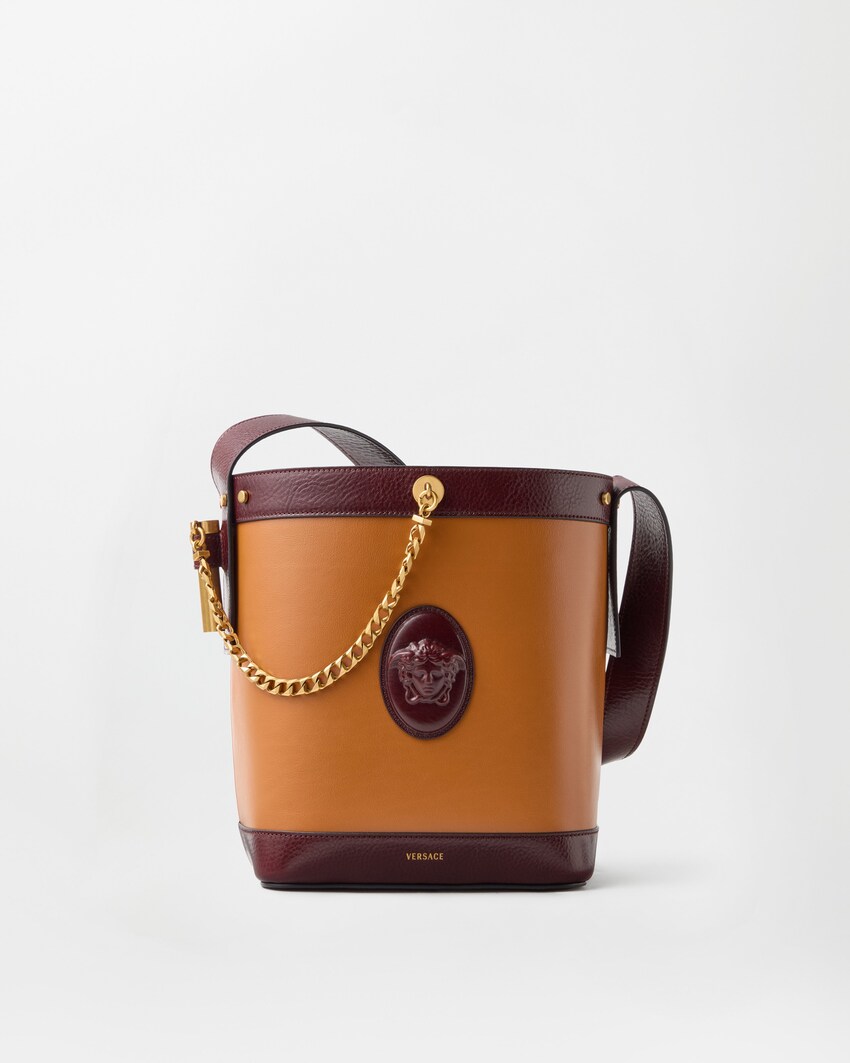
And the leather — this one's easy to miss — is still sourced from the same tannery in Arzignano that Gianni used in the eighties. It's a vegetable-tanned vacchetta that arrives at the atelier undyed, which means the colour is applied in-house and can be matched exactly to a fabric swatch. The Medusa-handle bags use it. So do the belts that don't get photographed much, the ones with a single gold-tone loop and no visible branding.
These aren't the things that move the needle commercially. But they're the things that separate a Versace piece that lasts fifteen years from one that looks tired after two. The house knows this. It just doesn't lead with it, because leading with craft doesn't test well in digital marketing.
Where it stands now
Versace sits in a strange position. It's too established to be considered emergent, too commercially successful to claim underdog status, and too associated with a specific kind of flash to be taken seriously by the people who take craft seriously. The runway shows pull numbers. The collaborations sell out. The brand health is strong.
But there's a gap between what the house is known for and what it's still capable of. The atelier can still execute a dress that requires sixty hours of handwork. The question is whether anyone's asking for it, and whether the asking happens at a price point that makes the handwork viable.
Donatella has said, more than once, that she's not interested in making clothes for museums. She wants them worn, wants them lived in, wants them to do work in the world. Which is a reasonable position for someone running a commercial house. But it also means certain techniques — the ones that only reveal themselves over time, the ones that require a specific kind of attention — get quietly phased out in favour of impact that reads immediately.
The Medusa is still there, cast in brass, hand-polished, set into a bag clasp that will outlast the leather it's attached to. But the double-ply silk, the offset mesh, the boning that turned a dress into architecture — those are archival now. You can still see them, if you know where to look. You just can't buy them new.