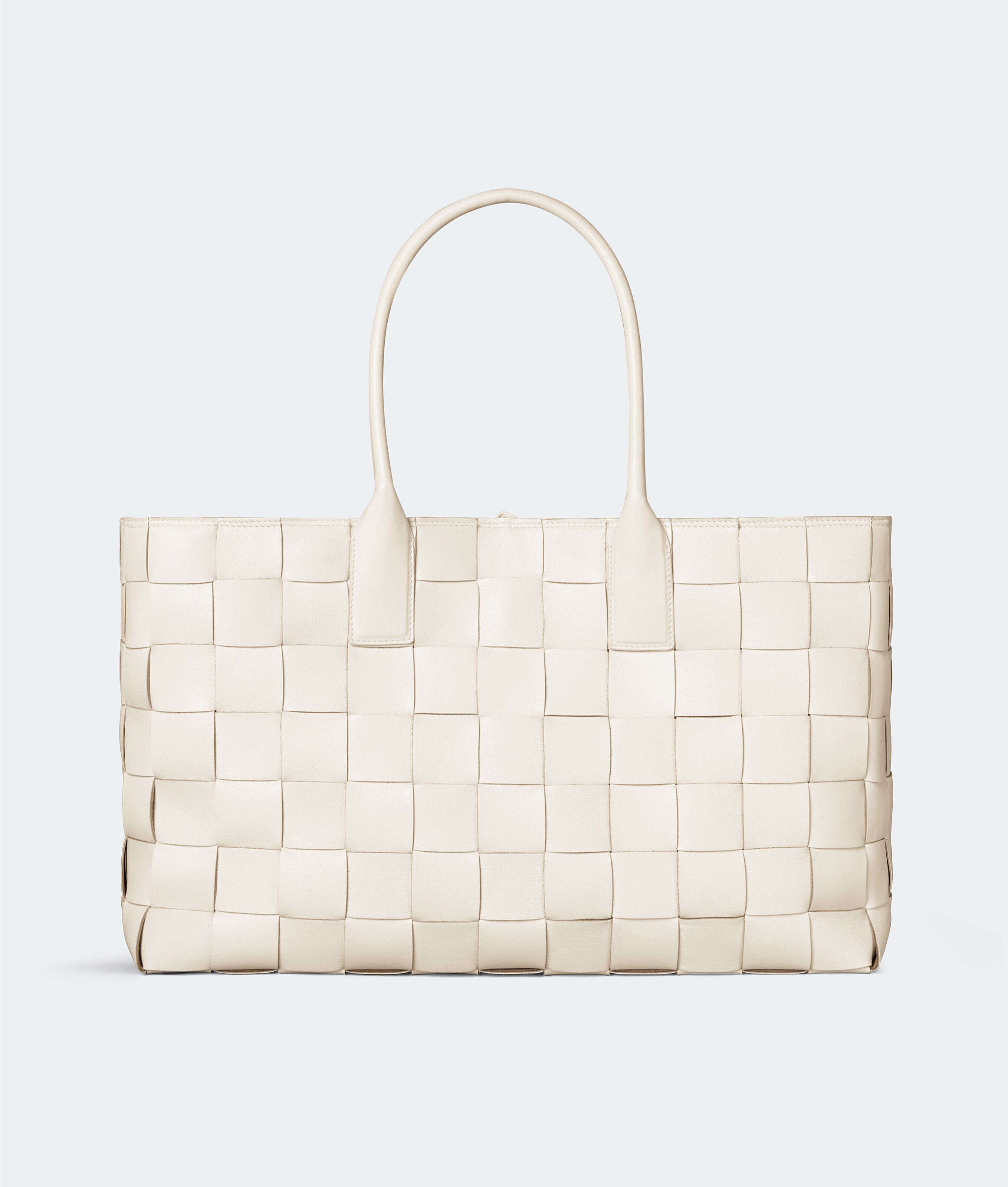
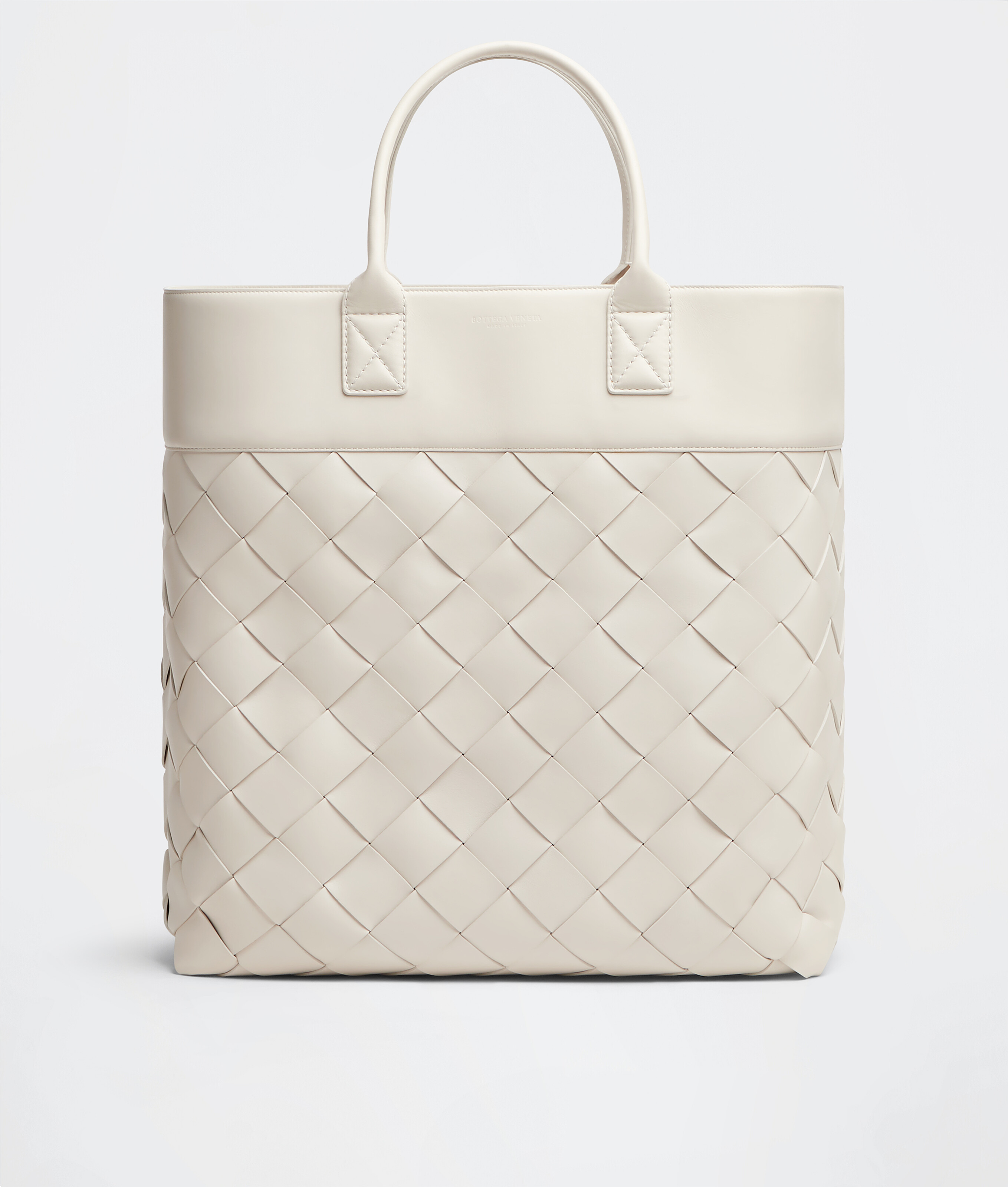
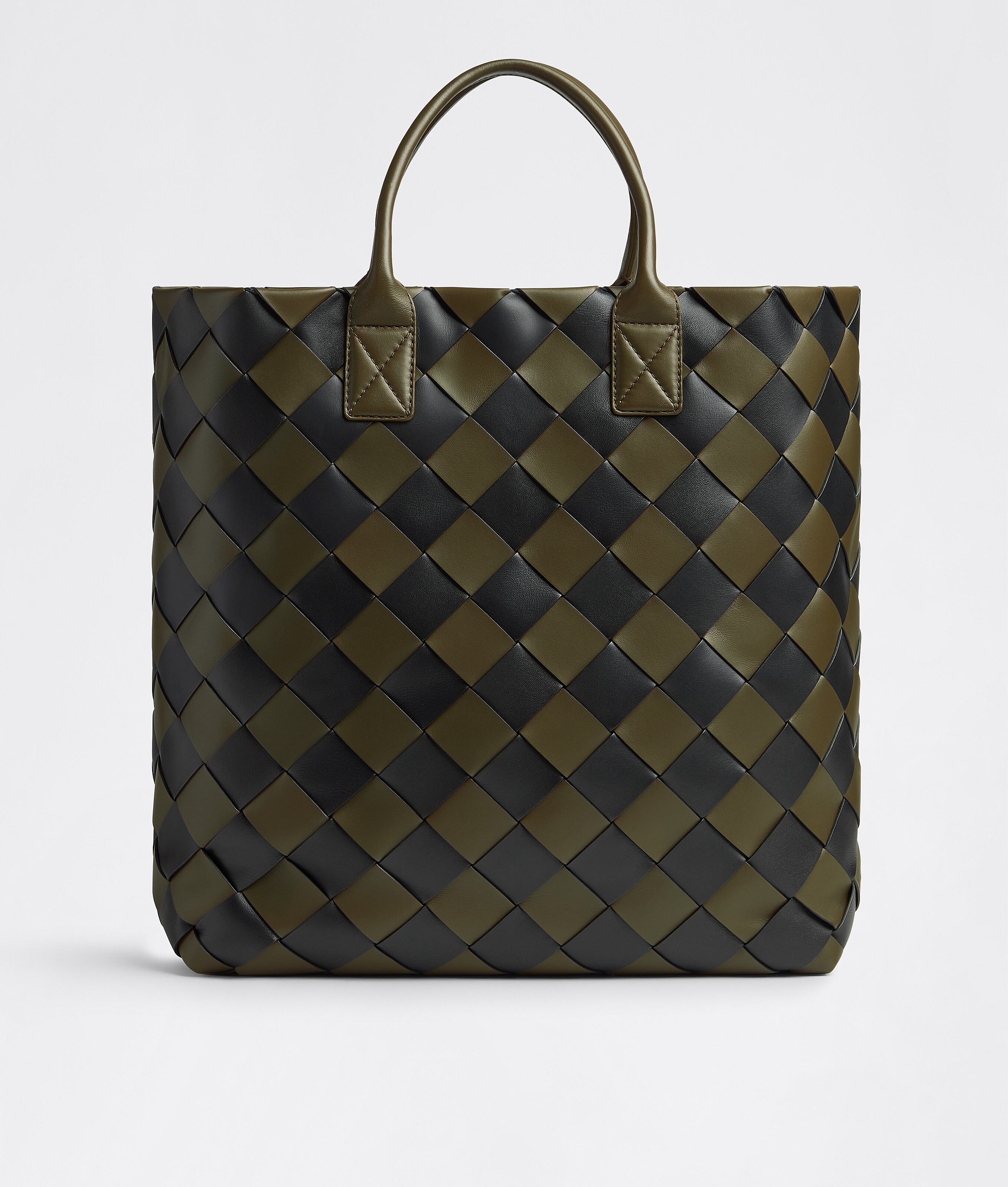
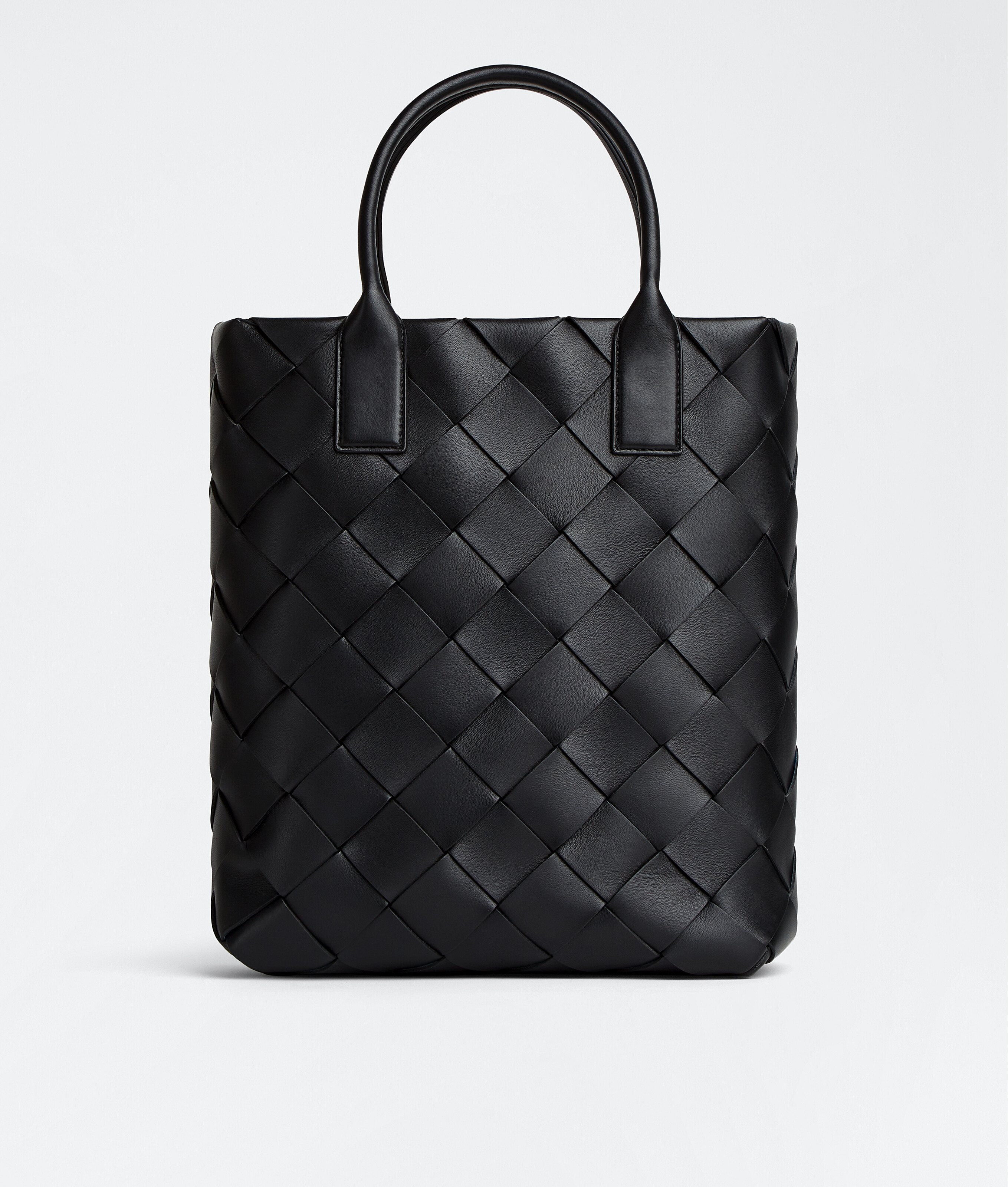
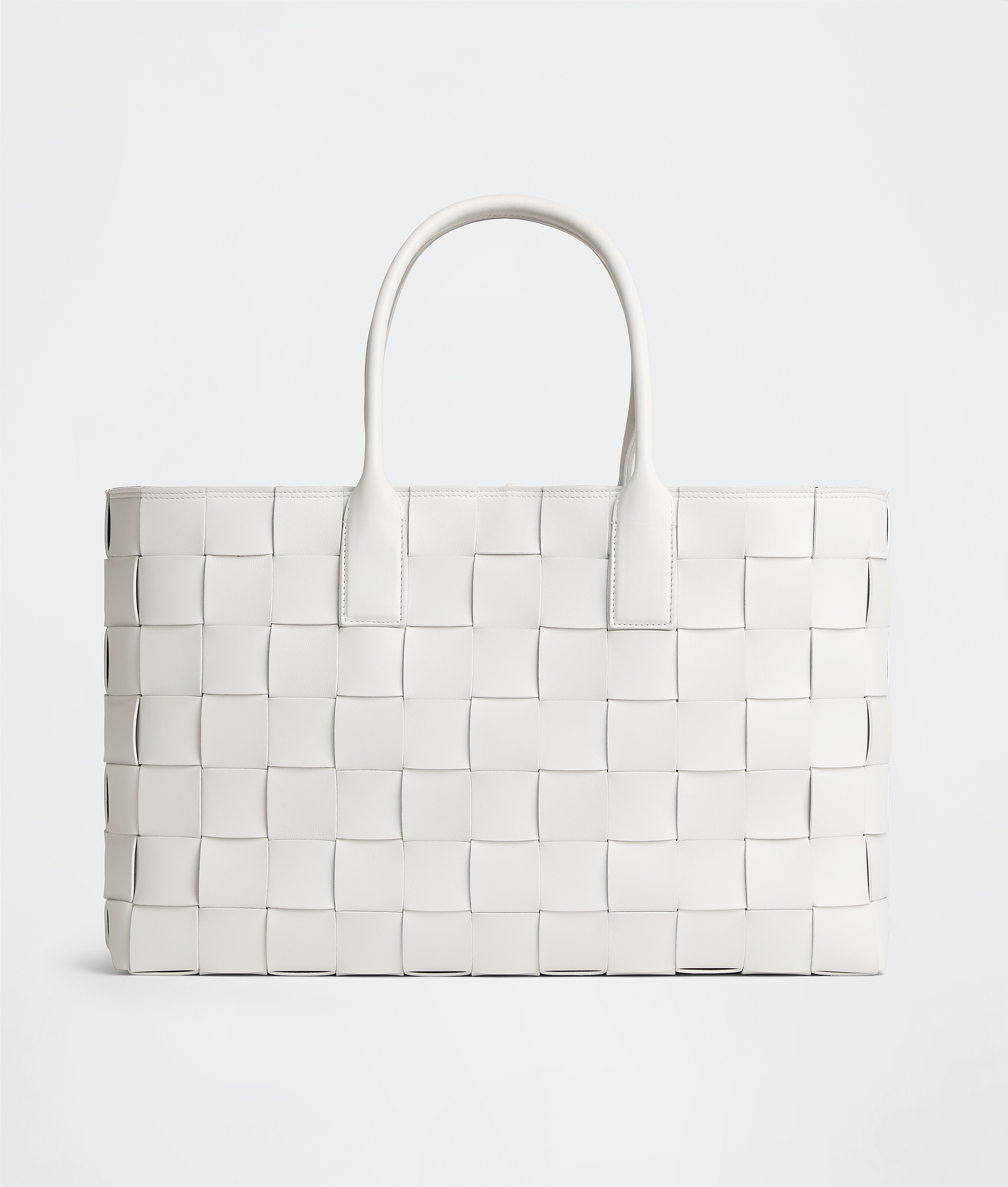
The Cabat has no lining, no logo, no hardware
The Cabat has no lining, no logo, no hardware. It is a tote woven entirely from intrecciato leather strips, and when you turn it inside out — which you can do, because there is no wrong side — the weave remains continuous. This is not a detail. This is the thesis.
Bottega Veneta was founded in Vicenza in 1966 by Michele Taddei and Renzo Zengiaro. The city matters. Vicenza sits in the Veneto, a region with centuries of leather craft behind it, and the house drew its first artisans from local workshops where intrecciato — a technique of weaving narrow leather strips into a flexible, durable surface — was already practiced. What Bottega did was isolate that one gesture and build an entire vocabulary around it.
The weave became the house code. Not a monogram. Not a clasp. A process made visible.
By the nineteen-eighties, Bottega had become the discreet choice. The bag you carried when you didn't need to announce anything. The tagline — "When your own initials are enough" — was coined in this period, and it worked because it named a specific kind of confidence. The customer was not looking for recognition. She had it already.
The Tomas Maier era and what it rebuilt
When Tomas Maier arrived as creative director in 2001, Bottega Veneta was in decline. The house had been sold twice. Production had moved. The intrecciato remained, but the context around it had softened into something close to heritage brand drift.
Maier's first move was to return to the weave, not as nostalgia but as structure. He tightened the craft standards, brought production back to Italy, and expanded the intrecciato into ready-to-wear, furniture, even homeware. He also understood that the house's discretion was not the same as invisibility. Under his direction, Bottega became quieter and simultaneously more present. The Veneta hobo, introduced in his early years, is still in production. The Knot clutch, a woven sphere with a sculptural clasp, became a red carpet fixture without ever becoming loud.
Maier stayed for seventeen years. That tenure is unusual in contemporary fashion, and it gave Bottega something most houses lack: a sustained point of view. By the time he left in 2018, the intrecciato was legible again, and the house had a customer base that understood what it was buying.
Daniel Lee and the rupture
Daniel Lee was thirty-two when he was appointed creative director in the summer of 2018. He had worked at Maier's side at Bottega, then spent time at Celine under Phoebe Philo. His first collection for the house appeared in February 2019, and it was not an homage.
Lee kept the intrecciato but applied it to new forms. The Pouch — an oversized clutch with a gathered, pillowy shape — became the house's most recognizable silhouette within six months. The Cassette, a compact bag with padded square segments, followed. Both were woven, both were sculptural, and both looked nothing like the slim, horizontal bags Bottega had been known for.
He also introduced the Puddle boot, a square-toed rubber Chelsea that sat somewhere between industrial and absurd, and the Lug sole, a chunky tread that appeared on everything from loafers to sandals. These were not quiet gestures. They were declarative, almost brutalist, and they worked because Lee understood that Bottega's discretion had become a trap. The house had been so committed to understatement that it risked being overlooked.
Lee left in November 2021. His tenure lasted three years. In that time, he turned Bottega into one of the most commercially successful and critically discussed houses in fashion. The waiting lists were real. The Pouch was everywhere, and then it was over-exposed, and then it receded into the wardrobe as a piece that had done its work.
Matthieu Blazy and the return to hand
Matthieu Blazy, who had been design director under Lee, took over in late 2021. His first collection appeared in February 2022, and the shift was immediate. Where Lee had been sculptural and bold, Blazy was softer, more interested in drape and the way a garment moved against the body. He brought back a certain kind of ease.
The intrecciato remained central, but Blazy treated it as one tool among many. He introduced fringe, featherweight leather, trompe-l'œil knits that looked like denim or canvas but were entirely woven by hand. His bags — the Andiamo, the Gemelli, the Hop — were structured but not stiff. They held their shape without announcing it.
Blazy is interested in craft as a form of intelligence. His collections reference everything from Italian still life painting to the way a mechanic's jumpsuit is cut, and the references are embedded in the garment rather than explained in the show notes. This is not conceptual fashion. It is fashion that thinks.
Under his direction, Bottega has become less about the single hero bag and more about a way of dressing. The customer who buys the Andiamo might also buy the leather trench, the woven sandal, the jersey dress that looks like nothing on the hanger and everything on the body. This is a harder sell than the Pouch was, and it is also more durable.
What to know before you buy
Bottega Veneta does not do logo hardware. If that is what you are looking for, look elsewhere. The house's signature is the weave, and the weave is visible or it isn't. There is no middle ground.
Prices begin around €950 for small leather goods — card cases, coin purses, woven pouches. The Cassette starts at €2,500 for the smallest size and moves up to €3,900 for the shoulder bag. The Andiamo, which has become the house's most versatile day bag, begins at €3,200. The Gemelli, a structured top-handle, is €3,600. The Hop, a soft hobo, starts at €3,400.
These are not entry-level prices, and Bottega does not offer diffusion lines or collaborations that bring the price point down. What you pay for is material and construction. The intrecciato is not embossed or printed. It is hand-woven, and the weave is what gives the leather its flexibility and its weight. A Bottega bag does not feel like other bags. It has a density to it, a kind of heft that comes from the fact that you are holding many strips of leather rather than a single piece.
If you are beginning with Bottega, begin with something small. The mini Jodie — a woven pouch with a single knot handle — is €1,850 and works as an evening bag or a crossbody. The card case is €390 and will last longer than your wallet. Both will give you a sense of the house's hand, which is what you are buying into.
The Cassette is the most recognizable bag Bottega makes right now, and that is both a strength and a risk. It is a strong shape, and it holds its value, but it is also very visible. If you want something that will age into your wardrobe rather than date out of it, consider the Andiamo or the Gemelli. Both are structured enough to feel deliberate and soft enough to feel lived-in.
Where the house is now
Bottega Veneta does not have a logo you can read from across the room. It does not do seasonal drops or limited capsules. It does not court influencers in the way other houses do, and it does not rely on nostalgia. What it has is a weave that has been in continuous production for nearly sixty years, and a creative director who understands that the weave is not a motif. It is a method.
The house's customer is not looking for the bag everyone else is carrying. She is looking for the bag that will still make sense in ten years, and she is willing to pay for the kind of construction that makes that possible. This is not a fashion house in the sense of constant reinvention. It is a fashion house in the sense of sustained attention.
The intrecciato is still woven by hand in Vicenza. The leather is still Italian. The bags still have no lining, no logo, no unnecessary seams. You can still turn a Cabat inside out, and the weave will still be continuous. That has not changed.