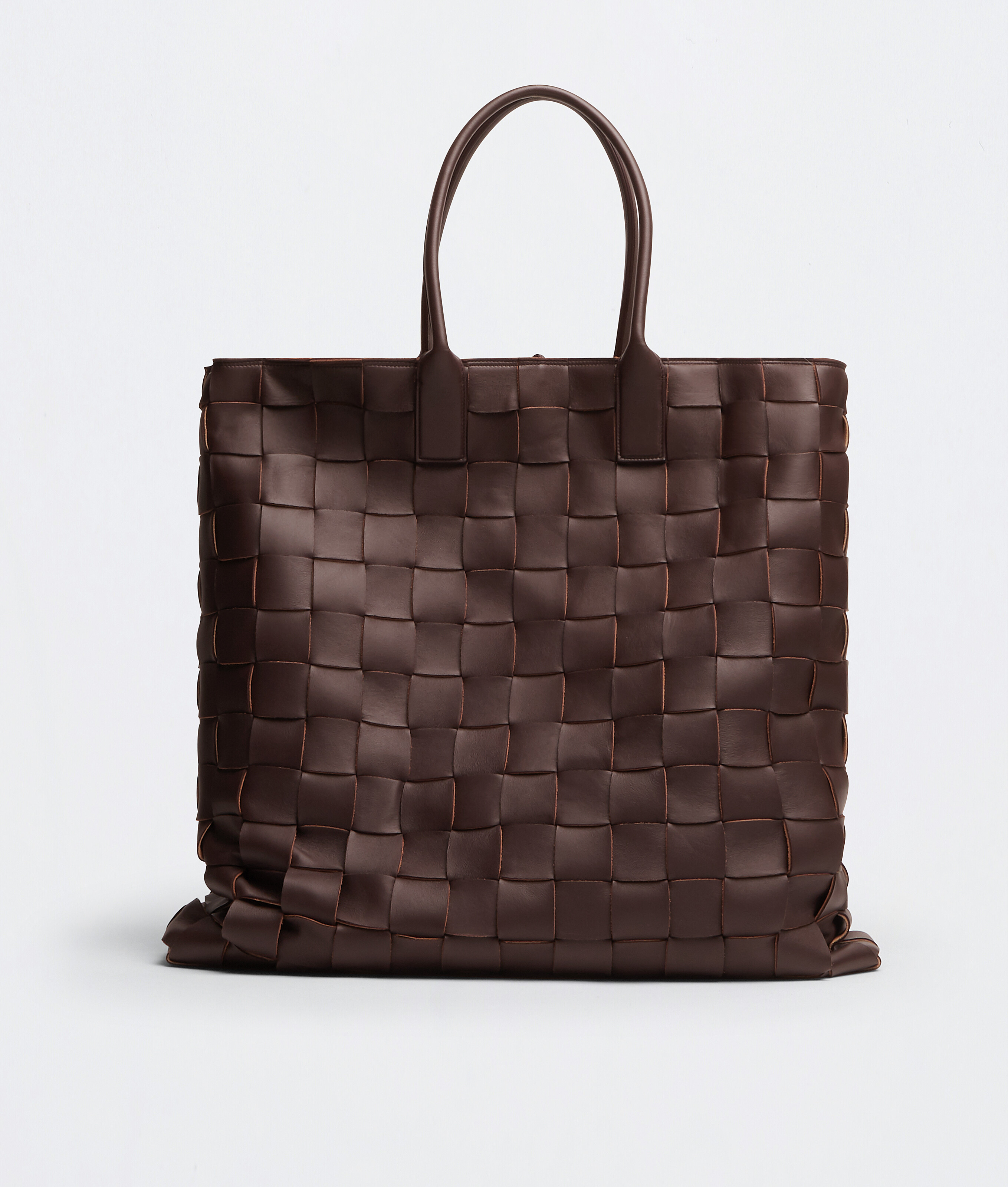
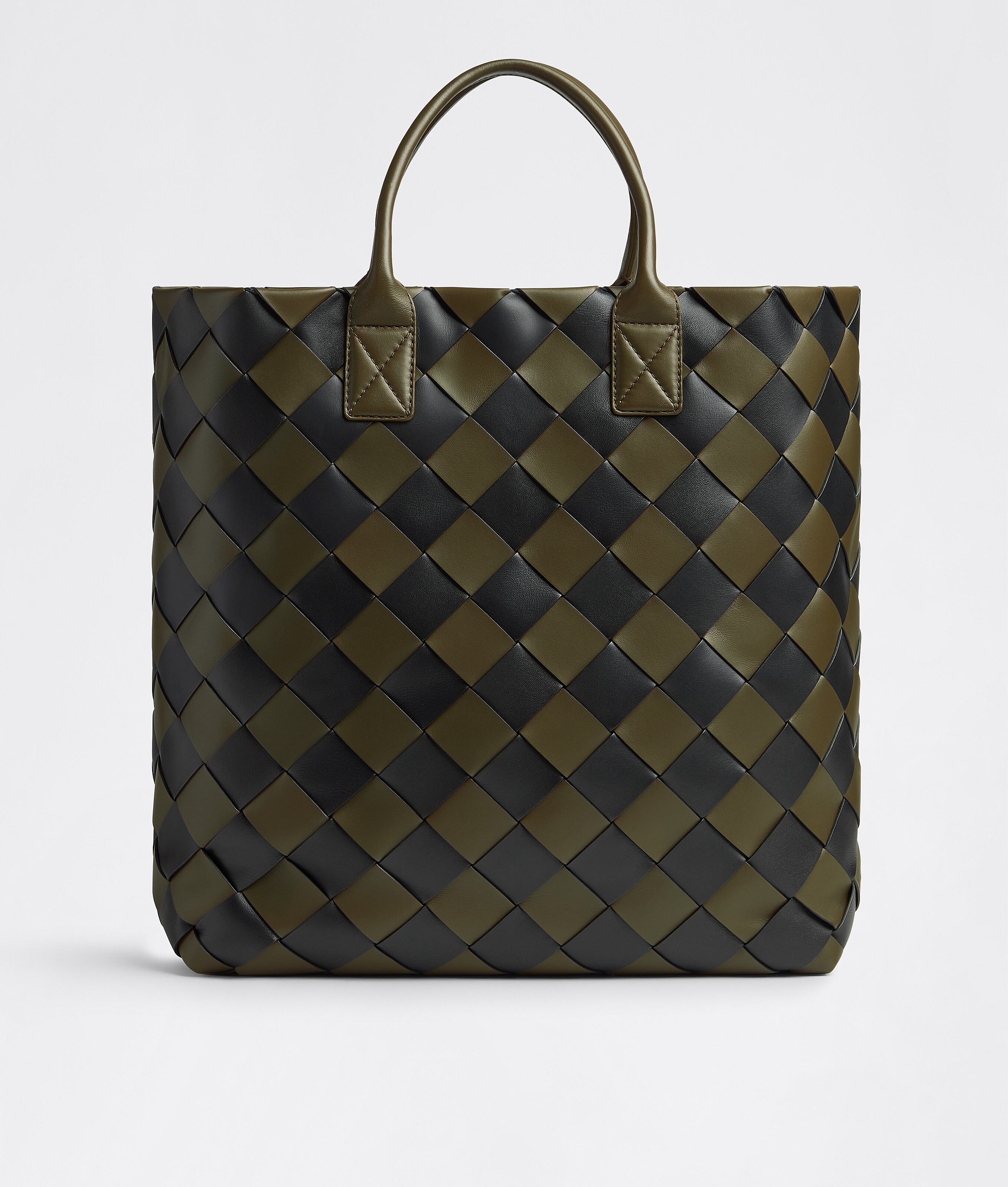
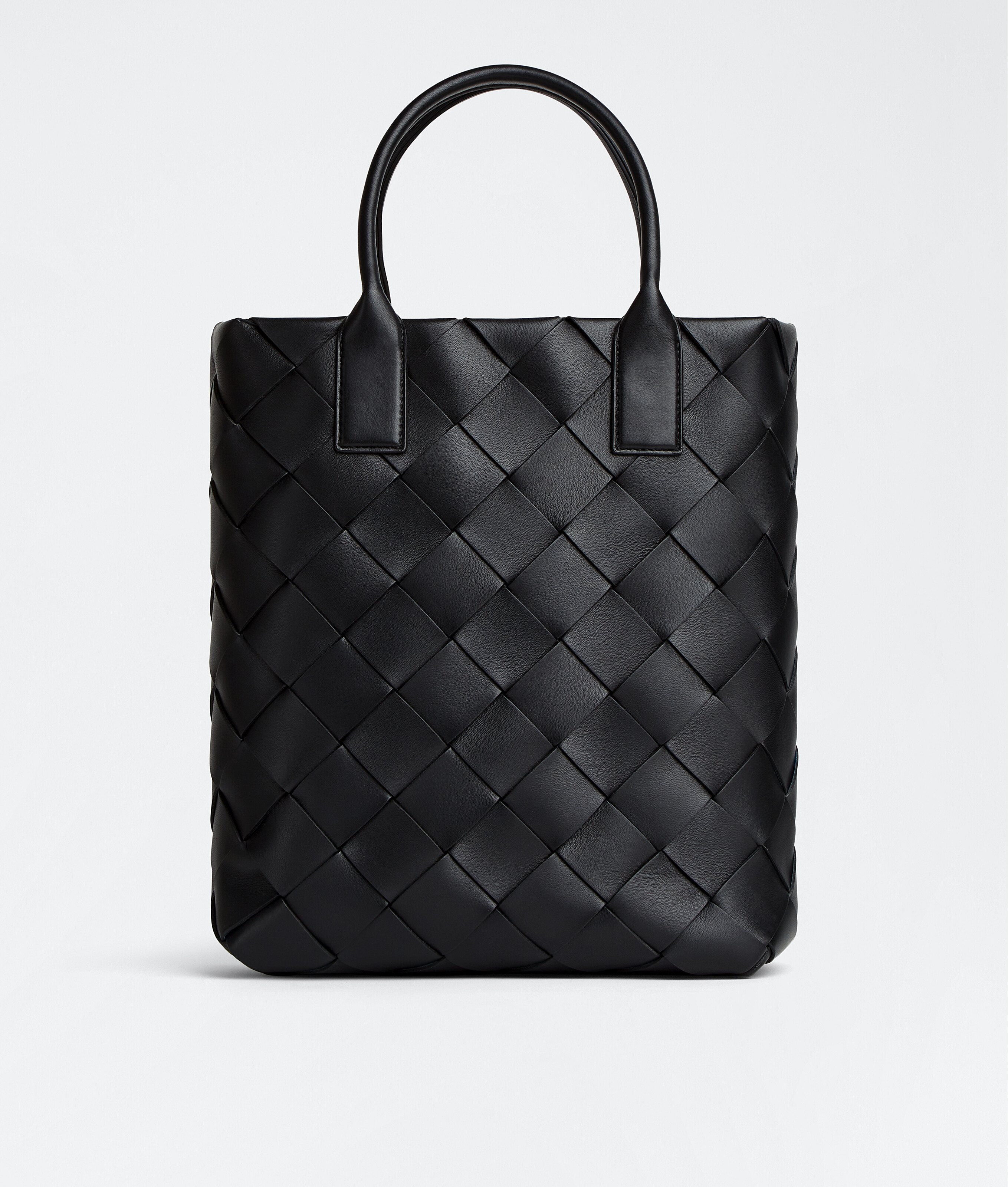
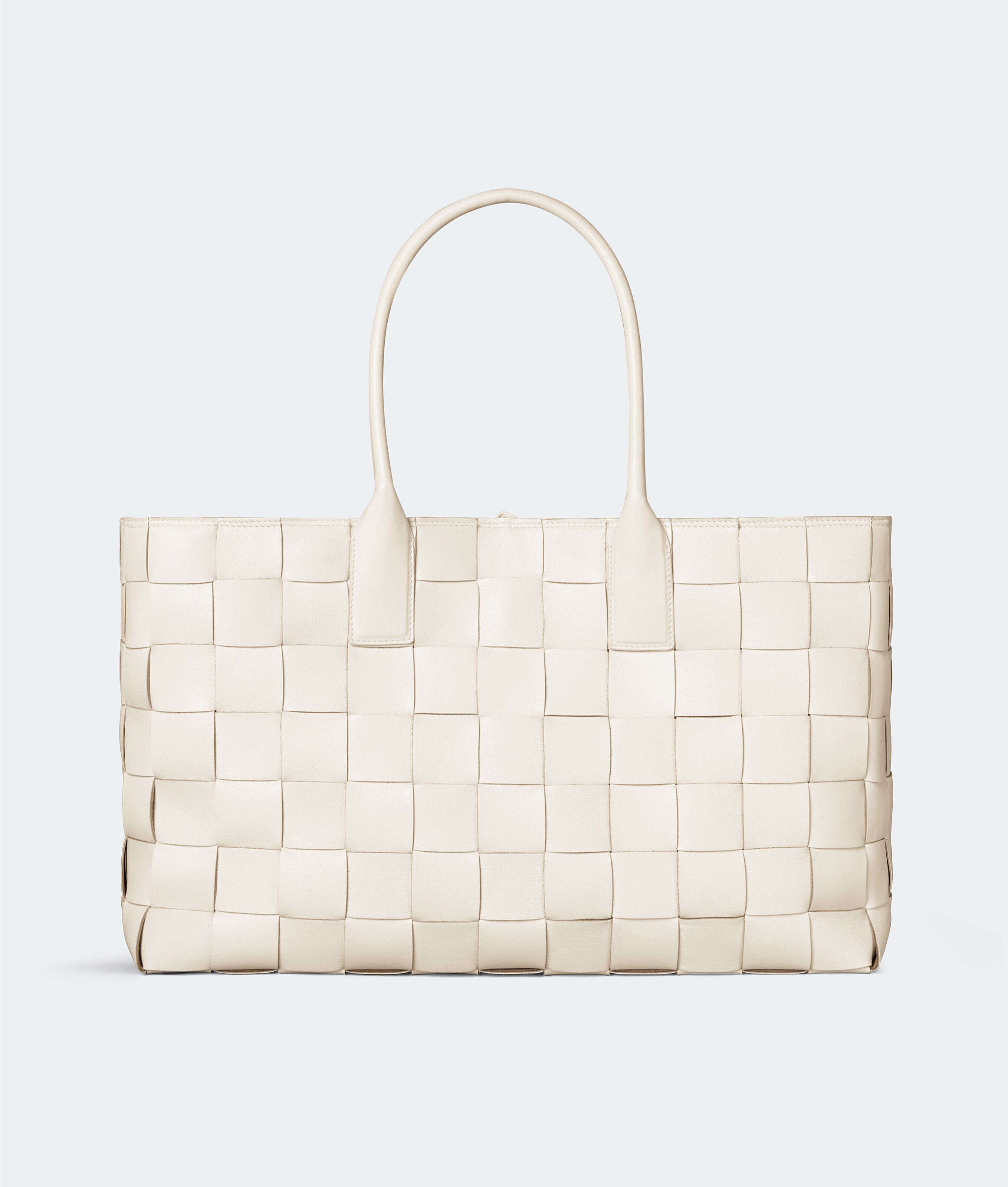
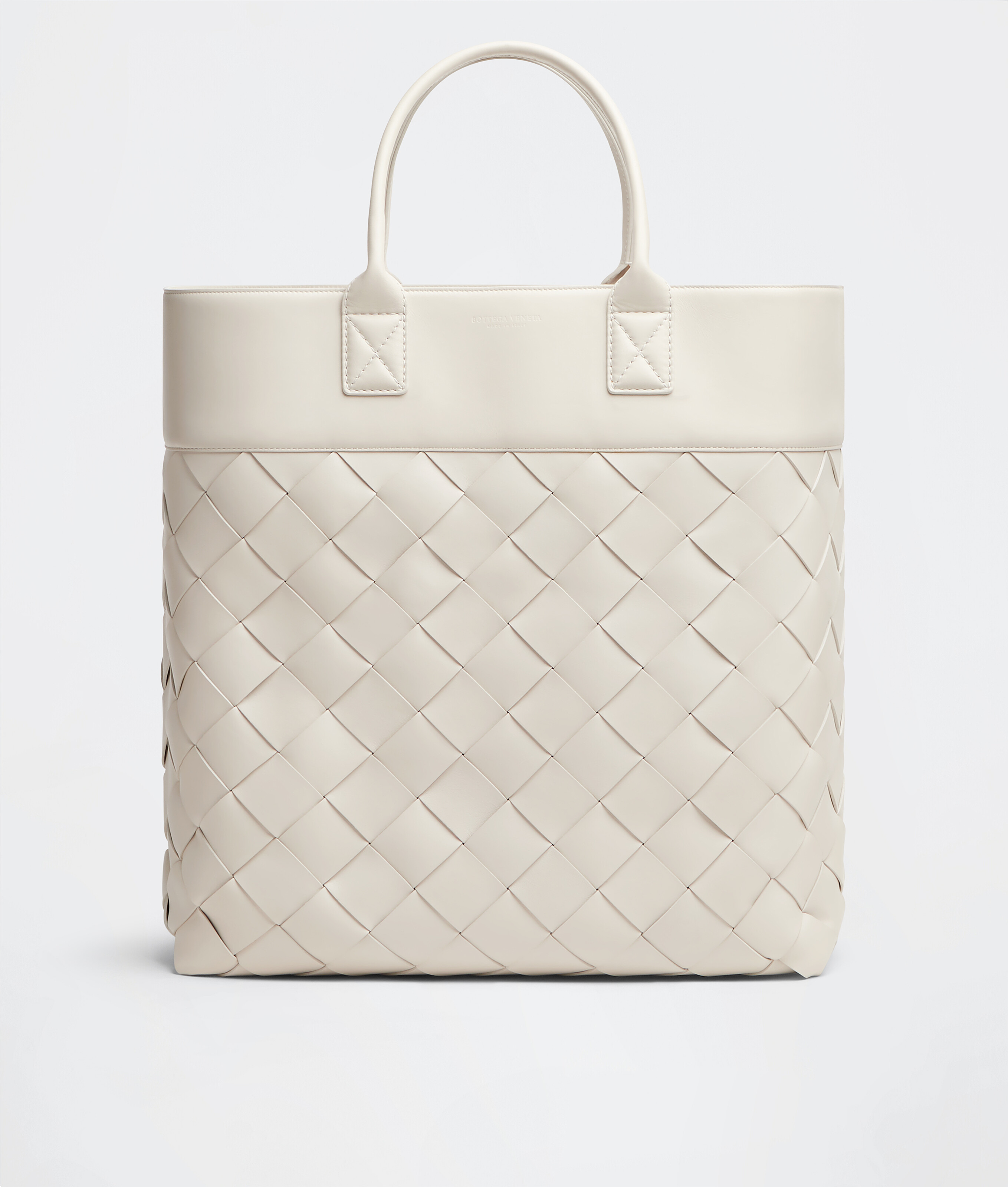
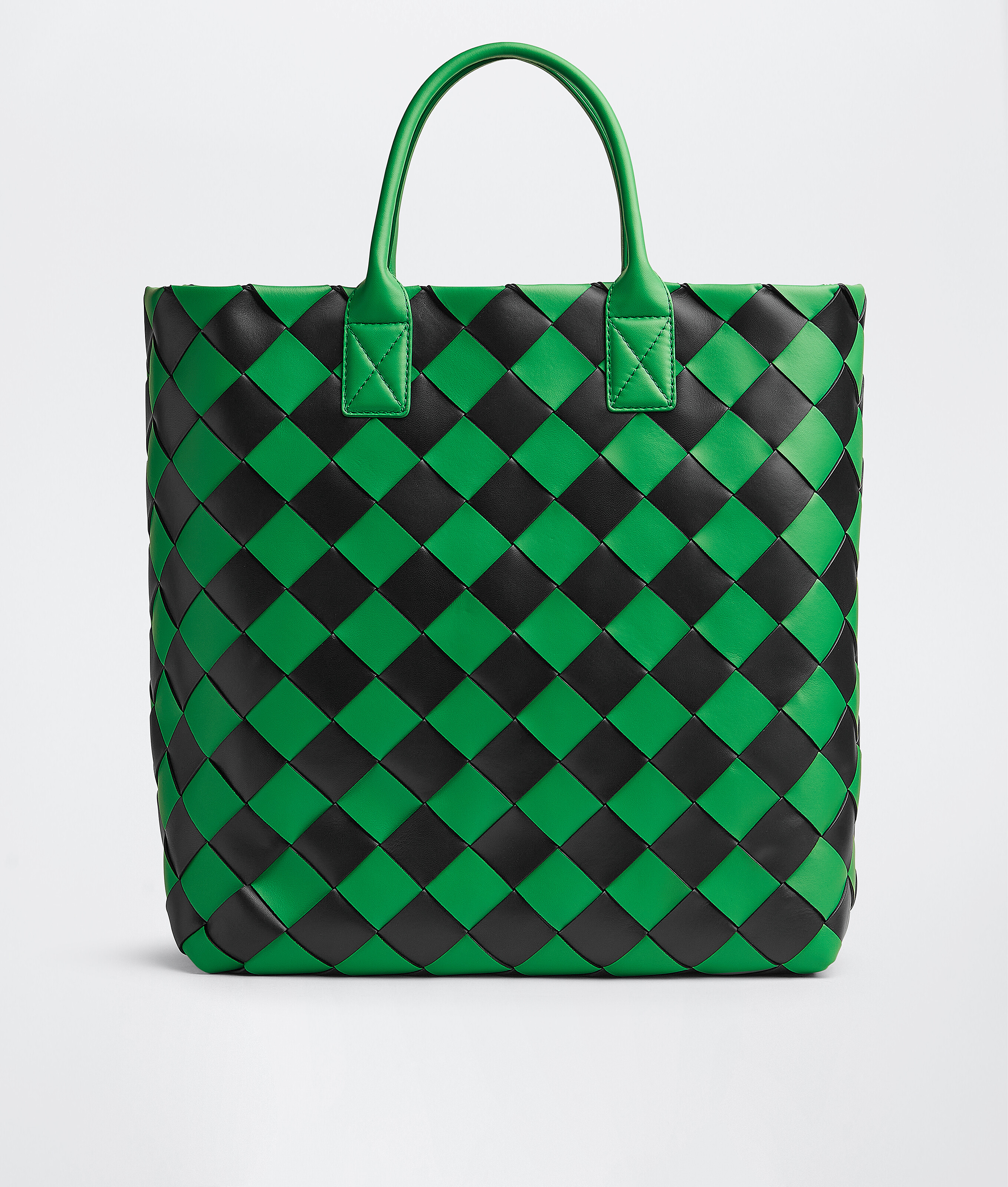
The Cabat tote has no lining, no logo, no hardware
The Cabat tote has no lining, no logo, no hardware. It is woven calfskin held together by its own structure—intrecciato, the house's signature eight-strand weave—and it weighs almost nothing. You can fold it flat when empty. This is luxury as the refusal of ornament, and it is also Bottega Veneta's founding principle: when your own initials are enough.
The maison was established in Vicenza in 1966 by Michele Taddei and Renzo Zengiaro, two leather artisans who built a workshop around intrecciato because the weave allowed them to use scraps. Offcuts became structure. By the seventies, American buyers at Bergdorf Goodman and Saks were ordering in volume. The tagline—'When your own initials are enough'—arrived in print advertising during the eighties, and it named something that already existed: a client base that did not need to announce what they carried.
The house nearly disappeared. In the nineties, licensing eroded the line. By 2001, when Gucci Group acquired Bottega Veneta, annual revenue sat at $90 million and the intrecciato had become shorthand for quiet wealth in decline. Tomas Maier, installed as creative director that same year, spent seventeen years rebuilding. He kept the weave, expanded it into ready-to-wear, and refused logomania even as it defined the early 2000s. Revenue passed $1 billion under his direction. He left in 2018.
Daniel Lee arrived in June of that year. He was thirty-two, had spent five years at Celine under Phoebe Philo, and his first collection for Bottega Veneta landed in February 2019. The Pouch—a soft, gathered clutch with no closure—appeared in that show. So did the Puddle boot, a square-toed Chelsea with an exaggerated sole, and the Jodie, a knotted hobo in butter-soft leather. Lee's Bottega was louder than Maier's: the silhouettes were sculptural, the colors were acid green and cobalt, and the campaigns shot by Tyrone Lebon felt like stills from a film about desire rather than advertisements for handbags. By 2021, the house had become the most-searched luxury brand on Lyst. Lee left in November of that year. No reason was given.
Matthieu Blazy, who had worked alongside Lee as design director, was named his successor within a week. Blazy's first solo collection, for fall 2022, opened with a leather trench coat constructed to mimic denim—topstitching, pocket placement, even the weight of the drape. A white poplin shirt was actually intrecciato leather cut and woven to read as cotton. The show was a demonstration of technique as concept, and it clarified what Bottega Veneta is now: a house that makes you look twice, not because of a logo, but because the material is not what it appears to be.
What you need to know before you buy
Bottega Veneta does not do entry-level the way other houses do. There is no logo canvas, no nylon pouch at $400 to get you in the door. The leather goods start around $1,100 for a card case and move quickly into four figures. The Pouch—still in production, still one of the house's most recognizable shapes—begins at $2,300 for the small size in nappa. The Jodie, depending on size and leather, ranges from $3,200 to $4,900. The Cabat, hand-woven in Montebello Vicentino, starts at $5,900 and can exceed $40,000 for exotic skins.
This is intentional. The house positions itself as the opposite of accessible, and the pricing reflects both material cost and the labor involved in intrecciato construction. Each Cabat requires sixteen hours of handwork. The weave cannot be mechanized. When you buy Bottega Veneta, you are paying for that time, and you are also paying for the fact that the bag does not announce itself across a room.
If you are beginning, start with small leather goods. The card case in intrecciato nappa is $1,100. The continental wallet is $850. Both are woven, both are durable, and both let you learn how the leather ages. Bottega's nappa is not treated to resist wear—it is meant to soften and darken with handling. This is a feature, not a flaw, but it requires a different relationship to patina than you might have with coated canvas or box calf.
The Pouch is the next step. It has become ubiquitous in certain circles—fashion editors, architects, women who work in contemporary art—but it remains a strong shape. The small size fits a phone, cardholder, keys, and lipstick. The large fits a laptop. There is no zipper, no clasp, no structure. You gather the top and hold it, or you tuck it under your arm. It is not practical in the way a Neverfull is practical, but it is light, and it packs flat, and it works as both day bag and evening bag depending on the leather. Nappa is softer and more casual. Intreccio (the woven version) reads dressier. Avoid the metallic finishes unless you are certain—they date faster than solid colors.
The Jodie is more structured. The single knot at the top is the recognizable detail, but the shape itself is a classic hobo. It sits on the shoulder, it holds its form, and it comes in three sizes. The mini is decorative. The small is daily-use. The medium is travel-capable. The knot is functional—it is how you open and close the bag—but it also adds visual weight, which means the Jodie reads more designed than the Pouch. If you want something that signals Bottega Veneta without being obvious, this is it.
Ready-to-wear and shoes
The clothing is less accessible than the bags, both in price and in wearability. A leather shirt starts at $4,900. A wool coat is $6,500. The tailoring is precise—Blazy worked under Raf Simons at Jil Sander and under Phoebe Philo at Celine, and both influences are present—but the shapes are often exaggerated. Sleeves are longer than standard, shoulders are dropped or broadened, hems are asymmetric. This is not clothing that disappears into your wardrobe. It asks you to build around it.
The shoes are easier. The Puddle boot, which launched under Lee and remains in production, is $1,250. The Stretch sandal—a mule with a padded sole and a single wide strap—is $950. The Orbit sneaker, introduced under Blazy, is $1,050. All three are recognizable without being logo-driven, and all three work with denim, suiting, or dresses. The Puddle in particular has become a signature: the square toe and the lug sole are distinct, and the boot works across three seasons.
Avoid the more experimental styles unless you are certain. The Puddle in quilted leather, the Orbit in shearling, the Stretch with a sculptural heel—these are statement pieces, and they are expensive statements. The house produces them in limited quantities, which means resale value can be strong, but it also means you are committing to a very specific look. Start with the foundational shapes. Learn how the house fits. Then move into the seasonal variations.
Where the house stands now
Blazy's Bottega is less about shock than about refinement. The fall 2024 show included a coat made from leather scraps woven into a grid, a skirt constructed from intrecciato leather fringe, and a series of bags that looked like crumpled paper but were actually molded calfskin. The technique is front-facing, but the effect is quiet. You have to be close to see how it is made.
This is a different strategy than Lee's, which was about making Bottega Veneta visible in a feed. Blazy's work is slower. It asks you to look at the garment, not the image of the garment. Whether this translates to the same level of commercial success is still unclear—the house does not break out revenue in Kering's reports—but the critical reception has been consistent. Blazy won the LVMH Prize in 2018, before Bottega, and he was named designer of the year by the British Fashion Council in 2022. The work is respected.
For someone beginning, this means you are entering at a moment when the house is not trying to be everywhere. The bags are not on every arm. The shoes are not in every store. Bottega Veneta is still operating as a house for people who know, and that creates a different kind of value. You are not buying into a logo. You are buying into a level of craft that is legible only to those who are paying attention.
A friend who works in textile conservation once told me she can spot intrecciato from across a room, not because of the weave itself but because of the way the leather moves. It does not crease the way stitched leather creases. It flexes. That is what you are buying: a material intelligence that does not announce itself, but that you will notice every time you pick up the bag.