The chain mail isn't meant to be comfortable
The chain mail isn't meant to be comfortable. It's meant to make a sound when you move — a soft, metallic whisper that announces you three seconds before you arrive. Gianni understood that. He also understood that most people would never wear it, and that was fine. The point was the idea of it, the fact that somewhere in Milan a woman might choose armour over silk.
That's the Versace most of us remember: the opera, the excess, the unapologetic camp. Medusa heads the size of dinner plates. Safety pins holding Liz Hurley together on a red carpet. Prints so loud they required a permit. But there's a parallel vocabulary running underneath all of it, quieter and more structural, that we've let slip out of the conversation. Not because it disappeared — Donatella's kept most of it alive — but because we stopped noticing.
The architecture nobody mentions
Gianni trained as an architect before he touched fabric. That shows up less in the prints than in the way a Versace jacket sits on the body. There's a geometry to the cut, especially through the shoulders and the waist, that doesn't flatten or drape so much as frame. The silhouette isn't soft. It's engineered.
Look at the tailoring from the early nineties — not the bondage leather or the Warhol collaborations, but the suiting. Versace built jackets with a kind of cantilevered shoulder that didn't need padding to hold its line. The sleeve head was set slightly forward, which meant the whole garment moved with you instead of against you. It was construction masquerading as ease, and it required an atelier that understood load-bearing seams.
That approach extended to eveningwear in ways we've mostly forgotten. The chain mail dresses everyone remembers were a technical feat — each link hand-soldered, each join calibrated so the whole thing moved like liquid — but they weren't the only experiment. Versace was also working with bonded jersey, laser-cut leather, and a kind of sculptural pleating that didn't rely on heat-setting. He wanted clothes that looked like they defied physics, and he was willing to fund the R&D to get there.
Most of that technical vocabulary is still in the house archives. Donatella references it occasionally — a bonded bustier here, a geometric pleat there — but it's no longer the point. The point now is the logo, the Medusa, the platform heels that show up on every influencer grid. Which is fine. Versace has always been about visibility. But we've traded one kind of visibility for another.
What the print actually did
The baroque florals and the Greek key borders are easy to parody, which means we do. But Gianni didn't use print as decoration. He used it as architecture. A trompe-l'œil corset printed onto a sheath dress didn't just reference historical dress — it became structure, flattening three-dimensional boning into two-dimensional ink. The body shaped the fabric, but the fabric also shaped the body. That's a different project than just putting a loud pattern on a safe silhouette.
The prints also did something specific to scale. Versace almost never worked small. Even the delicate motifs — the tiny Medusa heads, the fine chain links — were printed or woven at a scale that registered from across a room. He understood that fashion operates at a distance, that most people experience a garment from three metres away, not three centimetres. So he built for that distance.
That's why the prints hold up in photographs but sometimes falter in person. They were designed for the camera, for the runway, for the red carpet — all contexts where you're seen before you're touched. It's a very specific kind of intelligence, and it requires knowing exactly how much detail to omit.
Donatella's kept that logic alive, but she's also had to navigate a market that wants both the print and the logo. So now you get the baroque swirl with a Medusa stamped on top, and the whole thing starts to feel redundant. The print was already doing the work. The logo is just insurance.
The leather goods nobody talks about
Versace has never been a bag house. The Medusa hardware shows up on everything from crossbodies to totes, but there's no Birkin equivalent, no single silhouette that carries the brand. And that's fine — not every house needs to be Hermès. But it also means we've overlooked some genuinely strange and interesting leather work that happened in the nineties.
Gianni made bags that looked like they'd been excavated from Pompeii: embossed, oxidised, treated with patinas that mimicked ancient bronze. He made clutches shaped like seashells, evening bags that opened like compacts, top-handles with a kind of architectural hinge that made them feel more like sculpture than accessory. None of it was practical. Most of it was barely wearable. But it was all very clearly the work of someone who thought a handbag could be more than a container.
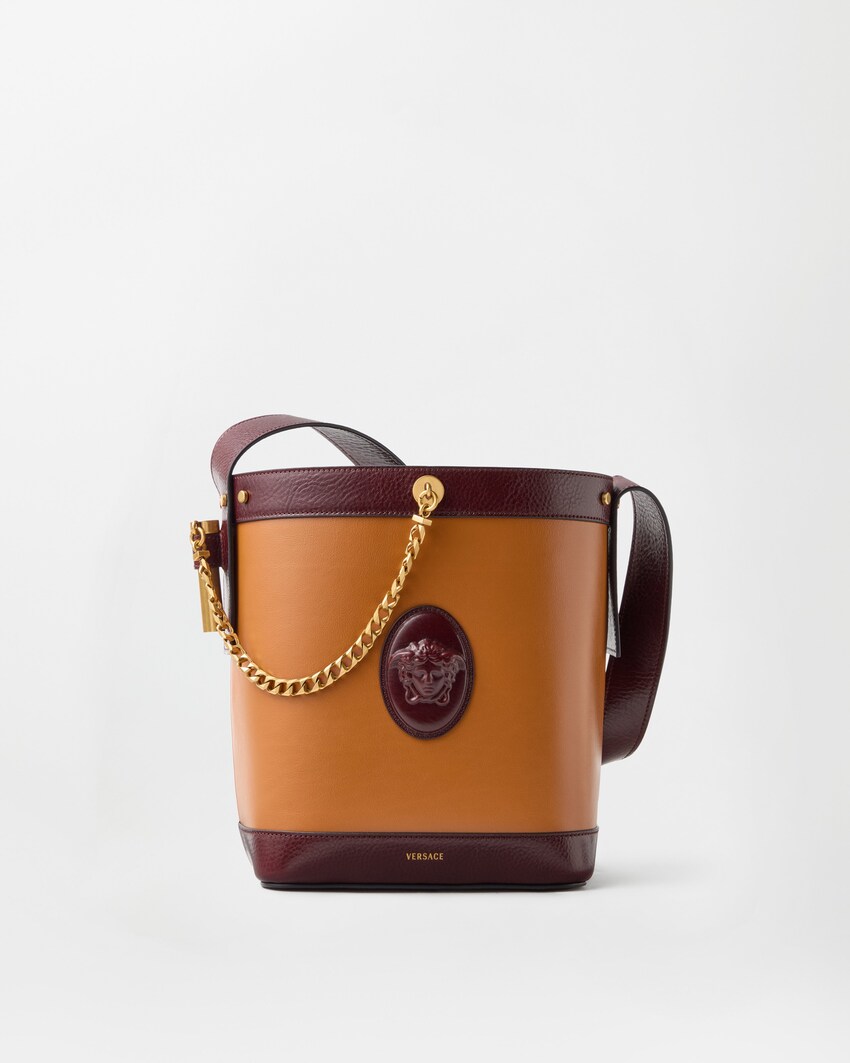
Donatella's brought some of that spirit back with the La Medusa bags — structured, hardware-heavy, unapologetically decorative — but the line between decorative and costume is thinner now. The nineties pieces felt like prototypes. The current bags feel like merch. That's not a moral judgement. It's a shift in function.
The shoes, though, have stayed strange. Versace platforms remain architecturally unsound in the best possible way: five inches of heel, two inches of platform, and a sole so aggressively chunky it reads as satire. But they work. You can walk in them, barely, and they photograph like a manifesto. Donatella's kept that logic intact even as the rest of the accessories have softened into wearability.
What Donatella kept
When Gianni died in 1997, the house could have collapsed inward. It didn't. Donatella took over and made a choice: she'd keep the codes, but she'd also make them legible to a generation that didn't grow up with them. That meant simplifying some things and amplifying others.
The Medusa got bigger. The safety pin became a motif instead of a one-off provocation. The prints stayed loud, but they also became more controlled — less rococo chaos, more engineered repeat. And the tailoring, which had always been sharp, got sharper. Donatella doesn't do soft.
She's also brought in collaborators who understand the house vocabulary but aren't beholden to it. The Fendace swap with Kim Jones and Silvia Venturini Fendi worked because both houses share a taste for maximal decoration and minimal restraint. The Palm Angels collaboration worked because Francesco Ragazzi already spoke fluent Versace — he just added a Californian accent.
But the deeper signatures — the structural cut, the trompe-l'œil print, the sculptural leather — those show up less frequently now. Not because Donatella's forgotten them, but because the market doesn't ask for them. The market asks for Medusa-stamped slides and logo-print T-shirts and platform boots that look good on a grid. Versace delivers, because Versace has always been pragmatic underneath the spectacle.
Where it sits now
Walk into a Versace boutique and you'll see two stores operating in parallel. One sells the codes: the baroque print shirts, the Medusa belt buckles, the safety pin earrings. The other sells quiet black tailoring, supple leather trousers, and knits so fine they almost disappear. The first store funds the second. The second store is where the original intelligence still lives.
That's not unique to Versace. Most heritage houses are running the same double operation. But Versace's version is particularly stark because the gap between the loud codes and the quiet ones is so wide. There's no middle ground. You're either buying the spectacle or you're buying the structure, and the structure doesn't announce itself.
Which means the codes we remember — the Medusa, the print, the gold hardware — are doing exactly what they were designed to do. They're visible. They're immediate. They're the reason someone buys the bag. But they're not the reason the bag works. The reason the bag works is in the leather weight, the strap construction, the way the hardware is anchored so it doesn't pull. And we've stopped talking about that part.
Gianni knew the armour would get the attention. He also knew it had to fit.