The collar on a Burberry trench sits higher than most people remember
The collar on a Burberry trench sits higher than most people remember. Not dramatically—there's no theatre in the construction—but high enough that when you turn it up, it covers the nape without bunching. That's deliberate. Thomas Burberry patented gabardine in 1879 because he wanted a cloth that would breathe while shedding water, and the collar is cut to work with that fabric, not against it. It's one of those details you notice only when you've worn the coat long enough to stop thinking about it.
Most of what people now associate with Burberry—the check, the logo rework, the Lola bag—arrived long after the house established its actual vocabulary. That vocabulary was never loud. It was a question of proportion, construction, and a handful of materials that performed specific jobs. Those codes are still there, but they've been buried under decades of licensing, rebranding, and the assumption that heritage means putting a tartan lining in everything.
Gabardine, Not Tartan
Burberry's first signature wasn't a pattern. It was a weave. Thomas Burberry developed gabardine as a tightly woven twill that could be proofed without rubbing wax into the fibres. The result was a cloth that remained breathable—critical for the explorers and officers who wore it—while keeping rain out. Roald Amundsen took it to the South Pole. Shackleton wore it in the Antarctic. The RAF specified it for flight jackets in both wars.
The trench coat, introduced during the First World War, was built around gabardine's properties. The storm flap isn't decorative; it's a second layer of protection across the right shoulder, where a rifle would rest. The D-rings were for attaching kit. The throat latch, when fastened, pulls the collar tight against wind. Every detail had a function, and the coat worked because the cloth allowed all of that hardware without adding bulk.
Gabardine is still in the collection, though it's no longer the only option. Burberry now offers the trench in cotton drill, technical blends, and even leather. But the original construction—the cut of the raglan sleeve, the width of the lapel, the placement of the belt—only makes sense in the context of that first fabric. It's a coat designed for a specific material, and when you swap the material, you're left with a silhouette that references the original without quite inhabiting it.
The Check That Wasn't Meant to Be Seen
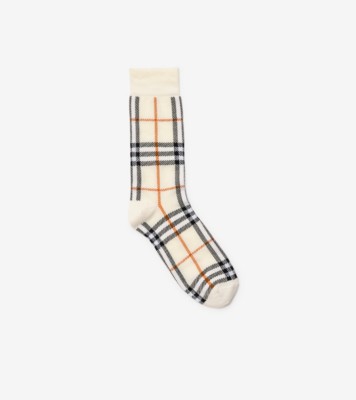
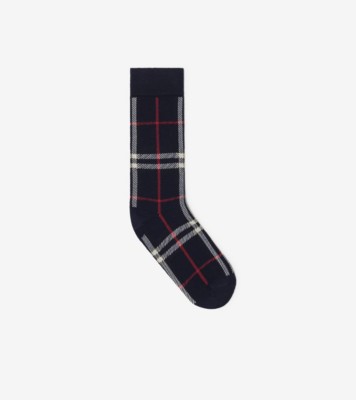
The Burberry check appeared in the 1920s as a lining. It was never intended as outerwear. The pattern—a camel base with black, white, and red stripes—was a house signature in the way that Hermès orange was a house signature: something you saw when you opened the coat, not something you wore on the outside.
That changed in the 1960s, when Burberry began licensing the check for umbrellas, scarves, and luggage. By the 1990s, it was everywhere—on baseball caps, bikinis, dog collars. The pattern became shorthand for the brand, which meant it also became shorthand for a particular kind of consumption. The check was no longer discreet. It was the point.
Daniel Lee, who took over as chief creative officer in 2022, hasn't abandoned the check, but he's used it differently. In his first collection, it appeared as a jacquard woven into outerwear, visible only in certain light. In another, it was abstracted into a pixel grid. The pattern is still there, but it's no longer doing the work of announcing itself. It's become, again, a detail rather than a statement.
The Equestrian Line That Built the Wardrobe
Before Burberry was a fashion house, it was an outfitter. The company supplied country estates with riding coats, shooting jackets, and weatherproof layers that needed to perform across long days outdoors. That equestrian heritage—less about sport than about utility—shaped the house's approach to tailoring.
The hacking jacket, cut with a longer back vent and a nipped waist, was designed to sit comfortably in the saddle. The car coat, introduced in the early 20th century, was shorter than a trench but built with the same gabardine and the same attention to weather resistance. These weren't fashion pieces. They were problem-solving garments that happened to look sharp because their cut followed their function.
Burberry still makes versions of both, though they're now positioned as part of the heritage line rather than the main collection. The hacking jacket, in particular, has become one of those pieces that tailors reference when they talk about balance—the way the shorter front and longer back create a clean line without excess fabric. It's a cut that works because it was designed for movement, not for standing still in front of a mirror.
Lee has brought some of that equestrian vocabulary back into the main line, not as literal reproductions but as structural references. His tailoring often features a higher button stance and a sharper waist suppression than you'd expect from a British house, but the shoulder remains natural, and the sleeve is set to allow a full range of motion. It's tailoring that acknowledges Burberry's roots in outerwear without trying to recreate them.
What Lee Kept, What He Left
When Lee arrived from Bottega Veneta, the question wasn't whether he'd reference Burberry's codes—every creative director does that—but which codes he'd choose. He didn't lead with the trench. His first runway opened with lean tailoring in charcoal and navy, worn with knee-high boots and structured leather bags that referenced saddlery without reproducing it. The check appeared, but sparingly. The rose—Burberry's other signature, a motif Thomas Burberry used in correspondence—was embroidered onto shirting and woven into knits.
What Lee has emphasised is weight. His fabrics are heavier than his predecessor's, and his silhouettes are more architectural. The trench, when it appears, is cut slightly longer and slightly wider through the body. The tailoring is sharper, but it's also more forgiving—less about a fitted waist and more about a clean shoulder and a strong drape. It's a shift in proportion that makes the clothes feel more grounded, less concerned with looking expensive and more concerned with looking solid.
The bags have followed the same logic. The Knight bag, introduced in Lee's first collection, is a structured top-handle with a curved base and a single metal clasp. It's not trying to be the next Lola or the next TB monogram bag. It's trying to be a bag that works, that holds its shape, that doesn't announce itself. The leather is thick. The hardware is minimal. It's the kind of piece that makes sense in the context of Burberry's equestrian past, even if it's not explicitly referencing it.
The Coat You Already Own
There's a version of the Burberry trench in nearly every wardrobe that's been accumulating for more than a decade. It might be vintage, picked up in a charity shop in Marylebone. It might be from the mid-2000s, before the check became overwhelming. It might be newer, purchased during one of the periodic creative resets. The coat is always slightly too long or slightly too short, and the belt never sits quite right until you've worn it enough times to stop adjusting it.
That's the thing about Burberry's actual codes—the ones that predate the branding exercises and the logo reworks. They're not designed to be noticed. They're designed to work. The collar that sits high enough to block wind. The sleeve that doesn't bind when you reach forward. The gabardine that sheds rain without feeling like you're wearing a tarp. Those details don't photograph well. They don't translate into Instagram carousels or campaign imagery. But they're the reason the coat is still in the wardrobe, still getting worn, still doing the job it was designed to do a century ago.