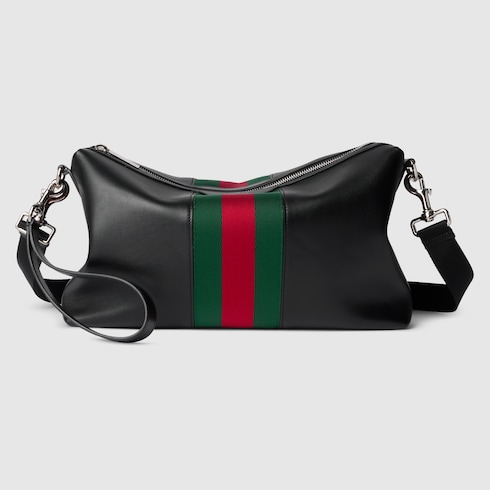
The double-G hardware on a Marmont bag, held under gallery light, reads differently now than it did five years ago
The double-G hardware on a Marmont bag, held under gallery light, reads differently now than it did five years ago. Not worse. Not better. Different. The emblem still carries weight — the interlocking initials trace back to Guccio Gucci's 1933 flourish — but the cultural charge around it has shifted. What was, until recently, the house of maximum dopamine and archival pastiche under Alessandro Michele has become something quieter, more legible, under Sabato De Sarno. The question isn't whether Gucci remains relevant. It does. The question is what kind of relevance the house is willing to settle for.
Fondations : Florence, cuir, et l'idée du voyage
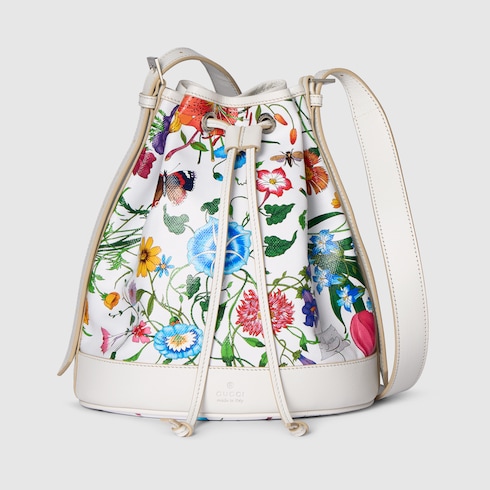
Guccio Gucci opened his first leather-goods shop in Florence in 1921, drawing on time spent as a bellhop at the Savoy in London. The house mythology leans heavily on this detail — the young man observing the luggage of the well-travelled, absorbing codes of luxury at a distance. By the thirties, Gucci was producing equestrian-inspired accessories: saddles, bridles, and eventually the bamboo-handle bag in 1947, born of wartime material shortages. The horsebit loafer arrived in 1953. The Flora scarf, commissioned by Rodolfo Gucci for Grace Kelly, came in 1966.
These are the touchstones. They recur in every brand narrative, every anniversary campaign, every attempt to root the present in craft tradition. And they are, on balance, legitimate. The house did build its reputation on leather facture and a specific vocabulary of hardware. What complicates the story is the decades that followed: family feuds, licensing sprawl, the near-collapse in the early nineties. By the time Tom Ford and Domenico De Sole arrived in 1994, Gucci was less a luxury house than a cautionary tale.
L'ère Ford-Michele : sexe, puis maximalisme
Ford's tenure — 1994 to 2004 — reset the house entirely. Velvet hip-huggers, satin shirts unbuttoned to the navel, advertising that made no pretence of subtlety. It was unapologetically carnal, and it worked. Gucci became, for a moment, the most talked-about brand in fashion. Revenues climbed from $230 million in 1994 to over $3 billion by 2003. When Ford left, the question was whether anyone could follow that act.
Frida Giannini tried, from 2006 to 2014, with a softer, more heritage-focused approach. Sales were steady but the cultural conversation moved elsewhere. Then came Alessandro Michele in January 2015, promoted from accessories to creative director with little fanfare and no runway experience. His first collection, shown that February with a matter of weeks' lead time, arrived like a colour-field painting in a room of grey wool.
Michele's Gucci was sui generis. Pussy-bow blouses over flared corduroys. Embroidered bees and tigers. Fur-lined loafers with no socks. It drew on the house's seventies archive but also on his own magpie instincts — Klimt, Hollywood Regency, his grandmother's wardrobe. The runway shows became events. Revenue doubled under his watch. By 2019, Gucci was generating close to €10 billion annually, making it Kering's largest and most profitable brand.
But maximalism has a half-life. By 2021, the formula was legible enough that it could be replicated, parodied, or simply ignored. Sales began to soften. Michele's collections still commanded attention, but the attention no longer converted at the same rate. In November 2022, Kering announced his departure. Sabato De Sarno, then design director of Prada's ready-to-wear, was named his successor two months later.
De Sarno : le pari du discret
De Sarno's first collection debuted in September 2023. The palette was muted — camel, ivory, slate, a few hits of red. Silhouettes leaned toward the body without clinging. Leather was treated simply. The runway notes mentioned "everyday luxury" and "natural elegance." Reactions were mixed. Some critics praised the restraint. Others found it forgettable, or worse, generic.
The challenge De Sarno faces is structural. Michele's Gucci was so visually dense that any successor risked looking anaemic by comparison. But the larger issue is market position. Gucci sits in an uncomfortable middle ground: too expensive to be accessible, too accessible to feel exclusive. A Dionysus bag retails around $2,500. A Marmont, $1,800 to $2,200 depending on size. These are significant purchases, but they're attainable in a way that a Birkin or a Lady Dior is not. Gucci moves volume. In 2022, before De Sarno's arrival, the house was still generating over €10 billion. That scale requires constant newness, constant product, constant reasons to return.
De Sarno's aesthetic, at least in its first year, doesn't lend itself to that pace. His clothes are considered. They ask to be worn, not photographed. The Ancora red he introduced — a warm, slightly orange-leaning scarlet — has become a signature, appearing on everything from handbags to loafers to ready-to-wear. It's a smart move, legible without being loud. But one colour and a philosophy of restraint don't yet constitute a vision sharp enough to shift the conversation.
Sales have continued to decline. Kering's Q3 2024 results showed Gucci's revenue down 25% year-over-year in comparable stores. Some of that is macroeconomic — luxury spending in China has slowed considerably. Some of it is the inevitable hangover from Michele's era. Some of it is that De Sarno hasn't yet given customers a compelling reason to buy.
La question de l'identité
What is Gucci now? Not what was it, or what should it be, but what does it communicate when you see the double-G on a belt, a bag, a loafer in the street? The answer depends on who's wearing it and where. In certain contexts, Gucci still reads as aspiration, the first major luxury purchase. In others, it reads as ubiquity. The house has always walked that line — accessible enough to scale, exclusive enough to command a premium — but the balance has become harder to maintain.
Part of the problem is that Gucci's competitors have clarified their positions. Bottega Veneta, also under Kering, leaned into quiet luxury and saw its cultural capital rise even as its revenue remained a fraction of Gucci's. Loewe, under Jonathan Anderson, became the thinking person's choice. Prada, where De Sarno spent years, has Miuccia Prada and Raf Simons trading ideas in public. Each of those houses has a clear point of view. Gucci, at present, has a heritage and a new creative director still finding his footing.
There's an argument that Gucci doesn't need to be the loudest voice in the room anymore. That after a decade of Michele's controlled chaos, a period of recalibration is not only inevitable but necessary. De Sarno has spoken about building a wardrobe, not a spectacle. About pieces that last. About craft over concept. These are reasonable ambitions. Whether they're sufficient to sustain a house of Gucci's scale is less clear.
Holding the whole
A friend in the trade recently described Gucci's situation as "the problem of the middle." Not in quality — the atelier work remains sound, the leather sourcing consistent — but in positioning. The house is too big to pivot quickly, too visible to retreat, too tied to volume to become truly scarce. It can't be Hermès. It probably shouldn't try to be Bottega. What it can be, perhaps, is itself: a house with deep craft roots, a complex history, and a willingness to let each creative director reinterpret the archive.
De Sarno is eighteen months into the role. Ford didn't hit his stride until his third or fourth season. Michele's first collection was brilliant and strange, but it took a year for the market to fully catch up. Gucci has time, and resources, and a back catalogue that few houses can match. Whether De Sarno can translate that into a coherent, saleable vision remains to be seen.
For now, the Marmont bag still sells. The loafers still move. The double-G hardware still catches light in a way that registers, even if what it registers has changed. Gucci endures not because it's always right, but because it's always been willing to be wrong in interesting ways. The house has survived family wars, near-bankruptcy, and the end of Tom Ford. It will survive this too. The question is what it looks like on the other side.