The green-red-green stripe doesn't appear on a single bag in the current Gucci lineup
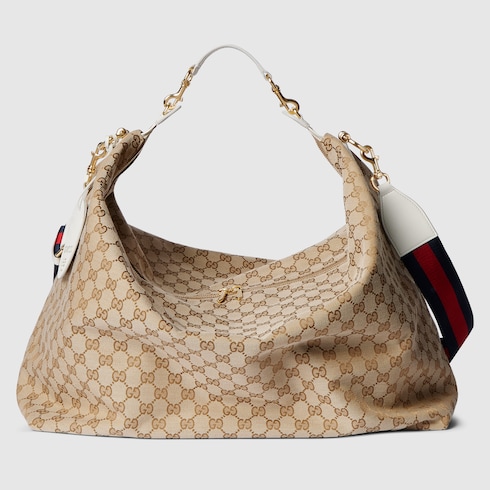
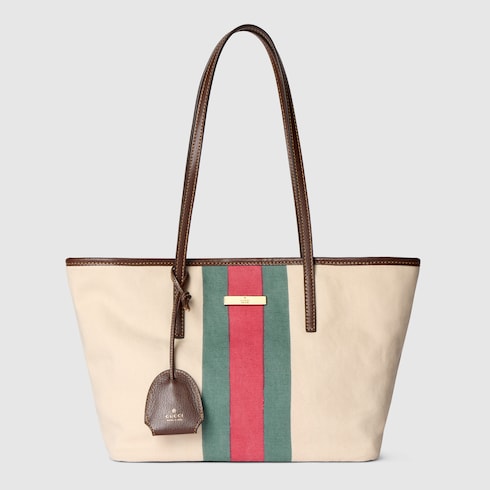
The green-red-green stripe doesn't appear on a single bag in the current Gucci lineup. Not the Jackie. Not the Horsebit. Not the Dionysus. It's there on the webbing of a canvas tote, stitched into the gusset of a duffel, woven through the handle of a weekend bag — luggage, mostly. The kind of thing you inherit rather than buy. The kind of thing that sits in the hall closet until you need to pack for a wedding in Puglia and realise it's the only piece large enough to hold three days of linen and a pair of loafers without looking like you're moving house.
That stripe used to mean Gucci before the double-G ever did. It came from the saddle girth, the band that holds the saddle to the horse, and it ran through the centre of nearly every product the house made in the Fifties and Sixties. Now it's a relic. Not discontinued — Gucci would never retire it outright — but relegated. It survives in the catalogue the way certain surnames survive in a phone book: present, traceable, no longer in active circulation.
This is what happens when a house rewrites itself as often as Gucci has. The codes don't disappear. They just stop being legible to anyone under forty.
The ones that came first
Guccio Gucci opened the Florence workshop in 1921 with one skill and one idea: leather treated the way the English treated it, sold to Italians who wanted the look without the import tax. The equestrian vocabulary wasn't borrowed for effect. It was literal. Saddles, bridles, stirrup leathers — those were the products. Bags came later, and when they did, they carried over the hardware and the stitching patterns because that's what the atelier knew how to make.
The bamboo handle on the top-handle bag — later called the Bamboo 1947, though no one used a date in the name until the archive became monetisable — wasn't a design flourish. It was a material substitution. Leather was rationed after the war. Metal, too. Bamboo grew in Japan, and Japan had trade routes that postwar Italy could still access. The handle was shaped over a flame, bent into a half-moon, lacquered to keep it from splitting. It worked. It looked good. It became a signature by accident, the way most signatures do.
The loafer arrived in 1953. Gucci didn't invent the loafer — that was American, possibly Norwegian depending on who you ask — but it put a metal snaffle bit across the vamp and turned it into something you could wear to the kind of lunch where you ordered in Italian and paid in lire. The horsebit loafer is still in production. Still leather-soled. Still comes in that particular shade of dark brown that photographs as black unless you're standing in direct sun. You can get it in other colours now — ivory, forest, a flat cherry red — but the brown is the one that matters. It's the only one that holds up under the mythology.
The era no one wants to remember
Tom Ford's Gucci is the one everyone remembers, and for good reason. He took a house that had spent the Eighties licensing its name onto keychains and beach towels and turned it into the most commercially successful runway operation in Europe. Velvet suits. Hip-slung trousers. That white dress Gwyneth wore to the Oscars in '96, cut to the sternum and held together by willpower. Ford made Gucci sexual in a way it hadn't been since the Seventies, and he did it without reaching for anything in the archive. He didn't need to. He had a point of view, and the point of view was enough.
What gets forgotten is the decade before Ford. The Eighties. The era when Gucci was still family-run, still fighting over who had the right to use the name, still putting the interlocking Gs on everything that would sit still long enough to be embossed. The logo became the product. Not an accent — the reason for purchase. You bought a Gucci wallet because it said Gucci, not because the leather was Tuscan vacchetta or the stitching was done by hand. The house survived that era, but it didn't come out clean.
Ford reset the narrative. He made the logo quiet again. Turned it into a lining detail, a clasp, a zipper pull. Let the cut and the colour do the work. When he left in 2004, Gucci had enough momentum to coast for a while, but the question was already forming: what is this house when it's not being rewritten by someone with a vision large enough to drown out the back catalogue?
What Sabato kept
Sabato De Sarno took over creative direction in January 2023. His first show landed that September, and the response was muted in the way that only a Milan response can be muted — polite applause, careful reservations, a general sense that we'd need to see the second and third collections before anyone committed to a reading. What he kept from the archive was specific. The Jackie bag, slim-bodied and curved like a crescent. The Horsebit loafer. The bamboo handle, though not on the bag you'd expect — he put it on a new structured top-handle that looked less like the 1947 and more like something you'd carry to a meeting where you needed to be taken seriously but not mistaken for a lawyer.
The stripe stayed in luggage. The double-G stayed small. What De Sarno brought forward wasn't the obvious codes. It was the proportion. Gucci in the Sixties was narrow — narrow lapels, narrow bags, narrow everything. Slim without being starved. De Sarno's first collection had that same leanness. Trousers cut close to the leg. Blazers with a soft shoulder but no volume through the body. Bags that sat under the arm instead of swinging from the shoulder. It wasn't a copy. It was a return to a silhouette the house had abandoned sometime around 1995 and never quite found again.
The question isn't whether De Sarno is referencing the archive. He is. The question is whether the market will recognise what he's referencing, or whether the reference is too quiet to register against the noise of what Gucci has been for the past twenty years.
The ones no one asks for
There's a belt. Thin — maybe two centimetres. Tan leather, stitched edge, a small brass buckle shaped like a stirrup. It sits in the accessories section of the website between the logo belts and the embellished belts, and it costs more than either because the leather is better and the construction takes longer. No one buys it. Or rather, someone buys it — the numbers wouldn't justify keeping it in production otherwise — but it doesn't move the way the double-G belt moves. It doesn't photograph the way the embellished belt photographs. It's the kind of thing you find in the closet of someone's mother and realise it's thirty years old and looks newer than the one you bought last season.
That's the code that got lost. Not the logo. Not the bag. The idea that a Gucci piece should last long enough to be passed down, and that lasting that long required a level of material and making that didn't announce itself but couldn't be faked. The house still makes those pieces. You just have to know to look for them, and most people don't. Most people are looking for the Marmont or the Dionysus or whatever bag currently holds the centre of the campaign image. Most people are looking for the thing that looks like Gucci, not the thing that is Gucci.
The difference matters less than it used to. But it's still there, in the stitching, in the weight of the buckle, in the way a thirty-year-old belt still closes without the leather pulling at the holes.