The horseshoe detail sits an inch below the top of the loafer's vamp
The horseshoe detail sits an inch below the top of the loafer's vamp. Not embossed. Not stamped. Sewn. Five stitches per side, in thread that matches the leather so exactly you'd miss it unless you knew to look. The artisan who showed me this worked in Scandicci for fourteen years before the house moved most production off-site. She said the horseshoe was there before Tom Ford, before the double-G became shorthand for a handbag you couldn't get, before Gucci meant anything to anyone outside Florence.
Most people date Gucci's codes to the Nineties revival or the Alessandro Michele era—the loafers with the fur, the Marmont with its quilted chevron, the green-red-green stripe that turned into a meme. But the house spent sixty years building a vocabulary that had nothing to do with being seen. Bamboo. Canvas with a specific diamond weave. A shade of brown they called cuoio, which isn't camel and isn't chocolate but splits the difference in a way only vegetable-tanned Tuscan leather manages. These weren't codes. They were solutions.
What they actually made first
Guccio Gucci opened the Florence atelier in 1921 with saddlery, which everyone knows, and then luggage, which makes sense if you've ever carried a leather bag on a train for eight hours. The canvas came later, during material shortages, and became the thing the house didn't plan for: a signature born of limitation. The interlocking Gs appeared in the Thirties, but not on the outside of anything. They were a lining detail, woven into the jute backing of the canvas so the fabric wouldn't separate from its structure. Functional, then visible, then logo.
The bamboo handle on the 0633 bag—now called the Bamboo 1947, because we can't leave a good name alone—wasn't about exoticism. It was about what you could source when metal was rationed. Japanese bamboo, heat-curved into a D-shape, attached with leather tabs that let the handle pivot. The bag didn't look precious. It looked like it worked. Grace Kelly carried one. So did Ingrid Bergman. Not because Gucci paid them, but because if you were getting on a plane in 1953, you wanted a bag that closed properly.
The loafer arrived in 1953, adapted from American moccasins Guccio had seen during his time at the Savoy in London. The metal snaffle bit across the vamp was the flourish, but the construction was the point: a single piece of leather for the upper, stitched to a rubber sole that actually gripped. No break-in period. No blisters. You could wear them on a yacht or to the office, which in postwar Italy wasn't a given.
The era no one references correctly
Tom Ford's Gucci gets credited with everything, which flattens what actually happened between 1994 and 2004. Yes, the velvet suits. Yes, the satin shirts unbuttoned to the sternum. Yes, the ad campaigns that made you feel like you were interrupting something. But Ford didn't invent Gucci's sensuality—he found the thread of it in the archive and pulled until the whole thing unraveled in his direction.
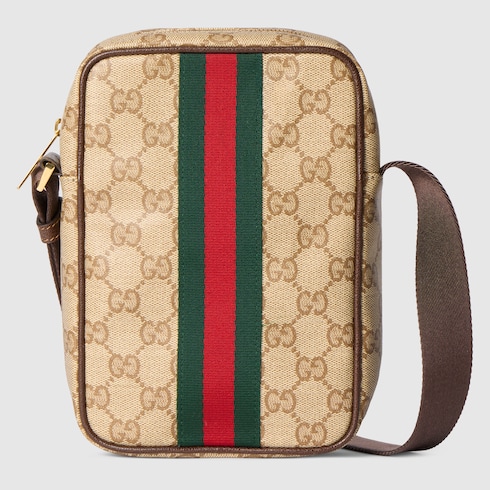
The bamboo bag came back, smaller and lacquered. The horsebit loafer got a heel and turned into the most plagiarised mule of the late Nineties. The green-red-green stripe, which had been a grosgrain ribbon detail on luggage, became a waistband, a boot shaft, a bag strap. Ford understood that Gucci's codes weren't about heritage—they were about a specific kind of European pragmatism that only looked like luxury after the fact.
What people forget is how much of that era was about fit. The suits were cut to skim, not cling. The trousers sat low but didn't gap. The bags had structure but softened with use. It wasn't about being seen in Gucci—it was about being seen, and Gucci happening to be what you were wearing. Subtle difference. Different outcome.
Frida Giannini's tenure gets dismissed as a holding pattern, which isn't fair but also isn't entirely wrong. She brought back the Jackie bag, reissued the Flora scarf, leaned into the equestrian codes until they started to feel like cosplay. The house was selling well—handbags, loafers, belts with the interlocking Gs large enough to read from across a restaurant. But the codes had become a checklist. Bamboo: check. Horsebit: check. Stripe: check. Nothing was wrong. Nothing was particularly right.
What Michele did and didn't do
Alessandro Michele's first Gucci show in 2015 looked like he'd opened the archive, shaken it upside down, and let everything land where it fell. Fur-lined loafers. Floral suits. Handbags with tiger heads. The Dionysus with its double-G clasp that wasn't the interlocking logo but a different double-G entirely, pulled from a Seventies belt buckle most people had never seen.
The press called it maximalism, which was easier than calling it what it was: a deliberate misreading of the house's own codes. Michele wasn't interested in the bamboo bag as an icon—he was interested in why it had become one, and whether you could route around that conclusion entirely. The loafer stayed, but it got a backless mule construction, embroidery, a two-inch platform. The stripe stayed, but it moved to unexpected places: the side of a sneaker, the collar of a coat, a webbing strap on a backpack.
What Michele understood—and what made his Gucci feel both chaotic and oddly rigorous—was that codes are only useful if you're willing to ignore them occasionally. The Marmont bag, which became the house's best-seller under his tenure, wasn't in the archive. The chevron quilting was new. The double-G clasp was new. But it felt like Gucci because it referenced the way Gucci used to work: a hardware detail that did something, a shape that made sense against the body, leather that would burnish with handling.
He also brought back things no one had asked for. The Jackie got a bamboo top handle. The Horsebit 1955 returned in its original proportions, with the metal clasp centred on the flap and nothing else competing for attention. These weren't reissues—they were admissions that some of the house's best ideas had been sitting in plain sight the entire time.
Where the house is now, quietly
Sabato De Sarno's Gucci is still forming, which makes it hard to assess and easy to underestimate. The first collection felt like someone had opened all the windows in a room that had been closed for eight years. Clean lines. Softer colours. The Blondie bag with a rounded, pillow-like shape and the interlocking Gs rendered in a brushed metal that didn't catch the light aggressively. The loafers came back in their 1953 proportions. The rosso ancora red—a shade somewhere between burgundy and rust—appeared on everything, not as an accent but as a base.
What's missing is the noise. The runway doesn't feel like an event you're lucky to witness. The campaigns don't look like they're trying to seduce you in a language you don't speak. It's Gucci at a lower register, which might be the riskiest thing the house has attempted in thirty years. The codes are there—bamboo, horsebit, the stripe—but they're set back in the composition, supporting rather than leading.
The Ancora tote, introduced last season, has a bamboo handle that curves less dramatically than the 1947 version. The leather is matte vacchetta, unlined, with a single interior pocket and no logo on the outside. It doesn't look like a Gucci bag until you see the handle, and even then it doesn't announce itself. It just works. You can carry it to a meeting, to the market, onto a train. It won't soften the way the Cassette does—vacchetta ages differently—but it won't look wrong in five years.
The loafers still have the horseshoe stitching below the vamp. Still five stitches per side. Still in thread that matches the leather. The artisan in Scandicci told me that detail almost got cut three times over the years—too small, too expensive, not visible enough to justify the labour. It stayed because someone kept saying no. Not because it was a code. Because it was correct.