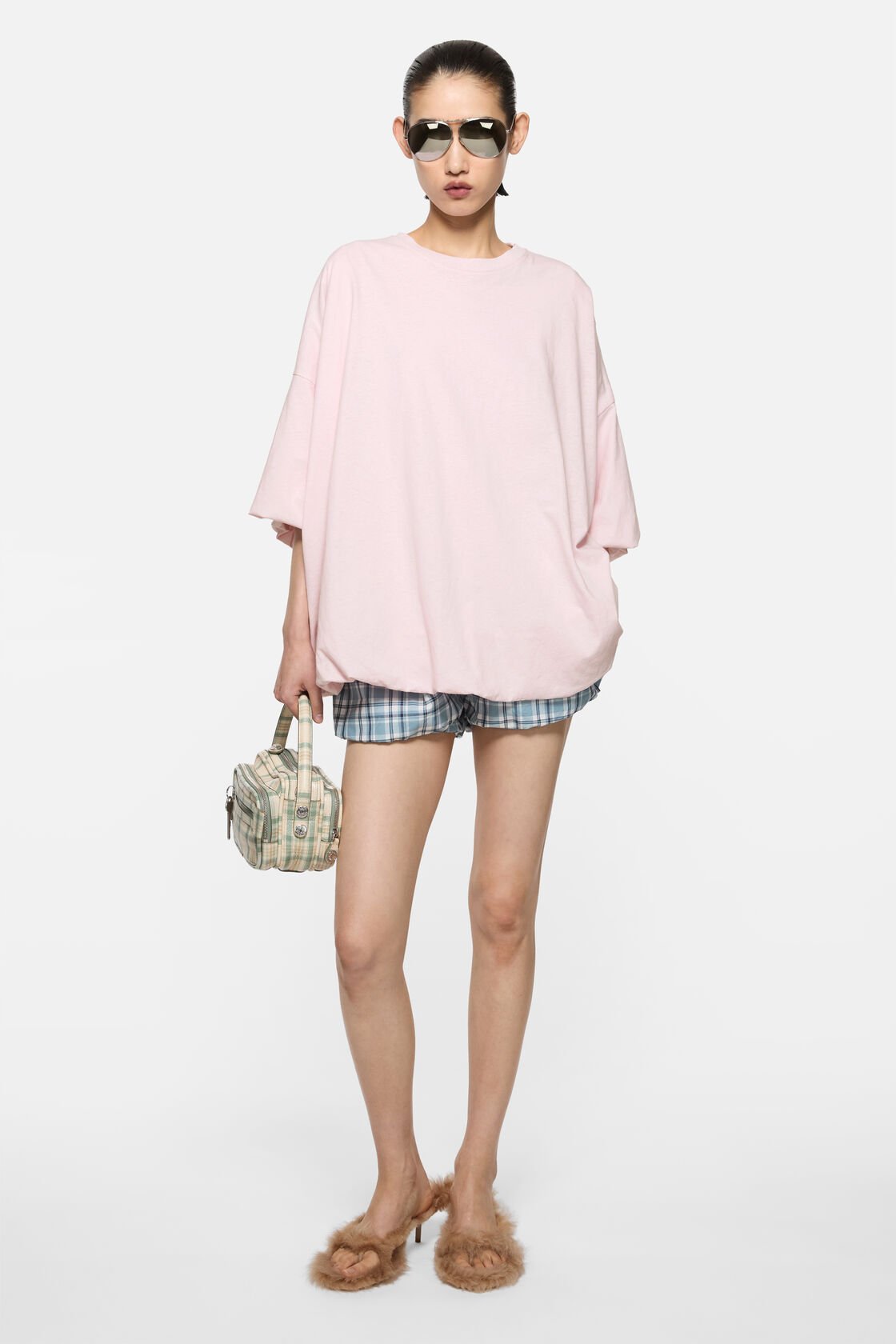
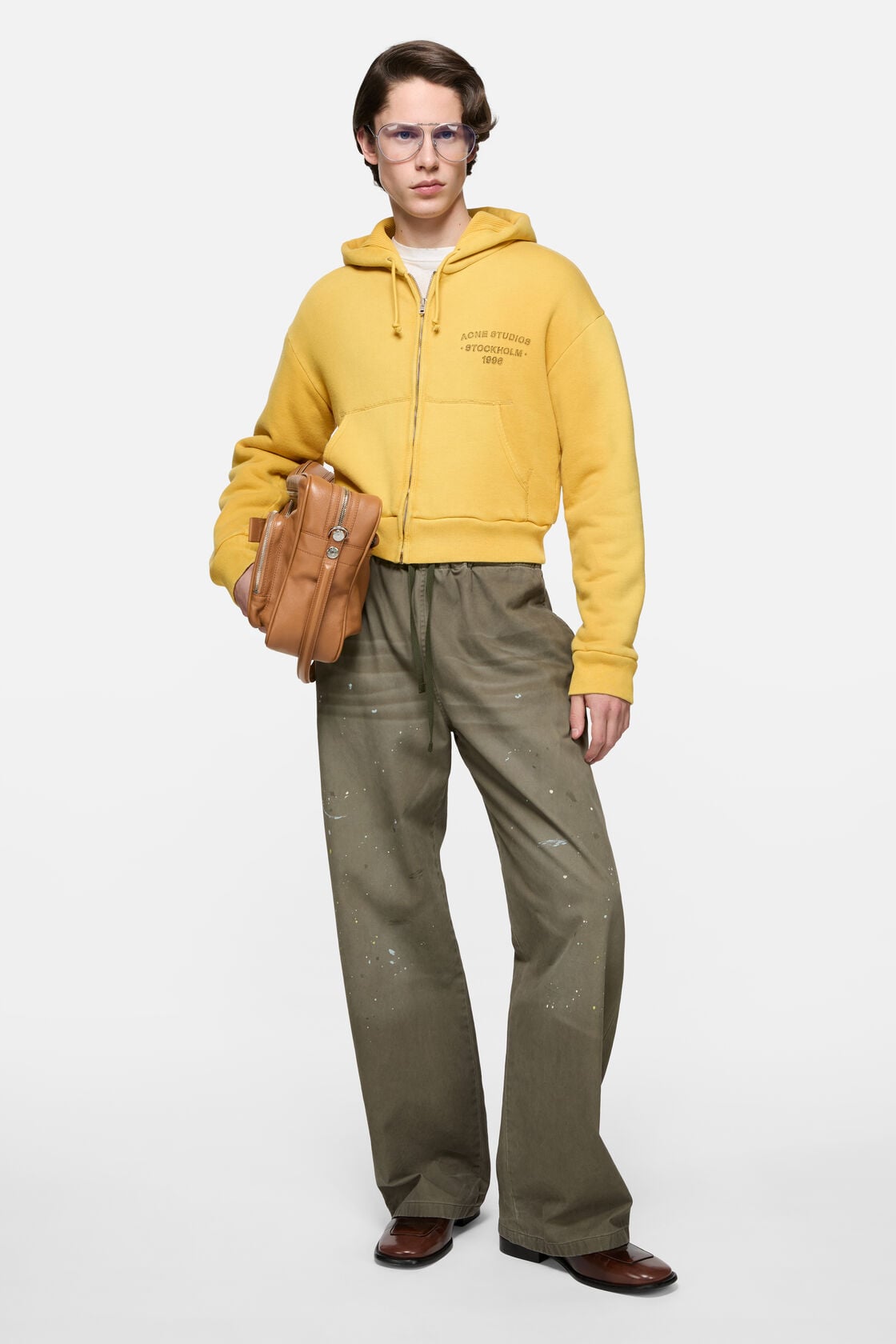
The Musubi bag sits on the counter like a soft leather knot someone tied and forgot to tighten
The Musubi bag sits on the counter like a soft leather knot someone tied and forgot to tighten. It doesn't look engineered. It looks like someone gathered supple calf into a bundle, looped it once, and called it done. That's the trick — Acne Studios has spent two decades making deliberate design look like it just happened.
If you're circling the brand for the first time, you're probably doing it because someone you trust wore something quietly strange. A scarf that's longer than it should be. A coat with sleeves that pool at the wrist. Boots that manage to look both minimal and faintly absurd. Acne doesn't announce itself the way Bottega or Loewe does. It sits one register quieter, and that's the point.
Fondation et identité
Acne Studios began in 1996 in Stockholm, founded by Jonny Johansson and three partners as part of a creative collective. The name is an acronym — Ambition to Create Novel Expressions — which sounds better in hindsight than it probably did at the time. The first product was a run of a hundred pairs of raw denim jeans with red stitching, given to friends and industry contacts. The jeans worked. People asked where to buy them. A brand followed.
What set Acne apart early wasn't a single signature but a sensibility: cerebral without being austere, wearable without being safe. Johansson, who remains creative director, came from art school, not fashion school, and the house has always carried that slight distance from industry convention. Collections reference film stills, avant-garde theatre, Swedish functionalism, and then land as a grey wool coat you'd actually wear in February.
By the mid-2000s, Acne had moved past denim into full ready-to-wear. The aesthetic cohered around a few principles: oversized tailoring, unexpected colour (rust, powder blue, washed-out coral), and a studied awkwardness in proportion. Sleeves ran long. Trousers pooled. Scarves trailed past the knee. It looked like borrowed clothes that fit better than your own.
L'ère qui définit
The years between 2010 and 2016 are when Acne became what people now think of as Acne. The studios expanded. The brand opened flagships in Paris, New York, and Tokyo. The runway shows — staged in Paris — began to draw the kind of attention that translates into waiting lists.
This is also when the house developed its vocabulary of recurring pieces: the Canada scarf, a wool blanket with fringed ends and an oversize Acne Studios label stitched on like a badge. The Jensen boot, a Chelsea with an exaggerated sole and a blunt, almost childlike toe. The Velocite leather jacket, a biker silhouette softened into something closer to outerwear than armour. These weren't one-season wonders. They stayed in the line, year after year, accruing the kind of familiarity that makes them feel like fundamentals.
The Canada scarf deserves its own paragraph. It costs around €230 and does nothing a wool scarf shouldn't do, except it does it longer and louder. The label sits at chest height when you wear it, a branding move so obvious it loops back into charm. It's also warm, which matters more than people admit when they're deciding whether to spend that much on a scarf. You see it on the street in Stockholm, Paris, and New York in roughly equal measure. It's become shorthand for a certain kind of taste — not minimal, not maximal, just specific.
Direction actuelle
Johansson is still at the helm, which is rarer than it should be. Most founders either sell and step back or sell and get replaced. Acne sold a majority stake to IDG Capital in 2015, but Johansson stayed on as creative director and the aesthetic hasn't lurched. The collections still feel like his — slightly off, slightly art-directed, never quite where you expect them to land.
Recent seasons have leaned into colour and texture more than the early-2010s greyscale. You'll see quilted nylon in acid yellow, shearling-lined coats in rust, and knitwear in shades that don't have easy names. The silhouettes remain loose, but there's more play now — cropped trousers with exaggerated pockets, oversized shirts with contrast stitching, denim treated to look sun-faded before it leaves the atelier.
The accessories have sharpened, too. The Musubi bag launched in 2018 and quickly became the house's most recognisable leather good. It's named after a Japanese knot used in obi ties, and the shape is exactly that: gathered, looped, soft. It comes in three sizes and a rotating cast of leathers — smooth calf, grained, suede, occasionally patent. Prices start around €1,100 and climb to €1,600 depending on size and material. It doesn't have the woven signature of Bottega or the hardware of Loewe, but it photographs well and sits comfortably under the arm, which is more than enough.
Ce qu'il faut savoir avant d'acheter
If you're entering Acne for the first time, start with the recurring pieces. The Canada scarf, the Jensen boot, the Velocite jacket — these have stayed in the line because they work. They're not seasonal bets. They're house codes that happen to be wearable.
Sizing runs large, especially in outerwear and knitwear. The house likes volume, and that's baked into the patterns. If you're between sizes, go down. If you prefer a closer fit, go down twice and expect it to still read as oversized. The runway looks are styled loose; the retail floor will try to sell you your usual size. Trust your instincts.
Fabrics tend to be good — not exceptional, but reliably solid. Wool coats hold their shape. Leather jackets soften without sagging. Denim fades the way raw denim should, slowly and with character. The knitwear pills less than you'd expect at this price point, though it's not immune. You're paying for design and cut more than for hand-finished details or heritage mills, and that's fine as long as you know it going in.
Prices sit in the contemporary-to-accessible-luxury range. A cotton poplin shirt runs around €250. Trousers land between €300 and €450. Outerwear starts at €800 for a wool coat and climbs past €2,000 for shearling or leather. Bags range from €650 for small leather goods to €1,600 for the larger Musubi. It's not entry-level, but it's not Celine either. You're paying for a specific point of view, not for a logo that does the work for you.
The house does sales, twice a year, and the discounts are real — 30 to 50 per cent, sometimes deeper on past-season colours. If you're patient and your size is common, you can wait. If you're after a core piece in black or grey, it'll sell through before it hits markdown.
Où elle se tient maintenant
Acne sits in an odd position. It's too established to feel like a discovery, but it's not quite a household name outside of fashion-adjacent circles. It doesn't have the handbag-driven recognition of Bottega or the logo leverage of Balenciaga. What it has is a consistent aesthetic and a loyal customer base that buys across categories — denim, outerwear, knitwear, bags, boots — because the pieces work together without trying too hard.
The brand isn't chasing virality. It doesn't drop capsules with streetwear collaborators or court influencers in any obvious way. The runway shows are attended, the pieces are photographed, and the clothes end up in wardrobes where they stay for years. It's a slower burn, and in an industry that rewards noise, that's either a weakness or a strength depending on what you value.
If you're looking for an entry point, go to a store. Acne photographs well, but it's better in person — the weight of the wool, the hand of the leather, the way an oversized sleeve changes the line of your shoulder. Try the Canada scarf in charcoal or rust. Try the Jensen boot in black leather. Try a Musubi in smooth calf and see if the knot sits where your hand expects it to. If it does, you've found your way in. If it doesn't, that's fine too. Not every house is for everyone, and Acne has never pretended otherwise.