The raw-denim jean that launched Acne Studios in 1996 had no rear pockets
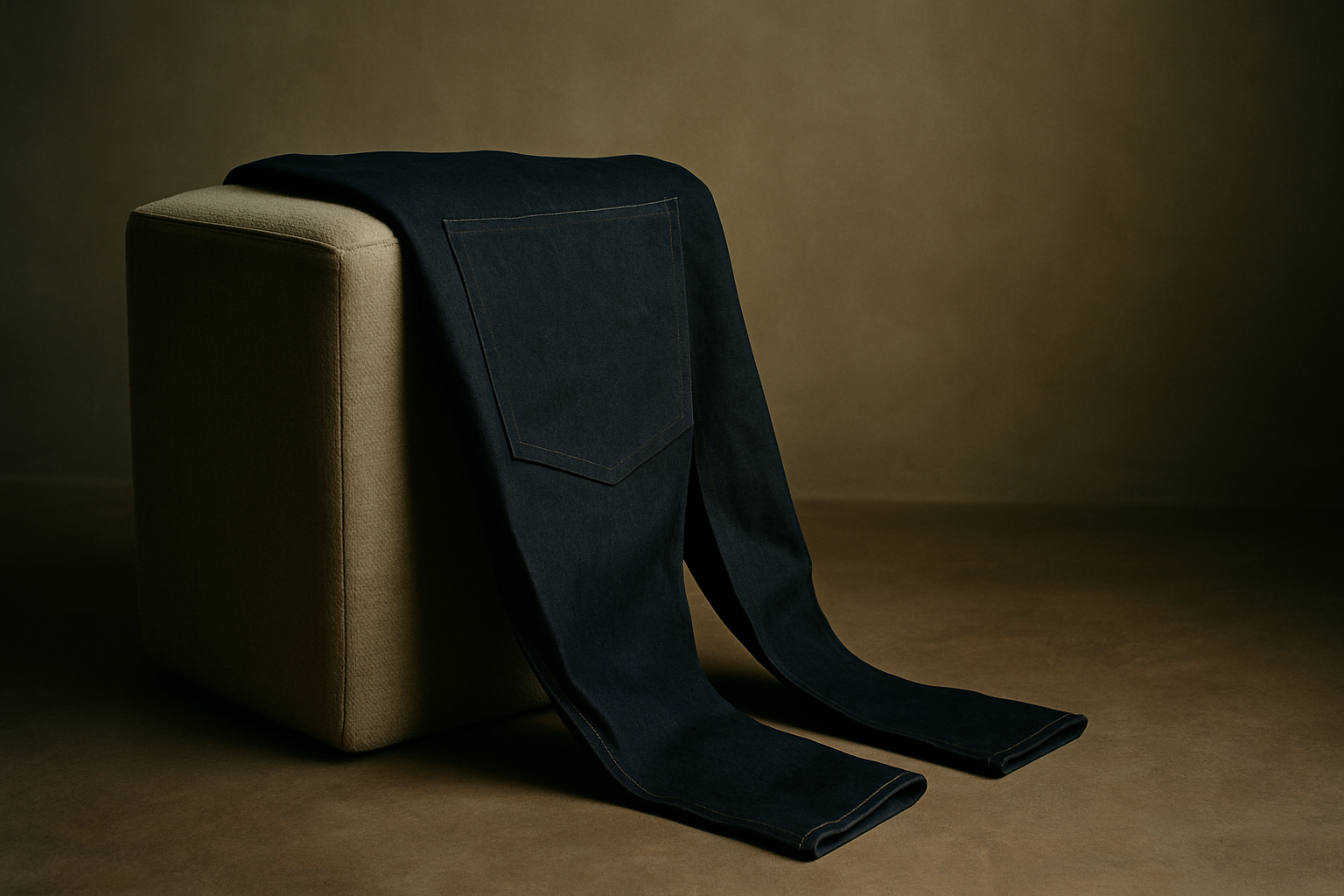
The raw-denim jean that launched Acne Studios in 1996 had no rear pockets. This was not an oversight. Jonny Johansson, then a creative director at a Stockholm ad agency, had sewn a hundred pairs for friends — straight-leg, unfinished hem, the shade of indigo that darkens with wear rather than fades. The absence of pockets forced a silhouette: clean, almost sculptural, resolutely not workwear. Within two years, those jeans had moved from gift to product, and the collective that made them — Ambition to Create Novel Expression, the acronym parsed later — had become a fashion house.
That origin story, repeated often enough to calcify into myth, nevertheless holds. Acne Studios did not begin with a collection or a manifesto. It began with a single garment, made in multiples, distributed through a network that predated Instagram but operated on similar principles: word of mouth, proximity, the notion that a good thing, worn by the right people, will find its own momentum.
I. Collective to Maison (1996–2005)
The early years resist tidy narrative. Acne operated as a creative studio — hence the name — with fashion as one output among several. Johansson and his partners produced magazines, directed films, designed furniture. The jeans were a product, but also a calling card. By 1998, the house had added T-shirts and knitwear; by 2000, a full ready-to-wear line. The aesthetic, if one can call it that in those years, leaned towards reduction: muted tones, oversized proportions, an aversion to ornament that felt more pragmatic than theoretical.
What distinguished Acne Studios from the Scandinavian minimalism that preceded it — the Jil Sander disciples, the Belgian avant-garde's Nordic cousins — was a certain looseness. Seams sat slightly off-grain. Sleeves extended past the wrist. The house showed in Paris from 2006 onwards, but the collections retained a studio quality: garments that looked as though they had been made, worn, and remade in the same afternoon. Johansson, who remains creative director to this day, has described his process as iterative rather than visionary. He works from a wardrobe, not a mood board.
The house's first flagship, opened in Stockholm in 2003, occupied a former bank. The interior, stripped to concrete and steel, became a template. Acne Studios stores would not feel like boutiques. They would feel like rooms where something else had happened before fashion arrived.
II. The Pink-Scarf Era and the Democratisation of Codes (2010–2016)
If the raw-denim jean announced Acne Studios, the Bansy scarf — a wool rectangle in a shade the house called 'powder pink', though the colour skewed closer to blush — made it legible to a wider audience. Introduced in 2010, the scarf became the kind of object that accrues meaning through repetition. It appeared on fashion editors, art students, the assistants who staffed gallery openings in Berlin and Copenhagen. It was not, strictly speaking, novel. But it was specific. The fringe was long. The fabric had weight. And the pink, crucially, was neither sweet nor ironic. It simply was.
This period, roughly 2010 to 2016, saw Acne Studios consolidate what had been instinctive into something resembling a system. The palette expanded but remained tethered to a core: grey, camel, navy, that particular pink. Outerwear grew more considered — the Velocite leather jacket, with its clean zip and absence of hardware, became another signature. Denim remained central, though the house now offered five or six cuts, each named with a Nordic matter-of-factness: Ace, Max, River. The jeans still had no rear pockets.
Johansson's approach to tailoring during these years avoided the extremes that defined much of menswear at the time. Suits were neither slim nor voluminous. They sat somewhere in between, cut with a slight ease through the chest and a trouser that broke once at the shoe. The effect was anti-heroic. One wore an Acne Studios suit not to command a room but to move through it without friction.
The maison also began to develop a secondary language, less visible but no less deliberate: the emoticon logo, screen-printed on T-shirts and later applied to sneakers, handbags, scarves. The mark — a naïve rendering of a face, eyes and mouth reduced to punctuation — registered as both playful and oddly melancholic. It did not announce luxury. It announced membership.
By 2014, Acne Studios had stores in eighteen cities. The house had become, in the language of the trade, a contemporary brand — a term that suggests scale without the baggage of heritage, accessibility without the taint of fast fashion. But the collections themselves resisted that flattening. Johansson continued to show in Paris, continued to work from a vocabulary of reduction and ease, continued to design as though the house were still operating out of a studio in Östermalm.
III. Expansion, Acquisition, and the Question of Identity (2017–Present)
In 2017, the Canadian fund Investor AB took a minority stake in Acne Studios, valuing the house at roughly half a billion euros. The transaction occasioned the usual anxieties: would the collections dilute, would the stores proliferate beyond reason, would Johansson remain at the helm. Seven years on, the answers are mixed.
The house has expanded, certainly. New categories — eyewear, fragrance, a collaboration with Mulberry on leather goods — suggest a push towards the kind of total wardrobe that contemporary fashion demands. The store count has grown, though not recklessly. And Johansson, now in his third decade at Acne Studios, continues to design the collections himself, without the apparatus of a large design team. He works, as he has always worked, from instinct rather than data.
What has shifted, perhaps, is the context around the house. The aesthetic codes that Acne Studios helped establish — oversized silhouettes, muted palettes, the marriage of streetwear ease and tailored structure — have become, if not ubiquitous, then certainly familiar. The house no longer feels like a secret. It feels like a reference point. And that shift, from insider knowledge to common language, carries its own set of challenges.
Recent collections have tested the boundaries of that language. Spring 2023 introduced a brighter palette: acid yellow, cobalt, a red that read as vermillion rather than crimson. The silhouettes loosened further, with trousers pooling at the ankle and shirting cut so wide it approached the poncho. Whether this represents evolution or course correction remains to be seen. Johansson himself has said little on the matter, preferring to let the garments speak.
The house's Paris showroom, relocated in 2022 to a nineteenth-century hôtel particulier near the Place Vendôme, offers a useful metaphor. The space retains Acne Studios' signature austerity — concrete floors, minimal furnishings, industrial lighting — but the architecture underneath is Haussmannian, all cornices and ceiling height. The tension between those two registers, the raw and the refined, feels deliberate. It also feels unresolved.
Coda
On a recent visit to the Stockholm flagship, I watched a young woman try on the Velocite jacket in black leather. She zipped it, unzipped it, turned to examine the back in the mirror. The jacket, now in its fourteenth year of production, has changed little since its introduction: the same clean front, the same absence of epaulettes or belt, the same leather that will crease and soften with wear. She bought it. As she left, the sales assistant folded the jacket into a pale-pink shopping bag, the house logo screen-printed in black. The bag, like the jean before it, had no extraneous detail. Just a handle, a base, and a mark that said, quietly, what it needed to say.