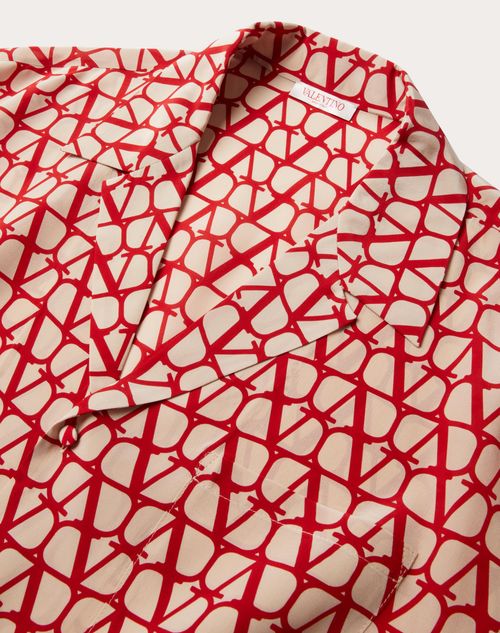
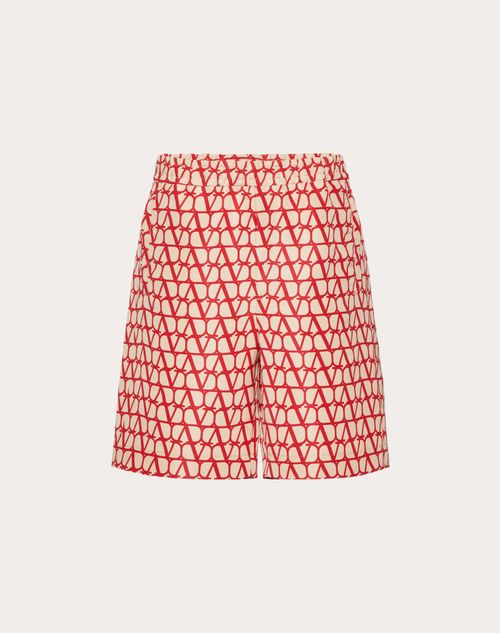
The red is registered
The red is registered. Pantone 18-1662 TPX. Valentino calls it Rosso Valentino, and the house has used it since 1959, when Valentino Garavani opened his atelier on via Condotti. The shade is darker than you expect — closer to arterial than poppy — and it appears on gowns, on boxes, on the carpet rolled out before each runway. You see it once and you remember it, which is the point of colour as signature.
If you are beginning with Valentino, you are beginning with a house that built its reputation on evening. The maison dressed Jacqueline Kennedy, Elizabeth Taylor, Audrey Hepburn. Garavani retired in 2008, but the archive he left behind is vast and specific: bows at the back, tulle worked into sculptural volume, embroidery that took months. That legacy is still visible, but the house has moved.
What Valentino was
Valentino Garavani and his business partner Giancarlo Giammetti founded the house in Rome. The first atelier sat above a café. Within a decade, Valentino was dressing women whose names appeared in newspapers, and by the 1980s the house had become synonymous with a particular kind of grandeur — gowns that required help to put on, jewel tones, ceremony. The white collection he showed in 1968 is still cited. So is the retrospective held at the Ara Pacis in 2007, forty-five years of work displayed in a building constructed for Augustus.
The house changed hands several times after Garavani's departure. Maria Grazia Chiuri and Pierpaolo Piccioli were named co-creative directors in 2008. When Chiuri left for Dior in 2016, Piccioli continued alone. His tenure redefined what Valentino could be. He kept the craft but opened the silhouette. The palette shifted. He introduced Valentino Pink — a shade between fuchsia and magenta that appeared in a fall 2022 collection shown entirely in that colour. Sixty-two looks, all variations on one tone. The collection was called Le Rose, and it moved through the room like an argument.
Piccioli also brought in collaborators from outside fashion. He worked with Jun Takahashi of Undercover, with the artist Tavares Strachan, with piercing artist Maria Tash. The runway became a place where evening and streetwear shared the same language. Hoodies appeared next to duchesse satin. Sneakers were shown with tulle. The Rockstud — a pyramid stud applied to shoes, bags, and ready-to-wear — became the house's most recognisable motif, louder than the red.
Piccioli left Valentino in March 2024. Alessandro Michele, formerly of Gucci, was named creative director two months later. His first collection for the house showed in September 2024. The language shifted again.
What Valentino is now
Michele's Valentino is dense. The fall 2024 collection included 85 looks. Lace over trousers. Brocade mixed with denim. Proportions that read as borrowed — oversized blazers, skirts that pooled at the ankle. The palette was darker than Piccioli's, heavier on burgundy and forest green. Michele kept the craft but turned down the volume on colour. He brought back a kind of ornamentation that had been absent — brooches, layered necklaces, embroidered collars. The silhouette felt less architectural, more accumulated.
This is a house in transition. The handbags and shoes you see now were designed under Piccioli. The ready-to-wear in boutiques still carries his handwriting. Michele's work will arrive in full by mid-2025. That means if you are shopping Valentino today, you are shopping two creative visions at once.
Where to begin
Start with accessories. Valentino's entry point has been the Rockstud since the line launched in 2010. The stud is functional — it holds the strap to the upper — but it reads as decorative. The most accessible version is the Rockstud flat, a pointed-toe ballerina with studs along the topline and a small strap across the vamp. Retail is approximately €850. The pump, slightly higher at €950, is the shape the house is known for: pointed toe, 100mm heel, studs tracing the edge.
The Rockstud bag exists in several formats. The smallest, the Rockstud Spike crossbody, starts around €1 400. The quilted leather is soft, the chain strap adjustable. The Rockstud Alcove, a top-handle shape introduced under Piccioli, sits closer to €3 200. Both are recognisable without logos. The studs do the work.
If your budget allows for ready-to-wear, consider the VLOGO belt. It retails for approximately €450 and works over tailoring, over knits, over the waist of a dress. The buckle is large but not cartoonish. The leather is smooth calfskin, available in black, tan, and seasonal colours.
For clothing, the entry is higher. A Valentino knit starts around €1 200. Dresses begin near €2 500. Eveningwear — the category the house was built on — can exceed €10 000 for pieces with embroidery or complex construction. This is not unusual for a maison at this level, but it does mean that Valentino positions itself above contemporary labels and alongside Dior, Chanel, Saint Laurent.
What to know before you buy
Valentino is not quiet. Even the pieces without studs carry a formality that reads clearly in a room. The tailoring has structure. The evening pieces require consideration — where you will wear them, how you will store them, whether your life has space for that level of finish. If you are drawn to the house, you are likely drawn to that.
The resale market for Valentino is active but specific. Rockstud shoes and bags hold value, particularly in neutral colours. Limited editions and collaboration pieces — like the Undercover Rockstuds or the Valentino Garavani archive re-editions — perform well. Ready-to-wear is less predictable. Piccioli's statement pieces, especially from collections like Le Rose, have collector interest, but everyday separates move more slowly.
Sizing runs European. Shoes tend to fit true to length but narrow through the vamp, especially in pointed styles. If you are between sizes or have a wider foot, size up. Ready-to-wear is cut for a European frame — longer in the torso, narrower through the shoulder. The house offers alterations at flagship boutiques, and most pieces benefit from tailoring.
Valentino's boutiques are in major cities: Paris, Milan, Tokyo, New York, London. The via Condotti flagship in Rome remains open. The house also operates an e-commerce platform with global shipping. Returns are accepted within thirty days, unworn and with tags attached. Sale periods happen twice a year, typically in January and July, with reductions between 30 and 50 percent.
What remains
The archive is still there. The house maintains an atelier in Rome and another in Milan. The haute couture line, Valentino Haute Couture, continues to show in Paris each January and July, by appointment only. These are not clothes you buy off a floor. They are made to measure, require multiple fittings, and can take six months to complete. Prices begin in the five figures.
But the archive is not the only thing that remains. The red is still in use. Michele showed it in his first collection — not as a flood, but as an accent. A coat lining. A ribbon at the neck. The Rockstud, too, persists, though it is quieter now, less central to the narrative. The house is deciding what it wants to keep and what it is willing to let go.
Valentino's first show was held in the Sala Bianca of Palazzo Pitti in Florence, in 1962. Garavani was thirty years old. He showed white organdie dresses with bows at the back, and the Italian press called him a successor to the great couturiers. That vocabulary — successor, legacy, inheritance — still follows the house. Michele is working within it, but he is also working against it. The question is not whether Valentino will survive the transition. The question is what shape it takes on the other side.
The red remains. The rest is still being written.