The safety pin dress doesn't exist in the archive anymore — not in the way you think it does
The safety pin dress doesn't exist in the archive anymore — not in the way you think it does. What lives in the Kensington Palace collection is a black column held together by oversized gold hardware, worn once by Elizabeth Hurley in 1994, photographed a thousand times since. What doesn't live anywhere is the idea that Versace was ever about restraint. The pin dress worked because it looked like it might fall apart. That was the point.
If you're starting with Versace now, thirty years past that premiere and five years into a Capri Holdings structure, you're not starting with the same house. You're starting with a name that still carries weight in airport duty-free, still appears on enough red carpets to justify the Instagram spend, and still makes a certain kind of bag that moves through resale at a pace the brand probably doesn't love to discuss. That's not a dismissal. It's context.
What the house was built on
Gianni Versace opened his atelier in 1978 with a vision that married Calabrian maximalism and Milanese technique in a way Milan hadn't seen before. The silhouettes were Grecian, the prints were Baroque, the metalwork was pure southern Italy. He worked in gold mesh, in safety pins as closures, in a colour palette that didn't apologise for itself. The Medusa head — lifted from the ruins of Reggio Calabria — became the house symbol in 1980, and it meant exactly what it looked like: beauty that could paralyse you if you stared too long.
By the nineties, Versace had built an entire aesthetic language around visible wealth. Not old money — visible money. The kind supermodels wore down runways synchronised to George Michael. Versace didn't dress in whispers. If you wanted a black column, you went elsewhere. If you wanted a black column held together with hardware that could double as a weapon, you came here.
Gianni was killed in 1997. Donatella, his younger sister, took over creative direction. The house continued, but the centre of gravity shifted. What had been operatic became editorial. The prints stayed, the gold stayed, but something in the proportion changed. By the time Capri Holdings acquired Versace in 2018 for over two billion USD, the question wasn't whether the house would survive — it was what, exactly, was left to preserve.
Where the creative direction stands now
Donatella is still there, still signing off on every collection, still appearing in the campaign imagery with the kind of frequency that signals both control and brand shorthand. She understands what Versace is supposed to look like, and she delivers it: body-conscious knits, archival Barocco prints reworked for the current market, plenty of gold hardware, and an aesthetic that reads as Versace from across a room.
The question isn't whether she knows the codes. The question is whether the codes still have the teeth they used to. Recent collections have leaned into logomania in a way that feels reactive — not to the house's own history, but to what's moving on resale platforms. The Virtus bag, launched in 2021, carries an oversized Medusa plaque that doubles as a turn-lock. It's recognisable. It photographs well. It's also designed with an eye toward the customer who wants the logo to do the talking, because the shape itself won't.
That's not unique to Versace. Half the European houses are doing the same math. But it does mean that if you're coming to Versace now, you're coming to a house that's learned to work within the constraints of a holding company's growth targets. The atelier is still in Milan. The leather is still Italian. But the strategy is American.
What to buy if you're starting here
Start with small leather goods if you want to test the house without the commitment. The Medusa coin purse runs around €295 and gives you the hardware, the logo, and enough of the house language to know whether it works on you. The zip-around wallet in grained calfskin sits at €495 and holds up better than the embossed styles — the Barocco print, while iconic, doesn't wear as gracefully once the top layer starts to lift.
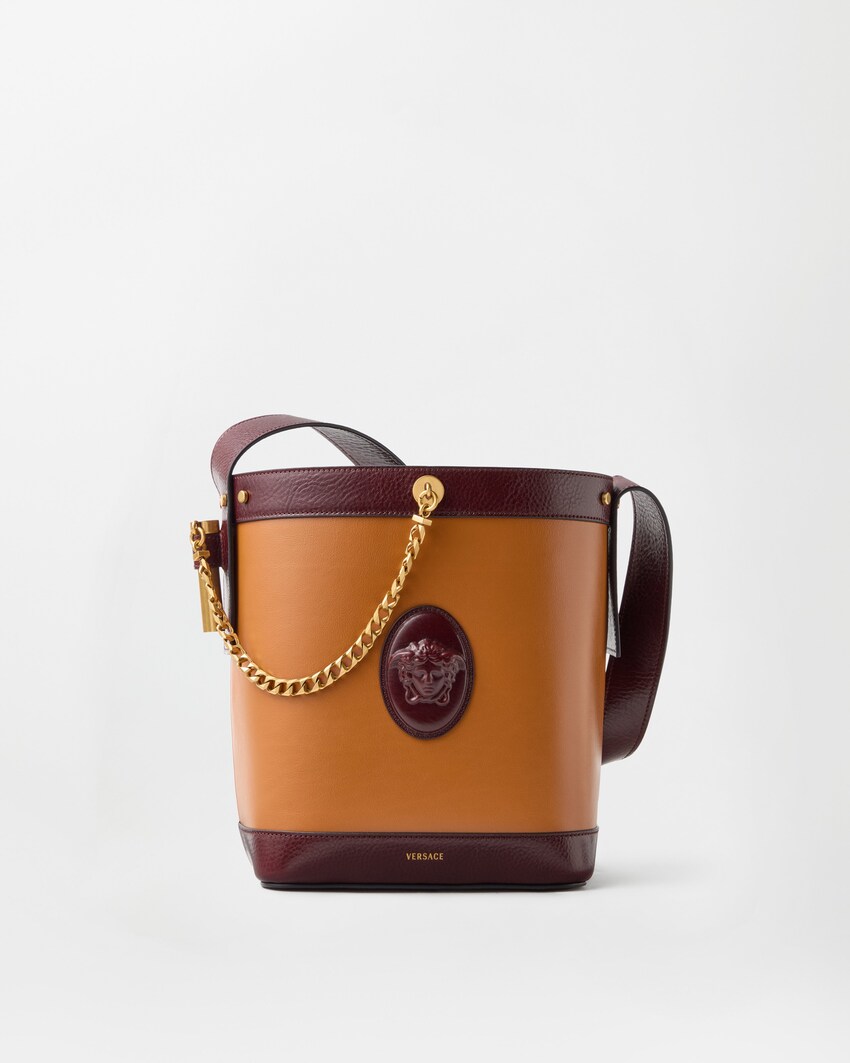
If you're looking at bags, the La Medusa is the most approachable entry point. It's a small shoulder bag with a chain strap and a centred Medusa emblem, priced around €1.450 in smooth leather. The size works for evening or as a day bag if you travel light. The chain is removable, which matters more than it sounds like it should — Versace hardware is heavy, and after four hours on your shoulder, you'll want the option to carry it as a clutch.
The Virtus tote is the house's play for the structured bag customer. It's stiff grained leather, dual top handles, and that oversized Medusa clasp. Starts at €2.100 for the medium size. It holds a laptop, it stands upright on a desk, and it looks like Versace even when you're carrying it logo-side in. That's the appeal. It's also the limitation — this is a bag that announces itself, and if you're not interested in that kind of declaration, it won't work for you.
The Greca Goddess bag is softer, more draped, with the Greek key motif running along the top edge. It's quieter than the Virtus, which is relative — we're still talking about a house that embroiders its logo into the lining. Pricing starts around €1.850 for the small hobo style. The leather is supple enough that the bag will begin to slouch after a season, which some people want and some people don't. Know which you are before you buy it.
Avoid the logo-printed canvas styles unless you're committed to that specific look. They're priced within a hundred euros of the leather versions, they don't age as well, and the resale value drops faster. Versace's strength has always been in material and construction — when the house leans away from that and into branding as the primary sell, you're paying for the name twice.
What you're actually buying into
Versace isn't a quiet house, and it's not trying to be. If you're drawn to the Medusa, to the gold, to the print-heavy aesthetic, you're buying into a very specific vision of luxury — one that's rooted in spectacle, in visible craft, in a kind of Mediterranean excess that doesn't translate to every wardrobe. That's fine. Not every house needs to translate to every wardrobe.
But you should know that the house you're buying into now is not the house Gianni built, and it's not quite the house Donatella ran in the early 2000s either. It's a house that's learned to operate within the logic of accessible luxury, which means broader distribution, more licensed products, and a design strategy that skews toward what's already proven to move. The atelier work is still there — the tailoring, the draping, the way a Versace gown fits through the body — but that's not what you're accessing at the entry level. At the entry level, you're accessing the logo, the hardware, and the suggestion of what the house used to be.
That's not a failure. It's just a different proposition. If you go in understanding that, you'll know what to look for and what to skip. Start with leather. Start small. And if the Medusa doesn't feel like yours after six months, don't force it. Versace works best when it's worn with the kind of certainty Gianni built into it from the beginning — when the clothes, or the bag, or the wallet feel like an extension of something you already believed about yourself.
The safety pin dress worked because Hurley wore it like she might take it off at any moment and still walk out of the room unbothered. That's the test. If the piece makes you feel like that, buy it. If it doesn't, there are forty other houses in Milan who'd be happy to dress you instead.