The safety pin dress lives behind glass now, but it still does what it was meant to do in 1994: stop you mid-step
The safety pin dress lives behind glass now, but it still does what it was meant to do in 1994: stop you mid-step. Not because it's shocking anymore — we've had thirty years to metabolise the sight of gold hardware holding black silk against a body — but because it remains the clearest articulation of what Versace has always proposed. Not subtlety. Not whisper. The idea that a garment can be architecture, armour, and announcement all at once.
If you're starting with Versace, you're starting with that proposition. The house doesn't do quiet entry points.
What you're buying into
Gianni Versace opened his atelier in 1978 with a vision that ran counter to the cerebral minimalism gathering force in Milan. He wanted Roman excess, Grecian line, and a kind of unrepentant sexiness that read as vulgar to some and revelatory to others. The Medusa head — lifted from the ruins of Reggio Calabria, a town forty kilometres from where Gianni grew up — became the house crest not because it was elegant but because it paralysed. That was the point. You look, you stop, you can't look away.
The codes built quickly: Baroque prints that looked like they'd been peeled off a Sicilian chapel ceiling. Gold Greca trim running down hems and hardware. Cuts that assumed the body wearing them had nothing to apologise for. By the early Nineties, the house had a roster — Naomi, Christy, Linda, Cindy — and a vocabulary. If Armani was selling power through restraint, Versace was selling power through volume.
Gianni's murder in 1997 didn't end the house, but it reoriented it. Donatella, his younger sister, took over creative direction and spent the next two decades holding the line between what the archive demanded and what the market would bear. She kept the Medusa, kept the gold, kept the body-con silhouettes, but the house softened in places. Or maybe the world caught up. By 2018, when Capri Holdings acquired Versace for $2.12 billion, the question wasn't whether Donatella could sustain the vision — she had — but whether the business model could scale beyond the top five per cent of the luxury market.
The answer, so far, has been partial. Versace still operates as a high-visibility, high-price house with ambitions toward accessible luxury that it hasn't quite reconciled. You'll find sneakers at $695 and T-shirts at $450, but the bags that define a season still land north of $2,000. It's not entry-level in the way Longchamp is entry-level. It's entry-level in the way a first Chanel bag used to be: a considered purchase, probably saved for.
Where to start, and what it costs
The Virtus line is the most coherent starting point if you want a bag. Launched in 2019, it's Versace's answer to the structured top-handle that every heritage house now fields. The silhouette is boxy, the leather is calf, and the hardware — a oversized Medusa medallion centred on the flap — does all the talking. The small tote runs around €1,950. The camera bag, which works as a crossbody, sits closer to €1,400. Neither will ghost into your wardrobe. That's not what they're for.
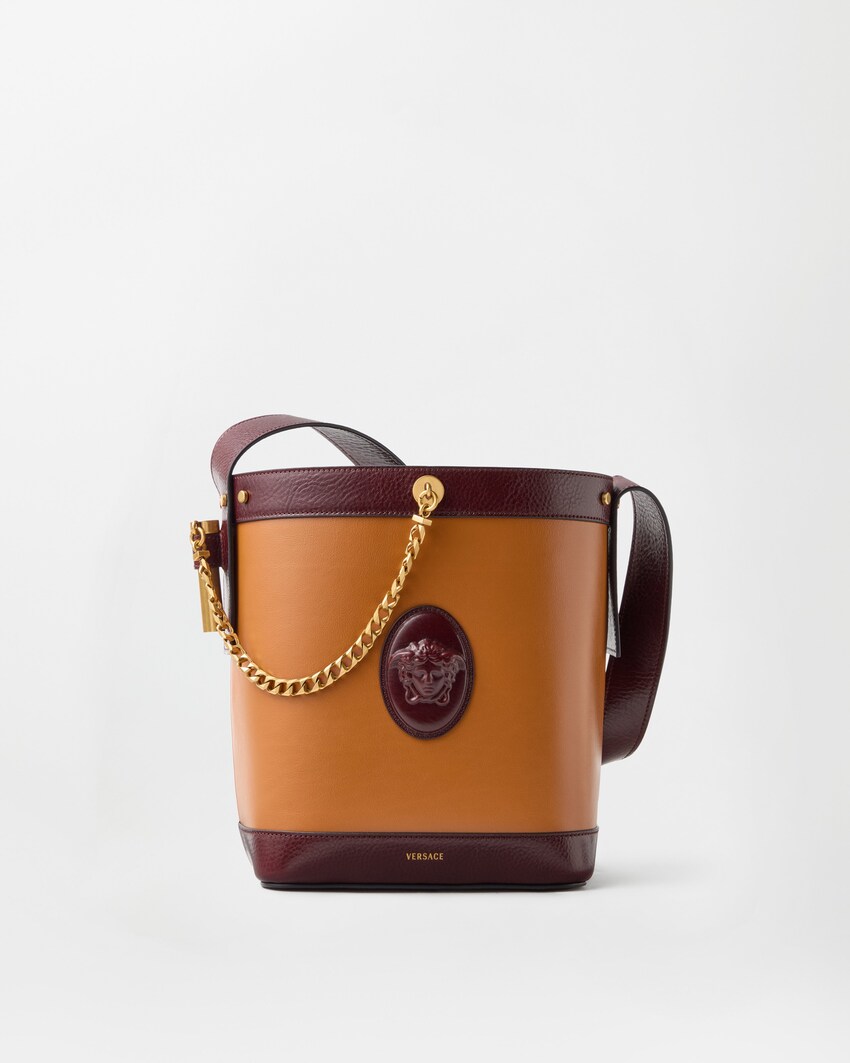
If Virtus feels too declarative, the La Medusa line pulls back slightly. Same icon, softer application. The small shoulder bag in grainy leather comes in at about €1,100, and the chain strap is fine enough that it doesn't clank when you move. You'll still get stopped on the street, but the stopping will feel like recognition rather than interrogation.
Shoes are where the house makes the most accessible play, though 'accessible' is doing heavy lifting here. The Trigreca sneaker — a chunky-sole runner with Greca detailing along the upper — retails for around €750. It's not subtle, but it's wearable in a way the platform Medusa Aevitas pump (€1,250, five-inch heel, not for the faint) is not. The Medusa '95 loafer, a newer style that landed in 2022, runs about €850 and reads as the closest thing Versace makes to a neutral. Black calf, gold hardware at the vamp, a silhouette you could wear to a contract signing or a dinner where you don't want to be the story.
Silk is the other vertical worth knowing. Versace still prints its scarves in Como, and a 90cm square will cost you around €350. The prints tend toward maximum: Baroque florals, trompe-l'œil chains, Medusa heads tessellated into near-abstract patterns. They don't layer quietly under a trench. They replace the trench as the focal point.
Ready-to-wear is harder to parse as a beginner, mostly because the price-to-wearability ratio skews aggressively toward occasion. A Barocco-print silk shirt runs €1,200. A tailored blazer with contrast Greca piping starts at €2,400. The jersey dresses — body-conscious, often asymmetric, frequently equipped with hardware at the shoulder or hip — range from €1,800 to €3,500 depending on how much metal is involved. You can wear these to work if your work is being photographed, but they're not office pieces in the conventional sense.
What you're not getting
Versace doesn't do quiet luxury. If that's the aesthetic you're after — the Loro Piana cashmere, the Hermès Kelly in étoupe, the Jil Sander coat that whispers rather than shouts — this isn't your house. Donatella has never pretended otherwise. In a 2021 interview, she said the goal was never to make clothes that disappear. The goal was to make clothes that announce. You buy Versace because you want to be seen buying Versace.
That has implications for versatility. A Medusa-stamped belt bag is not going to fade into a capsule wardrobe. A Barocco-print bomber is not going to pair neutrally with five other things you own. The house rewards commitment. If you're the kind of buyer who wants one statement piece that plays well with everything else, you'll find options — the black Virtus tote, the Medusa loafer — but you'll also be working against the grain of what the house wants to be.
The other thing you're not getting is understatement in construction. Versace's leather goods are well-made — Italian production, solid hardware, linings that won't shred in six months — but they're not in the same weight class as Bottega's intrecciato or Hermès' hand-stitched saddle work. The focus is on surface: the print, the hardware, the immediate read. A Virtus bag will hold up, but it won't develop the same kind of patina a Bottega Cabat will. It's not designed to. It's designed to look the way it looks now, five years from now.
Where the house is now
Donatella turned 68 this year and shows no sign of stepping back. The Spring 2024 collection leaned hard into the archive — safety pins reappeared on dresses, the Greca trim ran down everything from skirts to swimwear, and the finale look was a gold chainmail gown that could have walked straight out of 1997. It wasn't nostalgia, exactly. It was Donatella making the case that the codes still work, that the Medusa still stops you, that Versace doesn't need to soften to stay relevant.
The market seems to agree, selectively. Versace's handbag category has grown, particularly in Asia, where the Virtus and La Medusa lines read as status markers in a way they don't quite in Europe yet. The sneakers move. The silk prints move. Ready-to-wear remains the hardest sell, partly because the house is competing with itself — if you can get the logo and the Medusa on a bag for €1,400, why spend €2,800 on a dress that requires a specific occasion and a specific confidence to pull off?
The answer, when it works, is that the dress does something the bag can't. It builds a silhouette. It changes the way you hold your spine. It makes you the kind of person who wears a gold chainmail gown to a dinner where everyone else wore black crêpe. Versace has always been for that person, or for the person who wants to become that person for an evening.
How to think about it
If you're buying your first Versace piece, you're not buying into a system the way you would with Hermès or The Row. You're buying a statement. The question is whether you have somewhere to make it. A Virtus tote works if your life includes events where a Medusa-stamped bag reads as appropriate rather than excessive. A Barocco-print shirt works if you're comfortable being the most-dressed person in the room, or if your room is already full of people who dress that way.
The house doesn't reward timidity. It rewards conviction. The clients who look best in Versace are the ones who understand that the clothes are louder than they are, and have made peace with that. You're not trying to let the garment speak for you. You're letting it speak with you, at the same volume.
That's a specific skill. It's also a specific pleasure. There's a reason the safety pin dress still gets referenced, still gets reproduced, still appears on red carpets thirty years later. It proposed that a woman could be architecture. That she could be armour. That she could stop you mid-step, and that stopping you was not an accident but the entire point.
You walk into Versace knowing that. Or you learn it the first time you slip on a Medusa-stamped heel and realise the room has turned to look. The house has never been subtle about what it offers. The only question is whether you're ready to accept it.