The thing you notice first in the Gucci archive isn't the red and green webbing
The thing you notice first in the Gucci archive isn't the red and green webbing. It's the bamboo handles, yes, but also the way the leather on a 1957 top-handle has gone soft at the corners where a thumb pressed in over decades. The patina isn't romantic. It's evidence of use. And use, for most of Gucci's first forty years, meant something specific: a bag built to move through airports, train stations, the kind of travel that required both hands and a certain degree of pragmatism.
We've spent the last decade talking about Gucci in terms of maximalism, of irony, of the logo as protagonist. Fine. But before Alessandro Michele turned the house into a cabinet of wonders, and before Tom Ford made sex a product category, Gucci was a Florentine leather goods workshop that understood one thing cleanly: how to make an object that could survive being checked, carried, forgotten in the overhead bin, and still look considered.
The codes we remember are the loud ones. The ones we've forgotten are the ones that actually built the house.
The bamboo, before it became a bag
Bamboo entered the Gucci vocabulary in 1947 not as a design flourish but as a material solution. Post-war leather was rationed, hardware was scarce, and Guccio Gucci's sons were trying to keep the atelier running on whatever they could source. Bamboo grew in Italy. It could be heat-treated, bent, and fixed to a leather frame without metal rivets.
The result was the 0633, a top-handle bag with a curved bamboo grip that looked, at the time, like nothing else in the market. It wasn't precious. It was practical. The bag moved through the Fifties on the arms of women who flew Pan Am, who kept a second home in Portofino, who understood that a good bag was one you didn't have to think about.
By the Sixties, the bamboo handle had become signature, but it hadn't yet become logo. It was a recognisable detail, the way a specific weight of calf or a particular shade of burgundy can be recognisable. You didn't carry it to announce anything. You carried it because it worked.
The loafer that wasn't trying
The Gucci loafer entered production in 1953, and it entered as a men's shoe. Soft construction, a metal horsebit across the vamp, no laces. It was designed for the kind of man who spent August in Forte dei Marmi and didn't want to bend down.
What's easy to miss now is how unadorned the first iterations were. The leather was supple, the silhouette was clean, and the horsebit sat flat against the instep without any of the bulk that would come later. It was a slipper that could pass in town. The women who started wearing it in the early Sixties—borrowed from brothers, from husbands—understood that immediately.
The loafer became unisex not because Gucci marketed it that way, but because the design didn't insist on gender. It just sat on the foot and worked. By the Seventies, it had been adopted by a specific slice of the American East Coast—prep schools, summer houses, the kind of wealth that didn't announce itself. The horsebit was there, but it wasn't loud. It was just enough.
That balance—just enough—is what Gucci used to do well, and what the house has spent the last twenty years either overcompensating for or trying to recover.
The red and green, before it became shorthand
The webbing came from the saddle girth. Literal equestrian kit, repurposed as a decorative stripe on luggage in the early Fifties. Red, green, red. It appeared on the sides of weekend bags, on the straps of duffels, as a trim detail that referenced the house's roots in saddlery without making a production of it.
For a long time, it stayed there—trim. A detail. It wasn't until the Seventies, when Gucci started licensing everything from scarves to eyewear to playing cards, that the webbing became a logo in its own right. By then, the house had opened stores in New York, London, Tokyo. The stripe became a way to mark territory.
But in its first iteration, the webbing was just a nod. A way of saying: we know where we came from, and we're not pretending otherwise. It was the kind of gesture that works when a house is confident enough not to shout.
What Michele kept, what Sabato took
When Alessandro Michele arrived in 2015, he didn't discard the archive. He turned it inside out. The loafer came back, but with a shearling lining and an embroidered bee. The bamboo handle returned, but on a structured shoulder bag covered in floral jacquard. The codes were there, but they'd been pushed through a filter of excess that made them unrecognisable as the quiet, pragmatic objects they'd once been.
It worked. Gucci became the fastest-growing luxury house in the world, and Michele's magpie eclecticism felt, for a few years, like the only interesting thing happening in Milan. But it also meant that the codes themselves—the bamboo, the horsebit, the webbing—became decorative rather than structural. They were references, not foundations.
Sabato De Sarno, who took over in 2023, has tried to pull the house back toward restraint. His first collection was full of soft tailoring, matte leather, loafers in cognac and black with no embellishment beyond the horsebit itself. The bamboo bag returned in a smaller, cleaner silhouette. The webbing appeared as a discreet stripe on a belt, not as an all-over print.
The critical response was mixed. The commercial response is still being written. But what De Sarno understood—what he had to understand—is that Gucci's actual codes, the ones that built the house, were never about more. They were about enough.
The shoulder bag nobody talks about
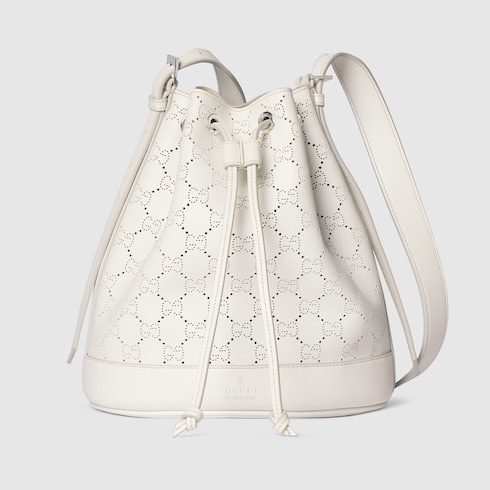
There's a bag in the current collection that doesn't have a name. It's a soft, unstructured shoulder bag in vacchetta leather with a single bamboo detail at the closure. No logo, no webbing, no hardware beyond a slim turn-lock. It sits under the arm in a way that feels studied but not stiff.
It's the kind of bag that would have made sense in 1968, and it makes sense now, and that gap—between then and now—is where Gucci is trying to live. Not in the archive as museum, not in the archive as costume, but in the archive as a set of principles that can still do work.
The bag costs €2.400. It will soften at the corners where your hand grips it. In five years, it will look like yours. That's not a pitch. That's just what the leather does.