The white lab coat hangs in the archive
The white lab coat hangs in the archive. No name on the label. No face in the photograph. Just the garment itself, cotton twill with a mandarin collar, worn by everyone who worked in the atelier from 1988 onward. Anonymity was not a gimmick. It was structure.
Maison Margiela built a language before it built a brand. The house opened in 1988 with a spring collection shown in a Parisian playground, models walking on gravel in Tabi boots split at the toe. Martin Margiela had left Gaultier's studio the year before. He brought no logo, no face, no interview policy. What he brought was a method: deconstruction as a physical act. Seams turned outward. Linings exposed. Garments that revealed their own making.
The early collections worked like demonstrations. A jacket constructed from a vintage scarf, its print interrupted by new seams. A sweater knit to the exact proportions of a men's dress shirt, collar and cuffs intact but translated into wool. The Tabi boot, adapted from a fifteenth-century Japanese work shoe, reappeared each season in new materials—leather, canvas, patent, denim. Repetition was the point. So was rigour.
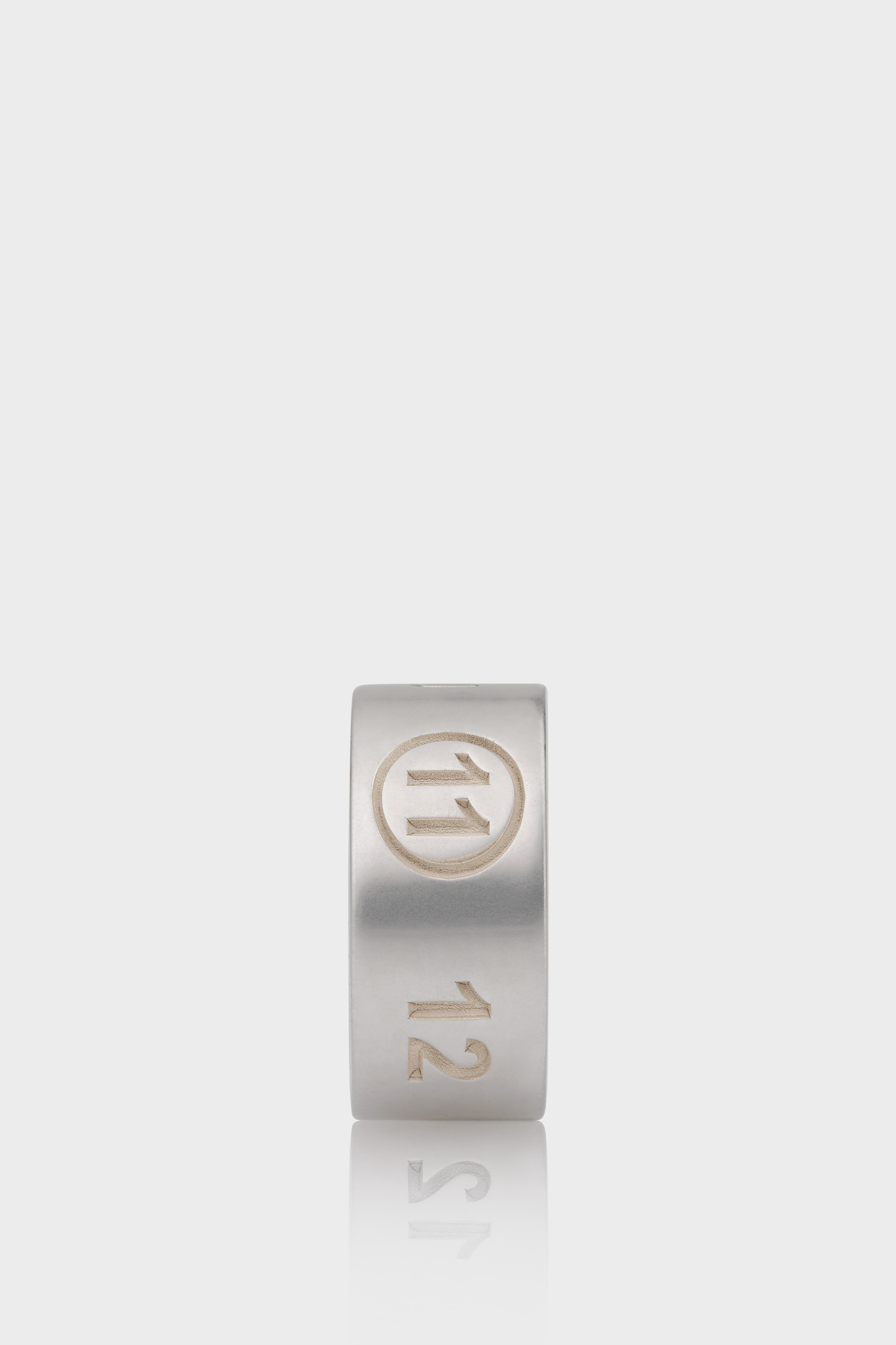
By 1997, the house had established its core codes. Four stitches at the back of each garment, white thread on white cloth, marking every piece without announcing it. Numerical labels from 0 to 23, each representing a line: 1 for women's, 10 for men's, 0 for Artisanal, 11 for accessories. No seasonal names. No designer portraits. The press received faxes on plain paper. Margiela himself did not appear for bows.
This was not minimalism. The work was dense, referential, often confrontational. A dress made entirely from broken plates, ceramic shards held together with metal rings. Garments dyed with mould and bacteria, hung in damp rooms to grow their own patina. The Replica line, launched in 1994, reproduced found vintage pieces with forensic precision—a 1950s sailor shirt, a 1970s work jacket—each tagged with a photograph of the original and the date it was discovered. The house was building an argument about authorship, about time, about what a garment could carry beyond its first wearing.
The Diesel years and the departure
In 2002, the house joined Diesel's Only the Brave group. The infrastructure changed. The method did not. Margiela continued to refuse interviews, continued to send collections without a named designer. But the scale shifted. Retail expanded. Collaborations began—first with H&M in 2012, a capsule that sold out in hours and introduced the house's vocabulary to a wider audience.
Margiela himself left in 2009. The house did not announce his departure until 2010. For a year, the atelier continued without him, guided by the same team that had worked under his direction. When the news finally came, it arrived in the house's typical manner: a brief statement, no drama, no retrospective. The work would continue. The codes would remain.
The collections between 2009 and 2014 held steady. The team, many of whom had been with Margiela since the beginning, maintained the same vocabulary. Tabi boots. Oversized proportions. Deconstructed tailoring. The Artisanal line continued its one-of-a-kind pieces, garments that required 40 or 60 hours of handwork. But something was missing. Not quality—the hand was still there. But the provocation had softened. The house was speaking its own language fluently, but it had stopped asking new questions.
Galliano arrives
John Galliano's appointment in 2014 was not an obvious choice. He came from Dior, from haute spectacle, from collections built on narrative and excess. Margiela had built a house on refusal. The tension was the point.
Galliano did not try to erase what came before. His first collection for the house, shown in January 2015, opened with the Artisanal codes intact: garments constructed from vintage pieces, raw edges, exposed seams. But he pushed the scale. A coat made from 40 deconstructed military jackets, its shoulders built up in layers. A dress composed entirely of leather glove fragments, each finger articulated. The silhouette was new—more volume, more drama—but the technique was legible. He was working within the house's grammar, not against it.
The Tabi remained. So did the numerical system, the white stitches, the refusal to appear for bows. Galliano gave interviews, but sparingly, and often spoke of the maison in the third person. He described himself as a guest in someone else's house. The humility felt genuine.
What he brought was a different relationship to the body. Margiela's work had often abstracted the figure, used oversized proportions to create space between cloth and skin. Galliano brought the garment back to the body's contours, then exaggerated them. Hips built out with padding. Waists cinched and released. Faces obscured with sheer knit balaclavas or veils made from deconstructed stockings. The Artisanal collections became sites of transformation, models unrecognisable beneath layers of cloth and prosthetic.
His co-ed shows, starting in 2018, collapsed the house's gendered lines. A man in a deconstructed ballgown. A woman in oversized tailoring with the shoulder line dropped to mid-bicep. The Replica line continued, but Galliano began sourcing from different eras—1920s undergarments, 1940s military surplus—and mixing them with the house's existing archive. A Tabi boot with a 1950s stiletto heel. A trench coat with its sleeves replaced by vintage scarf silk.
The house now
Maison Margiela does not operate like other houses. There is no creative director title on the website. Galliano is listed as the creative lead, but the team structure remains collective. The atelier still wears white coats. The faxes have been replaced by emails, but the tone is the same: factual, minimal, no adjectives.
The Tabi is now 35 years old. It appears each season in new forms—this year, a thigh-high version in cracked leather, a flat in recycled denim—but the split toe is unchanged. The Replica line has expanded to include fragrances, each one named for a memory: Jazz Club, By the Fireplace, Lazy Sunday Morning. The scents are literal, almost too literal, which is consistent with the house's approach. No metaphor. Just the thing itself.
Galliano's most recent Artisanal collection, shown in January 2024, included a dress made from deconstructed umbrellas, the metal ribs forming a new structure around the body. A coat constructed from 60 pairs of vintage jeans, each waistband visible. The technique is Margiela's. The scale is Galliano's. The result is something that could only come from this house, at this moment, with this accumulated history.
The question is not whether the house has remained true to its origins. The question is whether origins are fixed. Margiela built a system designed to outlast him. Galliano has tested that system, pushed it, occasionally broken it. The white stitches remain. So does the refusal of easy answers.
In the Paris flagship on rue de Marignan, the walls are painted white. The floorboards are stripped. The garments hang on metal rails with no decoration, no signage, nothing to distract from the cloth itself. In the back room, there is a table where the atelier works on Artisanal pieces. Sometimes you can see them through the doorway: hands moving over fabric, constructing something that will be worn once, photographed, and archived. The work continues. The lab coats are still white.