The white lab coat hangs in the archive room in Paris, sleeves still carrying the ghost of movement
The white lab coat hangs in the archive room in Paris, sleeves still carrying the ghost of movement. No name on the label. Just four white stitches at the back of the neck, hand-sewn, exposed. This garment could be from 1988 or from last Tuesday. That refusal to date itself remains the house's signature, even as everything around it has changed.
Maison Margiela was founded in 1988 by Martin Margiela and Jenny Meirens. The first collection showed in a children's playground in the twentieth arrondissement. Models walked on cracked asphalt. The clothes were deconstructed in the literal sense—seams exposed, linings visible, shoulder pads worn on the outside. This was not deconstruction as metaphor. It was garment construction shown in reverse, like an anatomy lesson conducted on a living body.
The house operated under a set of principles that became doctrine. No interviews. No photographs of the designer. Press releases signed by the collective, never an individual. The Tabi boot with its split toe, adapted from the Japanese worker's sock. The four white stitches on a blank cloth label. Garments made from other garments—a waistcoat assembled from vintage gloves, a dress constructed from broken plates held together with leather straps. Artisanal collection pieces shown alongside reproductions, both given equal weight. Runway shows staged in derelict Metro stations, vacant lots, supermarkets.
Margiela himself left in 2009. The house continued under a design team for five years, still anonymous, still signing everything collectively. Then in 2014, John Galliano arrived.
The Galliano Era
Galliano's appointment was a provocation. He came from Dior, from maximalism, from shows that were costume dramas staged as fashion. Maison Margiela had built itself on refusal—refusal of personality, refusal of spectacle, refusal of the designer as auteur. Galliano was the auteur par excellence.
What he did was unexpected. He stayed anonymous. No backstage bows, no interviews that centred his narrative. He worked within the house codes—the Tabi, the blank label, the exposed seam—but he bent them. The artisanal collections became Kabuki theatre rendered in fabric. A coat made entirely of wooden Tabi lasts. A dress constructed from shattered porcelain doll heads. Garments that seemed to be disintegrating in real time, hems unraveling as the model walked.
The ready-to-wear shifted too. Galliano introduced a new silhouette: the Snatched. Waists pulled in with corsetry worn over tailoring, creating an exaggerated hourglass that read as both historical and alien. He brought back the body after years of Margiela's deliberate absence of body. But he did it through distortion, not through display.
By 2017, Maison Margiela was showing at the Palais Garnier during haute couture week, though the house has never held official couture status. The collections were selling. The Tabi became streetwear, worn with denim and photographed outside the shows. Replica sneakers, reproductions of German army trainers from the 1970s, moved in volume. The house opened new flagships—New York, London, Seoul.
The Numbers and the Image
Maison Margiela is owned by OTB Group, the Italian holding company that also controls Diesel, Viktor & Rolf, and Jil Sander. OTB does not break out financials by brand, but analysts estimate Margiela's annual revenue between 250 million and 300 million euros. That puts it well behind Balenciaga or Bottega Veneta, houses of comparable age and aesthetic influence. But it represents consistent growth. The house was reportedly near 180 million euros when Galliano arrived.
The growth comes from two sources. First, the Tabi. The split-toe boot now exists in 40 iterations—leather, suede, patent, mesh, satin, denim. Heel heights from flat to 11 centimetres. Price points from €595 for a canvas ballet flat to €1,890 for a thigh-high leather boot. The Tabi accounts for an estimated 15 to 20 percent of total revenue. It is the house's Dionysus, its Antigona, its one object that sustains the whole edifice.
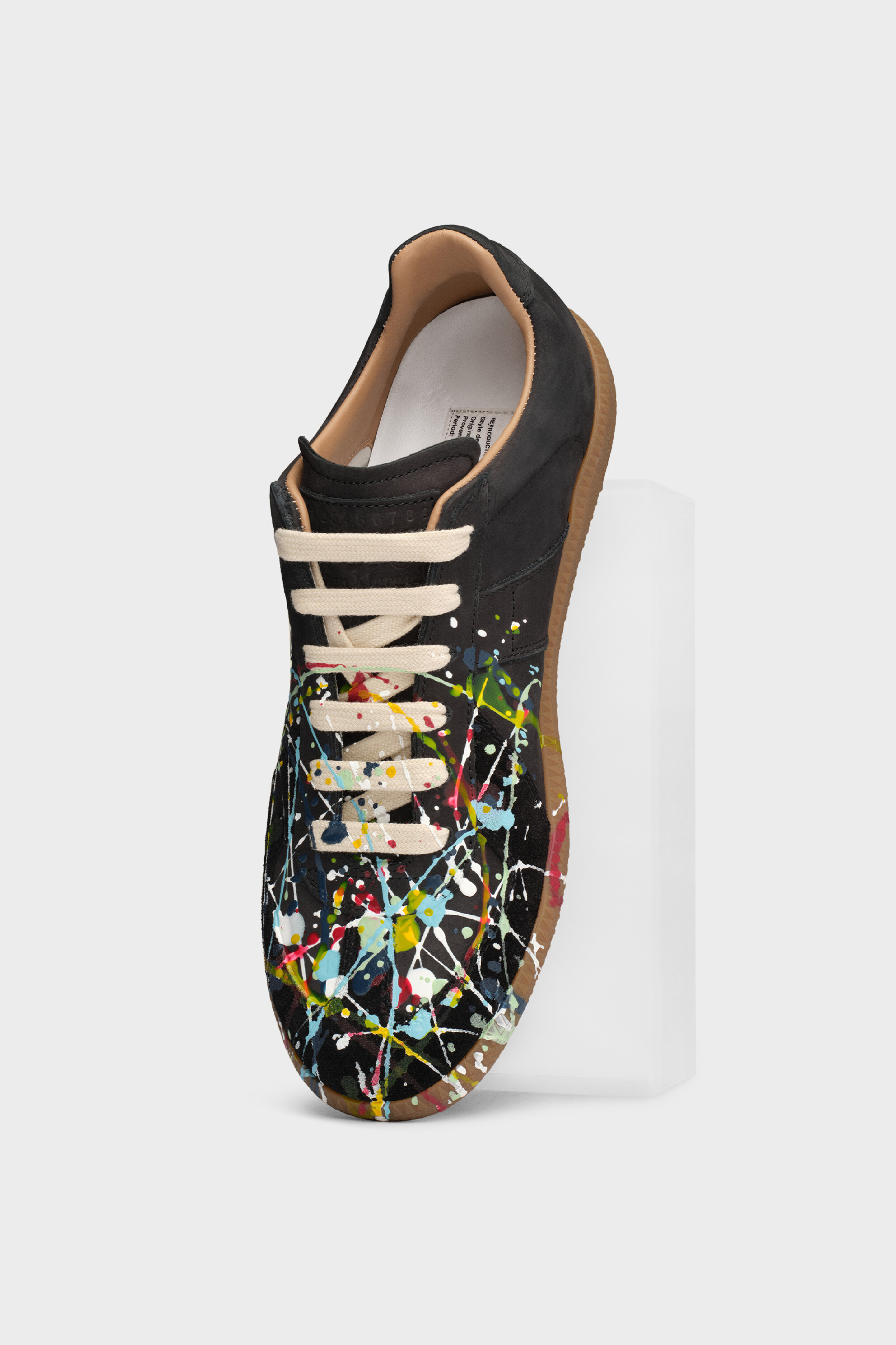
Second, the Replica line. These are reproductions of found garments—a 1950s jazz shoe, a 1970s German trainer, a 1980s paint-splattered sneaker. They retail between €350 and €495. They are accessible Margiela, entry-level in price but not in concept. The idea of the reproduction, the copy as original, remains philosophically aligned with the house's founding principles. And they sell.
The runway collections—the shattered porcelain, the wooden Tabi coat—do not sell in quantity. They are not meant to. They function as image, as provocation, as the reason the fashion press still covers every show. Galliano has kept Margiela relevant in an industry that cycles through references faster than it cycles through creative directors. He has done it by making collections that photograph as art, that circulate as meme and metaphor, while the cash registers ring up Tabis and Replicas.
Where the House Stands
Maison Margiela occupies an unusual position now. It is a cult brand that operates at scale. It is anonymous but fronted by one of fashion's most famous designers. It is conceptual but commercially stable. These are contradictions, but they are productive contradictions.
The house's influence is visible everywhere. The exposed seam, once a Margiela signature, is now standard design vocabulary. The Tabi toe has been copied by Acne, by Marni, by Zara. The idea of the reproduction, the archival reissue, the found object as luxury good—these are industry norms now, but Margiela was doing them in 1991.
What the house has lost is the element of refusal. Early Margiela said no to almost everything the fashion industry offered—celebrity, personality, newness, the idea of the season. Galliano's Margiela says yes, but in a distorted voice. Yes to the runway spectacular, but staged as anonymous ritual. Yes to the designer as auteur, but hidden behind the collective. Yes to commercial product, but framed as philosophical gesture.
This is not a criticism. It is an observation about what survival requires. A house cannot remain oppositional for 35 years and still exist as a functioning business. The question is whether the philosophy survives the compromise, or whether the compromise becomes the philosophy.
The white stitches are still there. The Tabi still cleaves the toe. The garments still arrive in white fabric bags, no logo, just the address of the atelier printed in plain type. But the bags now get unboxed on TikTok, and the Tabi gets styled with fast fashion, and the house shows in a gilded opera house instead of an abandoned Metro platform.
The Coat in the Archive
There is a coat from the autumn 1996 collection, held in the MoMu collection in Antwerp. It is constructed from a man's overcoat, a woman's dress, and a child's jacket, all vintage, all stitched together with the seams exposed. You can see where each garment begins and ends. You can trace the original buttonholes, now serving no function. The coat is unwearable in any practical sense—too heavy, too strange, too much a sculpture.
But it was sold as ready-to-wear. Someone could have bought it. Someone could have walked down the street in it, though they likely did not. The coat exists in the space between idea and object, between fashion and art, between the thing you wear and the thing you think about wearing.
Maison Margiela still makes coats like this, in the artisanal collections. They still show them on runways. They still offer them for sale, though the prices now reach five figures and the buyers are more often museums than individuals. The difference is that in 1996, that coat was the house. Now it is the house's memory of itself, performed twice a year in Paris, while the business happens elsewhere—in the Tabi, in the Replica, in the Snatched silhouette that photographs well and moves units.
The coat hangs in the archive. The stitches are still white. The question is not whether Maison Margiela has changed. Of course it has changed. The question is whether the coat still means what it meant, or whether we have learned to read it differently.