Versace aujourd'hui : où en est la maison
The Spring 2024 runway closed with a fitted blazer in gold lamé, worn over nothing, paired with low-slung trousers and a Medusa buckle the size of a saucer. The model's stride was deliberate. The music was loud. One could read the look as confident, or as compensatory. Either way, it was unmistakably Versace — a house that has never whispered when it could shout.
The question is whether that shout still carries the same authority it did thirty years ago, or whether it has become a kind of echo, louder but less distinct.
The founding gesture
Gianni Versace opened his atelier in 1978 with a conviction that luxury need not be restrained. Where his Milanese peers pursued understatement, he reached for Baroque excess: Medusa heads, Greek key borders, acid-bright silks, and a cut that made no apology for the body beneath. His women were not dressed so much as armoured in desire. His men wore shirts open to the sternum and trousers that sat on the hips like a dare.
The house built its reputation on a specific alchemy: couture technique applied to materials that refused to behave. Chainmail rendered in aluminium. Silk jersey bonded to neoprene. Prints that mixed Warhol, Rubens, and Miami Vice into a single square metre. It was not to everyone's taste, but taste was beside the point. Versace offered something else — a kind of visual confidence that read, in the right light, as power.
By the mid-nineties, the house had become a fixture of celebrity culture. Gianni dressed Elton John, Madonna, Princess Diana. The Spring 1994 collection featured safety pins holding together bias-cut gowns; Elizabeth Hurley wore one to a film premiere, and the image circled the globe. Versace was no longer simply a fashion house. It was a signal.
Then, in July 1997, Gianni was killed outside his Miami Beach villa. The house passed to his sister, Donatella, who had worked alongside him for years but had never held the pencil. She steadied the ship. The question was whether she could also steer it.
Donatella's inheritance
Donatella Versace took over a house in mourning and a business in flux. The late nineties were not kind to maximalism; minimalism was ascendant, and Versace's signature — more is more, and then more again — felt suddenly out of step. She held the line. The silhouettes grew tighter, the hemlines shorter, the palette more neon. If the world wanted restraint, Versace would offer the opposite.
It worked, to a point. The early 2000s saw a string of memorable moments: Jennifer Lopez in that jungle-print Jungle Dress at the 2000 Grammys, a look so widely searched it prompted Google to develop image search. The Versace woman remained a known quantity — tanned, confident, unapologetic. But the house struggled to grow beyond its core. Revenue plateaued. Accessories, the engine of most luxury houses, never gained the traction of a Birkin or a Dionysus.
In 2014, Blackstone acquired a 20 percent stake, valuing the company at roughly $1.4 billion. Four years later, Michael Kors Holdings — soon rebranded as Capri Holdings — bought Versace outright for $2.1 billion. Donatella stayed on as creative director. The Versace family stepped back from ownership but not from image. The transaction was presented as a partnership, though the power dynamics were clear.
Under Capri: the luxury conglomerate question
Capri Holdings is not LVMH. It does not have Bernard Arnault's capital reserves or his appetite for patience. It has three brands — Versace, Jimmy Choo, Michael Kors — and a market capitalisation that has, at various points, dipped below the sum of its parts. The business model is American: grow revenue quickly, streamline operations, expand accessories and fragrance, then either sell or extract dividends. It is not, on the face of it, a model built for the slow accumulation of cultural capital that sustains a heritage maison.
Since the acquisition, Versace has pursued what one might call aggressive accessibility. More collaborations: Fendi in 2022, a capsule that paired the two houses' monograms in a way that felt more like a marketing exercise than a creative conversation. More diffusion: Versace Jeans Couture, relaunched to capture a younger, price-sensitive customer. More celebrity seeding: the house dresses everyone from Dua Lipa to Cardi B, often in looks that photograph well but do not, strictly speaking, advance a point of view.
The runway collections under Donatella continue to mine the archive. Chainmail returns season after season. So do safety pins, Medusa hardware, and that particular shade of gold that reads as expensive from across a room. The question is whether this constitutes a coherent vision or a kind of brand management — a careful deployment of signifiers that reassure without risking.
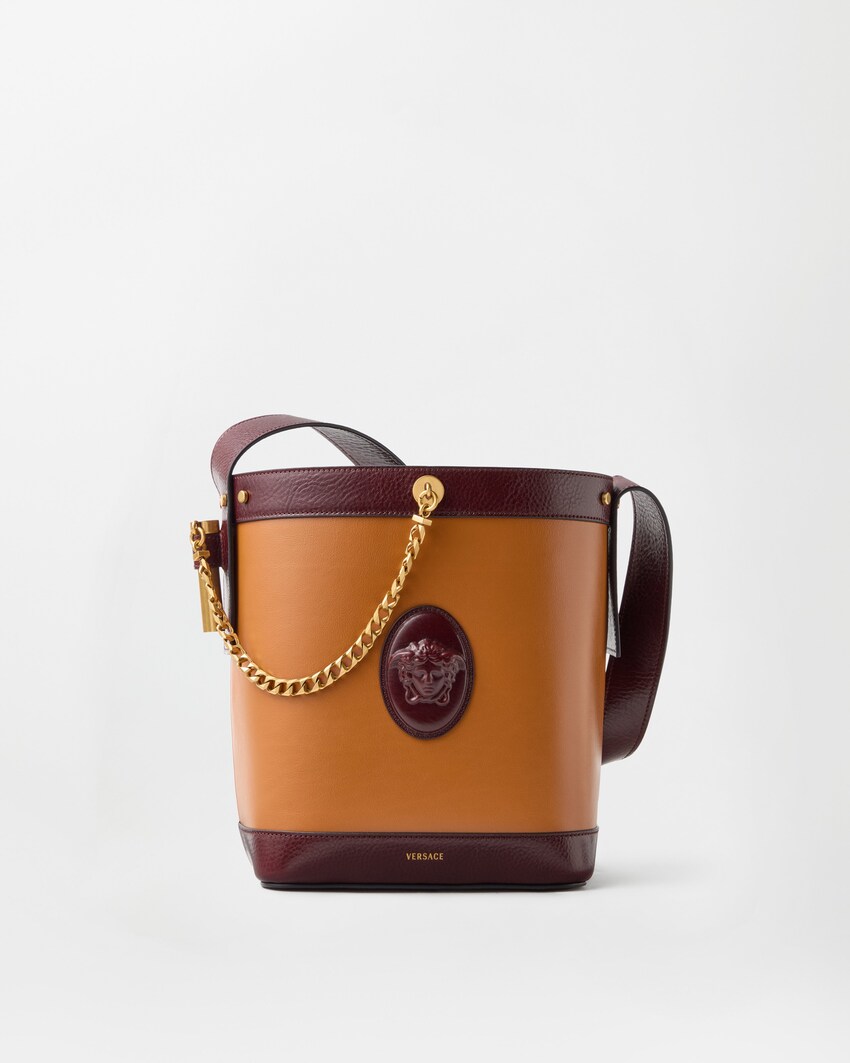
Sales tell part of the story. Versace's revenue in fiscal 2023 was approximately $1 billion, down slightly from the prior year. Capri's stock has underperformed. In August 2023, the company announced it would not meet its target of $2 billion in Versace revenue by 2025. Analysts pointed to weakening demand in China, slower traffic in European boutiques, and a handbag offering that has not broken through. The house is profitable, but it is not growing at the pace its owners require.
The image problem, or the image strategy
Versace's challenge is not that it lacks recognition. The Medusa is globally legible. The house's visual language — loud, sexual, unsubtle — remains distinct in a market crowded with beige. The challenge is that this language no longer feels urgent. It feels like a costume one can put on and take off, a reference rather than a reality.
Consider the brand's presence on social media, where Versace posts often and to significant engagement. The imagery is polished, the casting diverse, the locations sun-drenched. But scroll through a month of posts and a pattern emerges: the house is selling an idea of Versace more than it is proposing new ideas. The archive is both asset and trap.
There are moments when the work cuts through. The Spring 2023 collection included a series of tailored blazers in unexpected proportions — longer, looser, worn over slip dresses that recalled the house's nineties heyday without replicating it. The palette was restrained by Versace standards: black, white, a few flashes of cobalt. It suggested a willingness to modulate, to let a garment breathe. But these moments are intermittent, and they do not yet constitute a direction.
Donatella herself remains the house's most compelling ambassador. She is 68, platinum blonde, and unapologetic in a way that feels increasingly rare. Her interviews are direct. Her presence at fittings is hands-on. She has said, more than once, that she designs for women who are not afraid — of attention, of their bodies, of being seen. It is a coherent ethos. Whether it is enough to sustain a billion-euro business in 2024 is another question.
Where the house stands
Versace today occupies an odd position in the luxury landscape. It is too expensive to be accessible, too loud to be discreet, and too rooted in its own mythology to reinvent itself wholesale. It is not a house in crisis — the boutiques are open, the shows are attended, the red carpets are covered. But it is also not a house on the rise.
One thinks of the Jungle Dress, which now sits in the collection of the Fashion Institute of Technology. It is a museum piece, which is to say it is history. Versace's task, if it has one, is to make something that feels as urgent now as that dress did then. Not a replica. Not a reference. A new gesture, as bold and as specific as the original.
Whether that happens under Capri's ownership, or under Donatella's direction, or at all, remains to be seen. For now, the house does what it has always done: it puts gold lamé on the runway, turns up the music, and dares you to look away. Sometimes that is enough. Sometimes it is not.
The Spring 2024 show ended, as these shows do, with applause and camera flashes. Donatella took her bow in a black slip dress and heels. The lights came up. The editors filed out. And Versace, for better or worse, remained exactly what it has always been.