Versace aujourd'hui : où en est la maison
The gold Medusa head sits flush against black enamel, no larger than a five-cent coin, riveted to the tongue of a leather sneaker that retails for €795. It is a small thing, this emblem, but it does considerable work. It signals provenance. It promises a certain voltage. And it appears, in one form or another, on roughly forty per cent of what Versace produces today — bags, belts, ready-to-wear, fragrances, homeware. One suspects Gianni would recognise the symbol. Whether he would recognise the business is another question.
Fondation et apogée
Gianni Versace opened his first atelier in Milan in 1978, at thirty-two, after nearly a decade designing for others. The timing mattered. Italian ready-to-wear was ascendant, and Gianni understood that clothes could be both sculptural and immediate — worn once, photographed, remembered. He worked in saturated colour, in leather and metal mesh, in prints that borrowed from Greco-Roman friezes and Warhol's silkscreens in equal measure. The vocabulary was maximalist, but the construction was precise. A bias-cut silk slip required as much technical command as any couture gown, and Gianni had that command.
By the early nineties, Versace was a cultural fact. Naomi, Christy, Linda, and Cindy closed his shows in near-identical column dresses, walking to George Michael. The imagery was explicit — not in the prurient sense, though there was that, but in its refusal to suggest when it could declare. A safety pin held a dress together at the hip, and the world took note. The house generated desire not through withholding but through abundance.
Gianni's murder in 1997 cleaved the house in two: before and after. His sister Donatella, who had been his muse and collaborator, assumed creative direction. She inherited a business worth roughly $1 billion and an aesthetic so bound to one man's vision that continuation felt, at first, like impersonation.
Donatella's era and the Capri Holdings acquisition
Donatella's early collections leaned hard into the archive — the Medusa, the Greek key, the safety pins — but over time she found her own register. Her Versace was harder, more metallic, more explicitly about sex and power than Gianni's had been. Where he had drawn from art history, she drew from celebrity and music. By the mid-2000s, the house was dressing everyone from Beyoncé to Lady Gaga, and the runway felt less like a fashion show than a backstage pass.
But the business struggled. Versace remained family-owned longer than most of its peers, and that independence came at a cost. The company lacked the capital to expand at the pace required by a globalising luxury market. Stores were inconsistent. Licensing deals diluted the brand. In 2014, Blackstone acquired a twenty per cent stake, and the house began to professionalise — consolidating licenses, opening flagships, investing in digital infrastructure.
In 2018, Michael Kors Holdings — soon to be renamed Capri Holdings — acquired Versace outright for $2.12 billion. The Versace family retained a small stake and Donatella stayed on as creative director, but control had shifted. The acquisition was framed as an opportunity: Capri's resources would allow Versace to scale. Critics wondered whether scale was what Versace needed, or whether it would smooth away the very friction that made the house legible.
Creative direction under Capri
Donatella's collections since the acquisition have been steady, occasionally brilliant, and relentlessly on-brand. Spring 2023 featured neon mesh and archival Warhol prints. Fall 2023 leaned into tailoring, with sharp-shouldered blazers and leather trousers cut close. The Medusa appears in nearly every look, sometimes as hardware, sometimes as jacquard, sometimes embroidered at the hem. The vocabulary hasn't changed. The question is whether it needs to.
The runway shows remain spectacle — front rows stacked with musicians and actors, casting that skews toward social media reach as much as editorial cachet. But the energy feels different now. Where Gianni's shows had a kind of anarchic joy, and Donatella's early work carried a defiant edge, the current collections feel considered in a way that borders on caution. The house knows what it is. It executes that knowledge with precision. But one wonders if precision is enough.
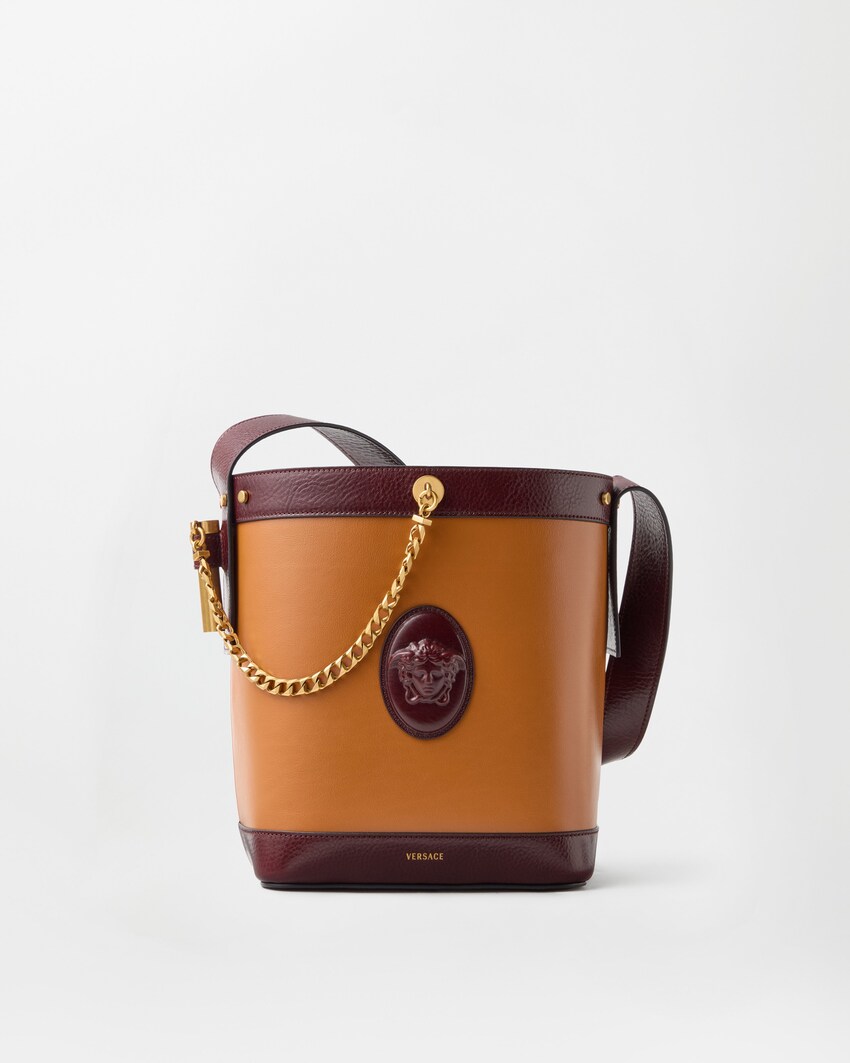
The accessories have become the engine. The La Medusa bag, introduced in 2022, is a structured top-handle in calf leather with the Medusa head rendered large and three-dimensional at the clasp. It retails for around €2,500 and has performed well, particularly in Asia. The Virtus line, which centres on a quilted chevron pattern and oversized hardware, has similarly found traction. These are not quiet bags. They announce themselves, and in a market where logos have returned with force, that announcement sells.
Financial realities and market position
Versace's revenue in fiscal 2023 reached approximately $1.1 billion, a modest increase from the prior year but still below the $1.4 billion Capri had projected when it made the acquisition. The gap is not catastrophic, but it is notable. Comparable houses — Bottega Veneta, Loewe, even Balmain under Rousteing — have managed sharper growth in the same period, often by leaning into craft narratives or by courting younger consumers through collaborations and limited releases.
Versace has tried the latter. There have been capsules with Palace, with Dua Lipa, with Fendi (the much-discussed Fendace swap in 2021, which generated press but unclear sales impact). The house has invested in sneakers, in logo-heavy casualwear, in homeware that extends the Versace aesthetic into bath towels and espresso cups. The strategy is not incoherent. But it does raise the question of how much a brand can extend before it thins.
The competitive set has shifted, too. When Gianni founded the house, the landscape was Armani, Valentino, perhaps Gaultier. Today, Versace competes not only with heritage Italian houses but with newer entrants like Jacquemus and Coperni, whose production cycles are faster and whose imagery feels native to the platforms where luxury is now discovered. Versace's Instagram account has 30 million followers, which is formidable. But follower count and conversion are not the same metric, and the house has been slower than some peers to translate digital attention into digital revenue.
There is also the matter of creative renewal. Donatella has been at the helm for twenty-seven years — longer than Gianni led the house. She is, by any measure, one of the most enduring creative directors in the industry. But succession is no longer an abstract question. She is sixty-nine. The house has not publicly named a deputy or an heir apparent. Whether Versace can survive another transition, and what form that survival might take, remains open.
Where the house stands
Walk into the Versace flagship on Via Montenapoleone and you will find the aesthetic fully realised: Baroque mirrors, gold fixtures, mannequins in chain-mail dresses and platform heels. It is a coherent world, and that coherence is worth something. But coherence can also be a trap. The house knows what it is, and it performs that knowledge with conviction. The risk is that the performance becomes rote — that the Medusa head, repeated across a thousand SKUs, stops functioning as a symbol and becomes mere decoration.
Versace's strength has always been its willingness to be too much. Gianni understood that restraint was not the only path to elegance, that a dress could be loud and still be considered. Donatella has carried that forward, and in doing so has kept the house legible in a market that often rewards the quiet and the coded. But legibility is not the same as relevance, and relevance requires risk.
The question now is whether Versace, under Capri's stewardship and with an aging creative director, can take that risk. Whether it can surprise. Whether it can make something that feels urgent rather than inevitable. The infrastructure is there. The capital is there. The archive is deep. What remains to be seen is whether the house can move beyond managing its past and into making something new.
At the end of the Fall 2024 show, Donatella walked the runway in black leather trousers and a white tank top, her hair platinum, her sunglasses on. The models formed a line behind her. The music was loud. The audience stood. It was, in every sense, a Versace moment — confident, unapologetic, exactly what one expected. And that, perhaps, is both the answer and the problem.