Versace : histoire d'une maison
The gold Medusa head — not stamped, but cast, then hand-polished — sits at the centre of every Versace button, buckle, and bag clasp. One notices it first as ornament, then as signature, and finally as a kind of covenant. Gianni Versace chose the gorgon in 1978 because, he said, anyone who falls under her gaze cannot leave. Whether that was ambition or prophecy is beside the point. The house he built around that image did, in fact, hold the world's attention for the better part of two decades, then lost it, then clawed it back.
L'atelier Via Gesù, 1978–1997
Gianni Versace opened his first boutique in Milan's Via della Spiga in 1978, but the real work happened a few blocks over, in the atelier on Via Gesù. He had apprenticed under his mother, a dressmaker in Reggio Calabria, and carried forward her respect for construction even as he set about dismantling every other convention the Italian system held dear. Where the Milanese establishment prized restraint — Armani's shoulder, Ferré's architecture — Versace reached for the Baroque. Gold brocade. Leather bonded to chain mail. Prints pulled from Greco-Roman friezes and recoloured in acid yellow, cobalt, fuchsia.
The technique, though, remained serious. He built his dresses on the bias, which requires more fabric and more skill than a straight grain. He used a technique called sbieco — diagonal cutting — to let silk jersey cling without appearing cheap. The famous safety-pin dress, worn by Elizabeth Hurley to a film premiere in 1994, was not a gimmick. It was an exercise in tension: how much can you reveal before the garment stops being a garment? The pins were gold-plated, each one hand-set, the intervals calculated so the dress would move but not shift. One suspects Gianni enjoyed the provocation, but he did not cut corners to achieve it.
By the early nineties, Versace had become the house that dressed rock stars, supermodels, and anyone else who understood that fashion could be theatre. The runway shows were not presentations but performances — Naomi, Linda, Christy, Cindy walking to George Michael, to Prince, the music as integral as the clothes. Gianni himself moved through those years with the confidence of someone who had earned his place. He bought Casa Casuarina on Miami's Ocean Drive and restored it, room by room, in the same spirit he applied to his collections: excess as a form of discipline.
Then, in July 1997, he was shot on the steps of that house. The fashion press spent the next decade trying to explain what had been lost. Most of it was conjecture. What remained was a body of work — several thousand pieces, archived in the house's Milan headquarters — and a question: could the house survive without the man who had willed it into being?
Donatella prend la relève, 1997–2016
Donatella Versace had been her brother's muse, his confidante, and the creative director of Versus, the house's diffusion line. She had not, however, been groomed to lead the main collection. That responsibility fell to her by necessity, not design. The first few seasons were uneven. Critics noted that she leaned heavily on Gianni's archive, reworking his prints and silhouettes without advancing them. Fair enough. She was working through grief in public, under the scrutiny of an industry that does not pause for mourning.
By the early 2000s, though, a distinct voice began to emerge. Where Gianni had drawn on antiquity and opera, Donatella looked to contemporary music and street culture. She dressed hip-hop artists — Tupac had worn Versace before his death, but now the house courted that audience intentionally. She put Jennifer Lopez in a jungle-print dress with a neckline that plunged past the navel; the image became one of the most-searched in early internet history and, incidentally, prompted Google to develop its image search function. One could argue that Donatella understood celebrity in a way her brother had not needed to. He had created it. She had to negotiate with it.
The clothes themselves grew harder, more architectural. She favoured leather, metal mesh, and a kind of aggressive tailoring that didn't so much flatter the body as challenge it. The Palazzo bag, introduced in 2015, became the house's first major accessory success in years — a structured top-handle in calf leather, the Medusa rendered in relief on a gold plaque. It was not subtle, but it was coherent. Donatella had spent nearly two decades finding her footing, and by the mid-2010s, she had something to say.
Then, in 2018, the Versace family sold the house to Capri Holdings (formerly Michael Kors) for $2.1 billion. Donatella stayed on as creative director, but the terms had shifted. The house was no longer a family operation. It was a brand within a conglomerate, expected to deliver growth, expand its accessories line, and compete with LVMH and Kering on their terms.
Le Versace d'aujourd'hui
What Versace looks like now depends on where you stand. On the runway, Donatella continues to mine the archive — the safety pins reappear, the Medusa proliferates, the color palette holds to black, gold, and that particular shade of electric pink the house has claimed as its own. The spring 2024 collection featured chainmail dresses and leather corsets, each piece a callback to the house codes established in the nineties. Some critics see this as stagnation. Others argue it's brand discipline, the kind of consistency that builds equity in a market where recognition is currency.
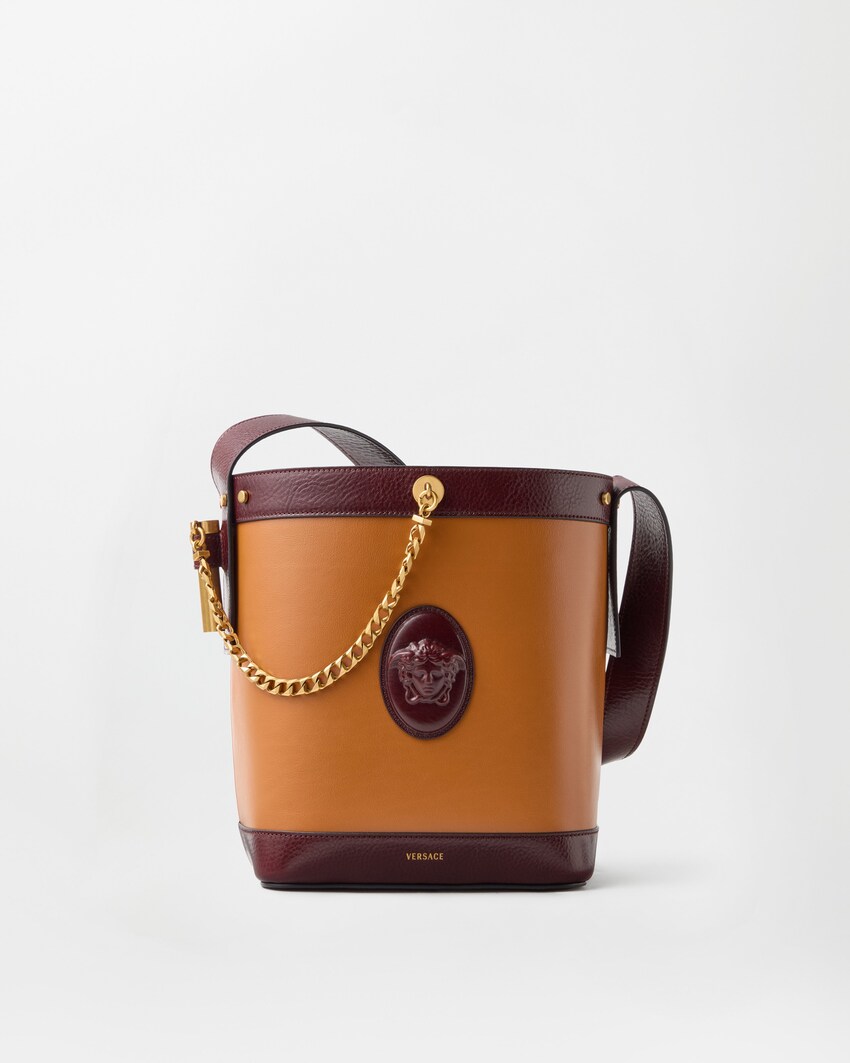
Off the runway, the business has pivoted toward accessories and lifestyle. The Medusa Aevitas platform pump — a chunky-soled sandal with a gold Medusa emblem — became a bestseller, not because it advanced the language of footwear but because it was legible, Instagrammable, accessible at a $1,000 price point. The La Medusa bag, introduced in 2021, follows a similar logic: a structured shoulder bag in nappa leather, the hardware oversized, the branding unavoidable. These are not quiet pieces. They are not meant to be.
The tension, if there is one, lies in the gap between what the house was and what the market now demands. Gianni built Versace as a couture house that happened to make ready-to-wear. Donatella has had to reverse that equation, building a ready-to-wear and accessories business that gestures toward its couture past. The atelier still exists. The house still produces made-to-order pieces for clients who want a safety-pin dress or a hand-beaded gown. But those commissions are no longer the centre of gravity. The centre is elsewhere — in the handbag margins, in the licensing deals, in the logo sweatshirts that move volume in Asia and the Middle East.
Is that a compromise? Probably. Is it survival? Certainly. One can lament the shift or accept it as the cost of remaining operational in an industry that has little patience for houses that don't scale. Versace, at least, has not tried to soften itself in the process. The Medusa still stares out from every clasp and button, daring you to look away. You don't.
There is a photograph from 1991: Gianni Versace backstage after a show, adjusting the strap on Naomi Campbell's dress. He is bent close, his hands on the fabric, her hand resting lightly on his shoulder. It is a small moment, the kind that happens a hundred times in any given season. But the image holds because of what it suggests — that the work, even at that level, remained tactile, specific, a matter of millimetres. Whether the house can sustain that spirit under its current ownership is an open question. What is certain is that the gold Medusa endures, cast and polished, still holding its gaze.